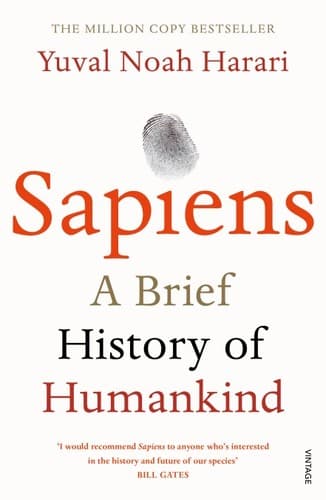
Read It
The laziest way to read human history is as a straight line from backward to advanced. This book does the opposite. It takes the things we treat as natural—money, nations, laws, corporations—and pulls them apart to show the shared fictions underneath. Homo sapiens wasn't kinder or smarter than other human species. We just learned to tell stories earlier, and we were willing to cooperate, kill, pay taxes, and work overtime for those stories.
Harari doesn't wrap this in comfort. Progress often means the extinction of other species, the oppression of some people by others, and no measurable gain in individual happiness. By the end, he isn't even sure the category "human" will survive much longer. Reading this feels like being lifted to ten thousand meters and looking down at your own species—absurd and clarifying at the same time.
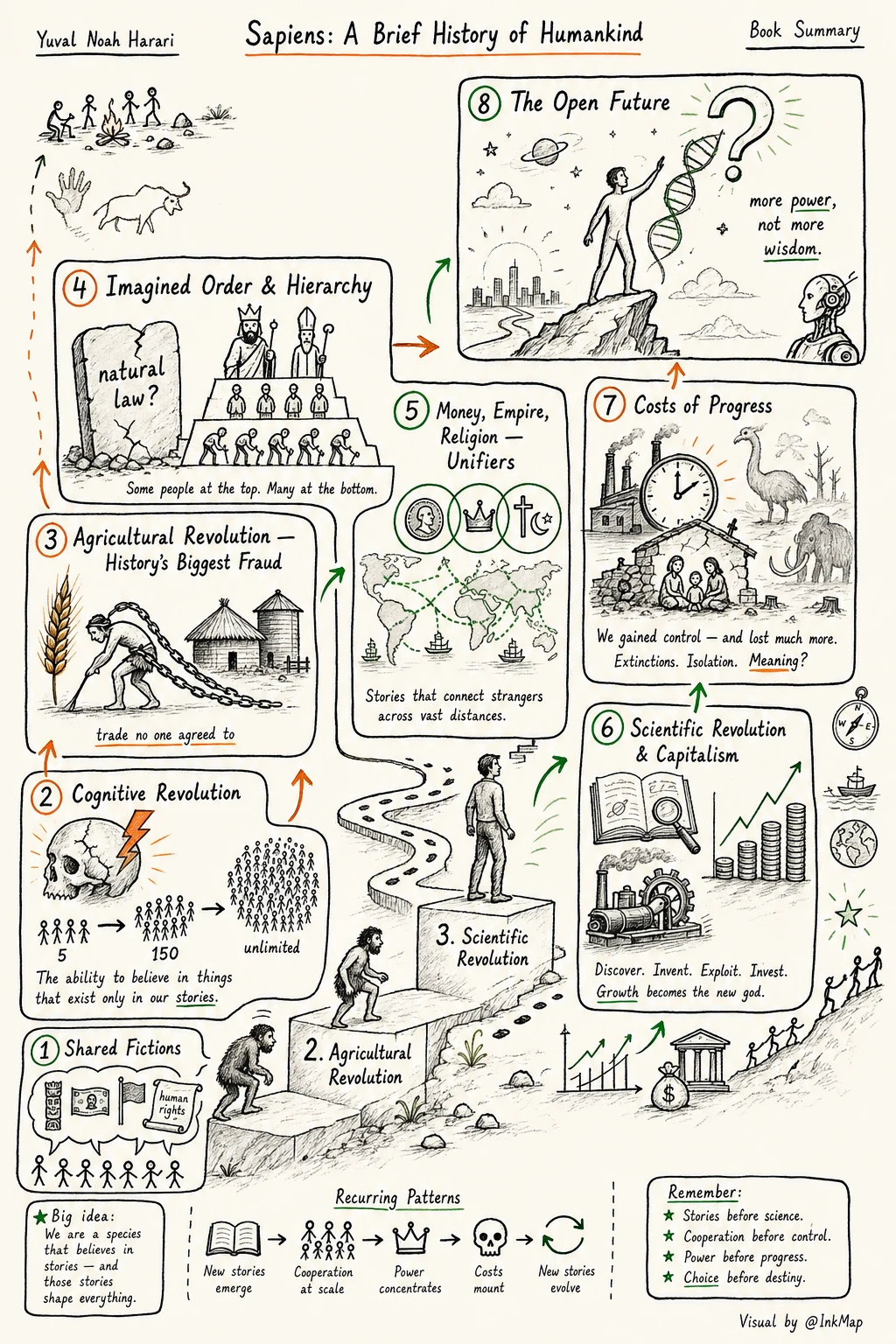 Open full InkMap ↗
Draw It
The text constantly mixes three levels: mechanism, consequence, and evaluation. The mechanism is how shared fictions enable large-scale cooperation. The consequence is what that cooperation produces. The evaluation is whether those consequences count as progress. If you read chapter by chapter, these blur together until you're left with a vague "humans got here through stories." I separated them into three parallel lines: fiction as the operating system of cooperation, cost as the bill the system keeps running up, and happiness as the bad debt that GDP can never settle. The three lines run alongside each other through time rather than appearing in sequence. Once they're drawn that way, it's clear Harari isn't discussing three separate topics. He's describing one system showing up in three different dimensions.
Take It With You
If this book leaves one judgment, it's this: the orders we believe in are not truths. They are stories that were chosen and repeated. The boundary is also clear. This doesn't deny the value of cooperation, and it doesn't deny that some fictions cause less harm than others. It only reminds us that when someone says "this is how it's always been," we have the right to ask: whose story is this, and who is paying for it?
CHAPTER BY CHAPTER