CHAPTER 11
Imperial Visions
Read It
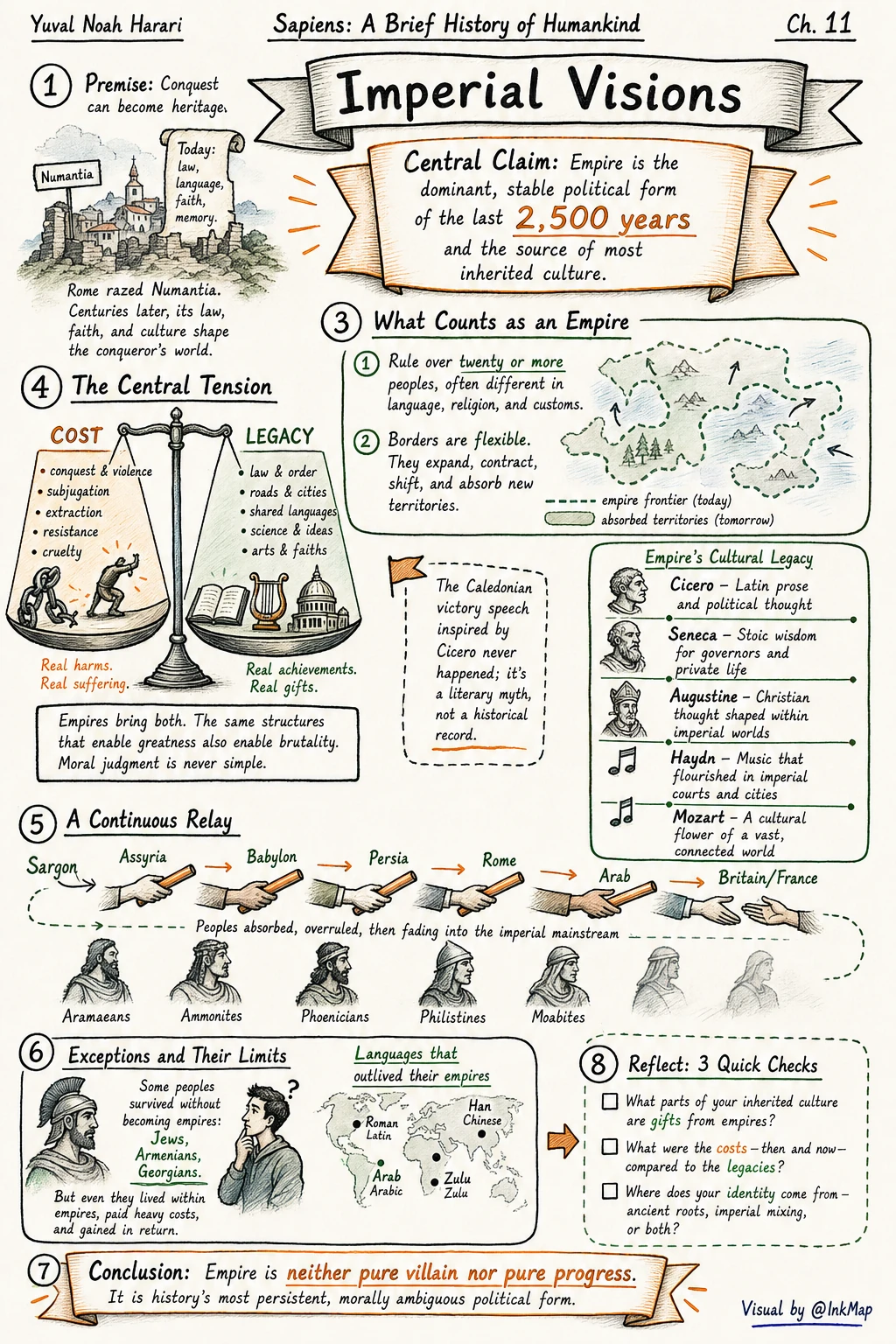
Empire has a branding problem. We think of it as an aberration, a brutal episode that interrupts the healthy life of nations. Harari says the opposite: for over two thousand years, empire has been the default setting. Most people who ever lived did so inside one. The machinery exterminates countless distinct peoples and cultures, but it also manufactures what those peoples' descendants later call their authentic heritage. Roman philosophy, the Taj Mahal, Habsburg music—all financed by extraction from conquered populations. Even the language used to criticize empire is often a legacy of empire. That's the moral knot: empire is simultaneously a destroyer and a creator, and nearly everyone alive is a cultural descendant of some conquest. The chapter doesn't ask us to forgive empire. It asks us to stop pretending there's a clean, authentic 'before' we can return to. There isn't.
 Open full image ↗
Draw It
The core tension is that empire produces both annihilation and inheritance, often through the same act. Prose tends to separate these: first the brutal conquest, then the cultural flowering. But the structure is more entangled. I kept the two features—rule over distinct peoples and endless expansion—as the defining frame. From that frame, both the destruction and the cultural production flow. The Middle East's relay of empires from Assyria to colonial rule shows the pattern: each empire wipes out some distinct group, then contributes materials the next empire absorbs. The visual resists making empire a villain or a hero. It makes it a factory, with inputs of conquered peoples and outputs of language, law, and identity.
Rethink It
Organizations have the same double character. A company that acquires and absorbs smaller teams destroys their distinct cultures. But the acquiring company's own practices, vocabulary, and identity are themselves products of earlier absorptions. The tools we use to describe 'our' culture were often built by people no longer in the room. Recognizing this doesn't make acquisition harmless. It makes the conversation more precise: we can argue about whether a merger was worth the destruction, but we can't pretend that some pure original culture exists to defend.
Take It With You
Empire is not a deviation from history; it is history's most common pattern. The cultures we call our own are almost all imperial by-products. That doesn't excuse the violence. It just means there's no uncontaminated ground to stand on—only the question of what we build with what was taken.