CHAPTER 16
The Capitalist Creed
Read It
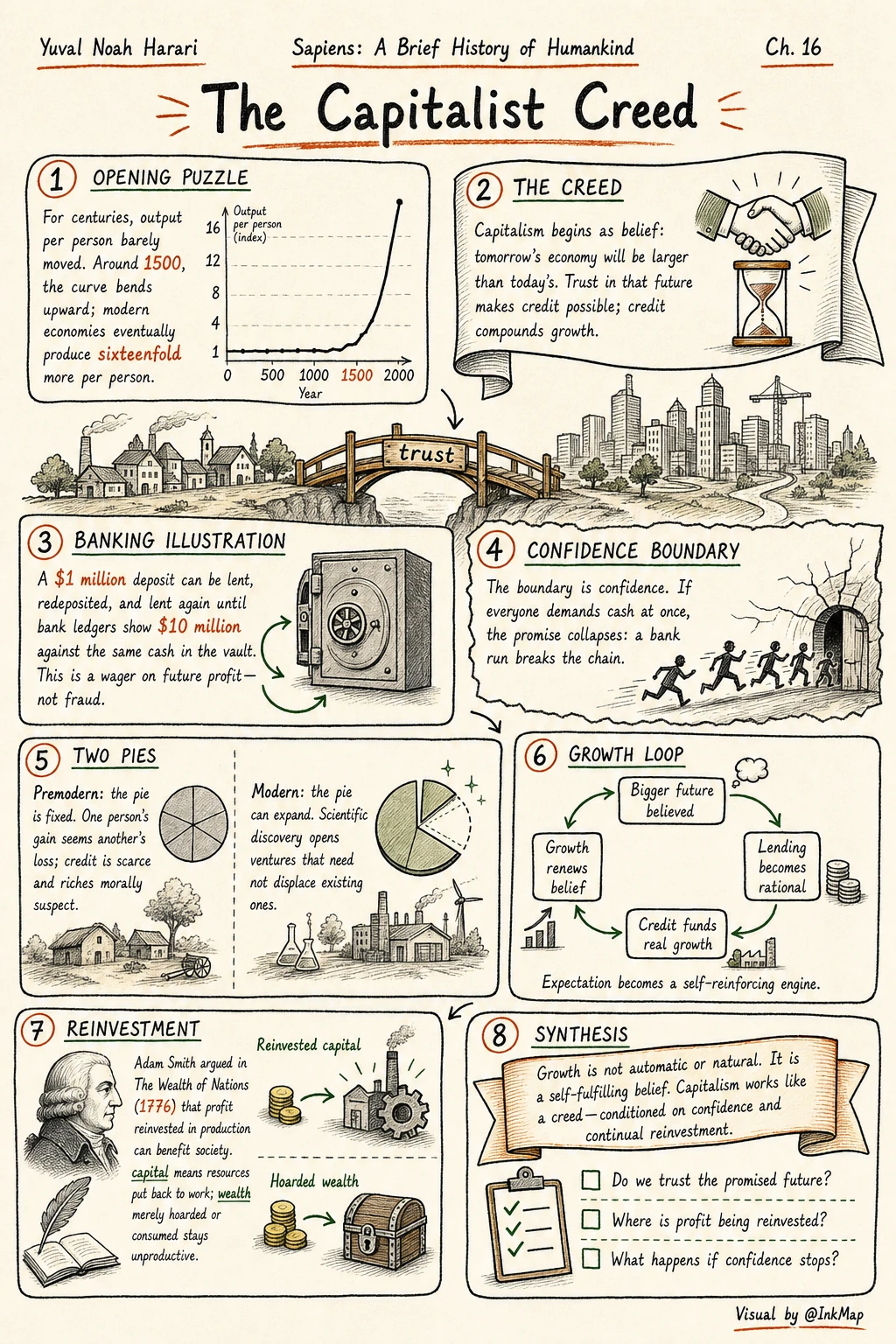
Capitalism is most easily misunderstood as a system about greed or money. Harari reframes it as a system about the future. Modern economic growth did not come from discovering new resources but from people starting to believe that the future economy would be bigger than the present one. That belief made credit possible, credit drove real investment and production, and the ethic that profits must be reinvested turned the whole thing into a self-reinforcing loop. Banking works because the numbers on the books far exceed the physical cash in the vault; the system runs on shared trust in future earnings that have not yet materialized. Premodern societies were not short of money but short of that trust, so they stayed trapped in a stagnation loop: no money to hire workers, no workers to build enterprises. Adam Smith's key distinction—capital as profit reinvested in production versus wealth as resources hoarded or spent unproductively—is what made self-interest convertible into collective benefit.
 Open full image ↗
Draw It
The core of this chapter is a contrast: premodern societies treated wealth as a fixed zero-sum pie, modern societies treat it as a pie that can keep growing. In prose these two worlds read like a chronological sequence, but the real dividing line is not technology or resources. It is the structure of trust. Trust, credit, and growth form a loop; break any link and the whole thing stops. Placing the capital-versus-wealth distinction inside that loop shows why the same money leads to completely different outcomes under different beliefs.
Rethink It
Startup fundraising often runs on the same judgment. Investors are not asking how much money you have now; they are asking whether you believe the future can be much bigger. If the founding team itself treats the market as fixed and only thinks about dividing the existing pie, it is hard to convince anyone to invest. But the loop also breaks if everyone believes in growth and no one reinvests profits into production. The test is simple: are you hoarding wealth or accumulating capital?
Take It With You
Capitalism is not a system about money. It is a system about trusting the future. The single criterion for whether someone or some company is really participating in the loop is whether profits are reinvested in production or hoarded.