CHAPTER 17
The Wheels of Industry
Read It
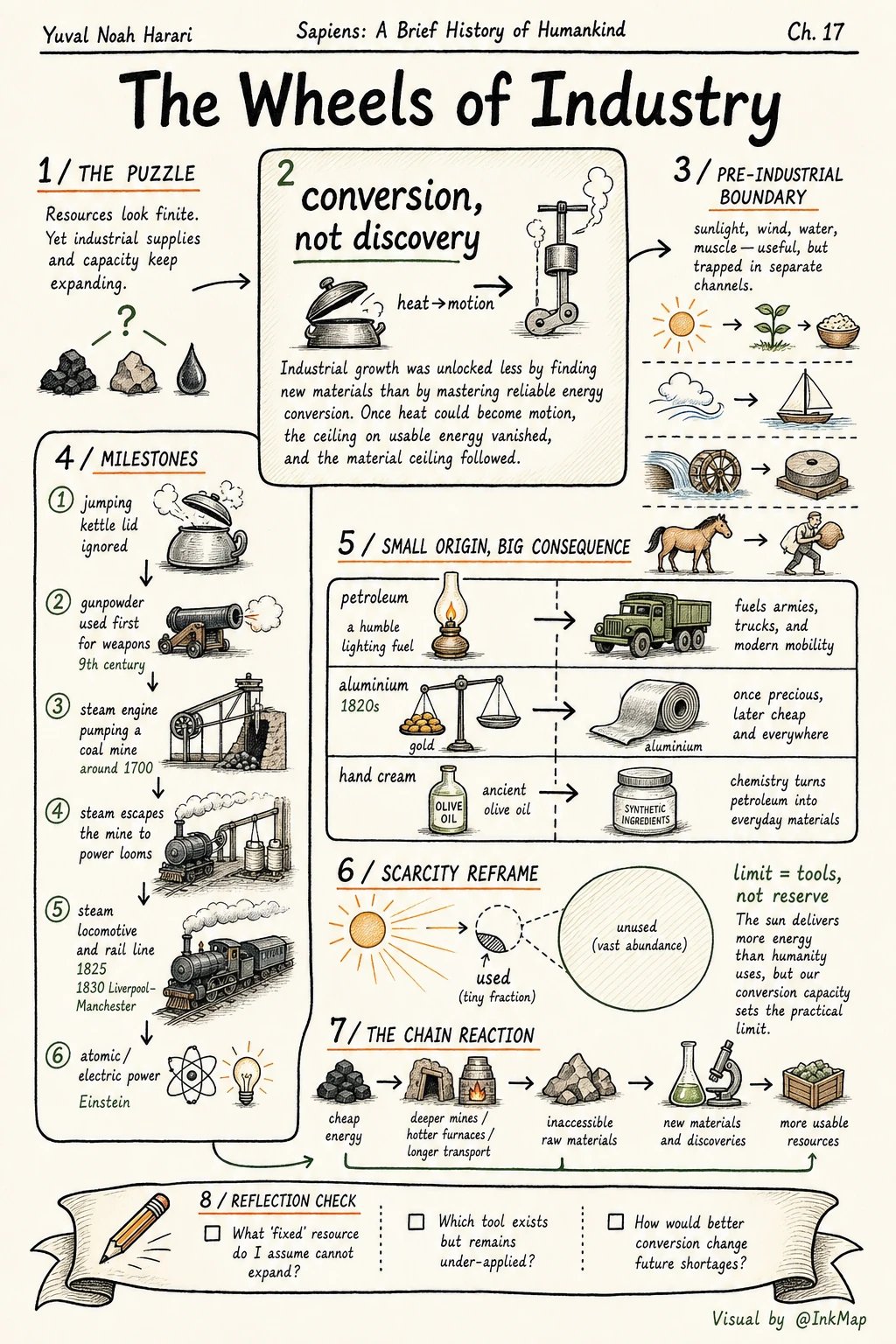
The Industrial Revolution looks like a story about coal, iron, and steam engines, but the real problem it solved was not a shortage of resources. It was learning to convert one form of energy into another. Before industrialization, nearly all usable energy came from sunlight captured by plants and channeled through human and animal muscle, because no device except the living body could perform that conversion. The steam engine was born in coal mines not because someone set out to invent a new power source but because the mines were short of fuel and flooded with water. Its real significance came later, when it migrated into weaving, transport, and beyond, breaking the mental boundary that energy was tied to a single use. Gunpowder took six hundred years to become artillery; the gap between mass-energy equivalence and the atomic bomb was forty years. The earth receives vastly more solar energy than humanity uses. The bottleneck was never the total stock of resources but the technique for converting them. Aluminium went from more precious than gold to a cheap everyday material once energy and technology dissolved the raw-material constraint.
 Open full image ↗
Draw It
This chapter constantly conflates two levels: the stock of resources and the capacity to convert them. Prose makes it sound like humans discovered more energy, but Harari's point is that humans learned to convert. I mapped it to separate "energy sources" from "conversion technologies" so the reader sees that apparent resource limits are really knowledge limits. The steam engine's birth, migration, and eventual reach into nuclear power are not a simple line of progress but a series of broken boundaries on what conversion can do.
Rethink It
Technical bottleneck discussions often blur "we don't have the resource" and "we don't know how to convert it." A team says "we don't have enough data," but the real problem may be that they have not converted existing data into usable features or models. Once the levels are separated, the conversation stops being about what is missing and starts being about how to turn what exists into a different form.
Take It With You
The Industrial Revolution was not about more resources. It was about a breakthrough in conversion capacity. Any time someone says "we lack resources," the first question should be: is the stock insufficient, or do we simply not know how to convert it?