CHAPTER 20
The End of Homo Sapiens
Read It
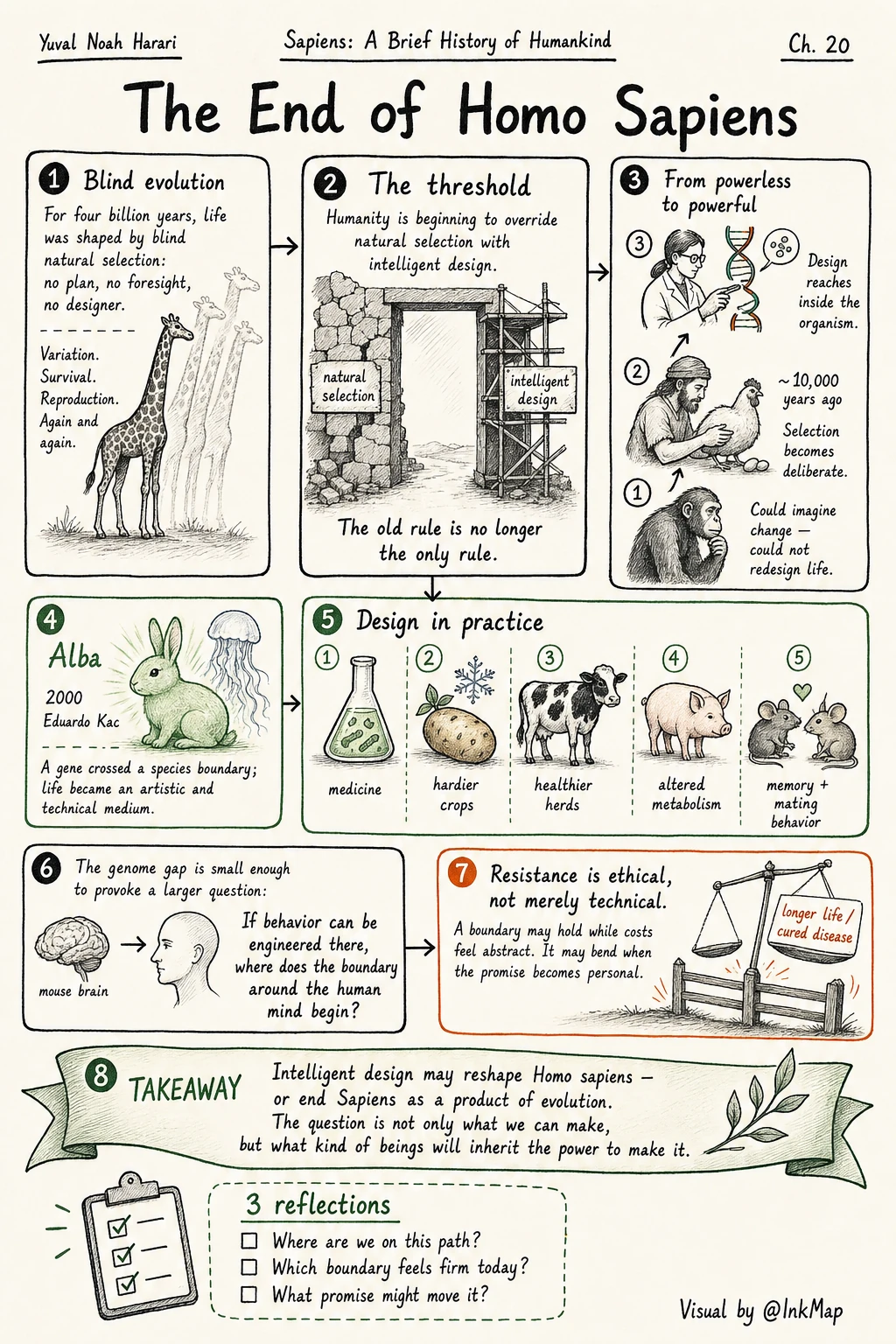
The chapter looks like it's about genetic engineering, cyborgs, and artificial life—futuristic stuff that feels distant. But the real question isn't whether the technology will work. It's whether we're ready to talk about whether we should use it. Harari says natural selection ran for nearly four billion years without a plan, and now it's being replaced by intelligent design. The unsettling part is that the replacement isn't some villainous organization. It's us—through the enhancement side effects that quietly ride along with therapeutic research. Our ethics and politics haven't kept up, not because we're slow, but because the change is outpacing the language and frameworks we have for it.
 Open full image ↗
Draw It
What's easy to lose in prose is the boundary between three layers: technical feasibility, ethical legitimacy, and political legitimacy. Gene editing is already technically feasible, still ethically contested, and politically almost unregulated. Laying these out separately shows they don't advance in sync—technology runs ahead, ethics chases, and politics hasn't left the starting line. The other thing worth mapping is the contrast between natural selection and intelligent design: the former has no purpose, the latter does, but who defines that purpose? That question gets buried under technical detail in the text.
Rethink It
In technical reviews, we mostly ask "can we do it?" and rarely "should we?" A recommendation algorithm can boost click-through rates—technically fine—but does it push users toward more extreme content? A surveillance system can improve security, but does it erode privacy? This chapter reminds me to separate the layers: feasibility is an engineering question, legitimacy is a values question, and legality is a governance question. Mixing them together either lets technical feasibility paper over value disagreements or lets ethical anxiety block technical exploration.
Take It With You
The real obstacle to human genetic modification isn't the technology. It's that we haven't invented a language that can hold both "therapy" and "enhancement" at the same time.