CHAPTER 10
The Scent of Money
Read It
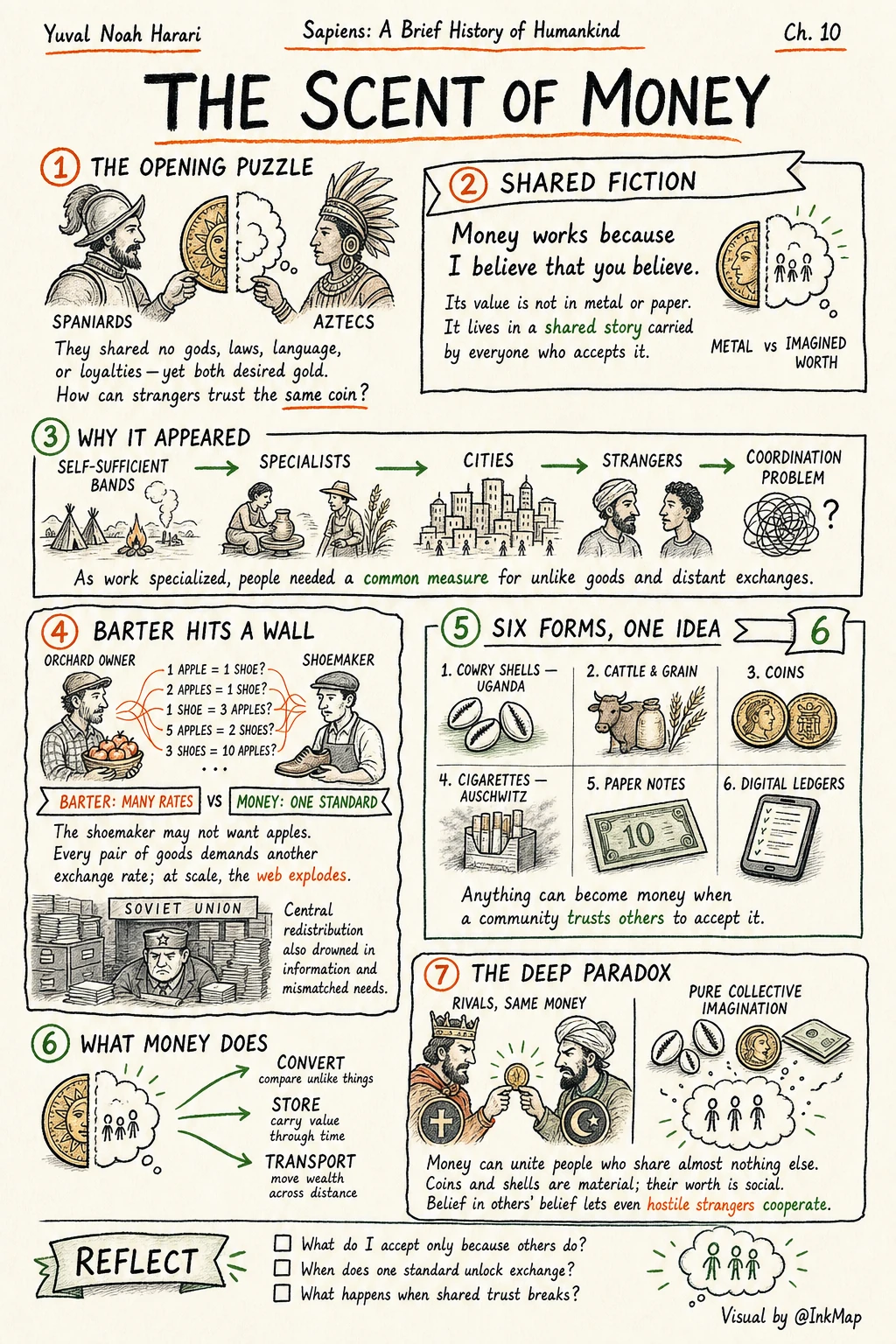
Money gets mistaken for a technology, a tool backed by gold or governments. It's closer to a shared hallucination. Two people who would never share a meal, a god, or a border will exchange pieces of paper or strings of digits and call it trade. They do this because each believes the other will accept those tokens tomorrow. That belief is the whole machinery. Barter broke down as economies scaled: in a world of specialists, finding someone who wants exactly what you have and has exactly what you need becomes a combinatorial nightmare. Money solved that by becoming a universal middleman. It converts anything into anything else, stores value without rotting, and moves across distance. The cost? Once everything is convertible, everything becomes a price. Land, health, time, even dignity. The scent of money is the smell of trust—and of a quiet alienation that lets strangers cooperate without ever understanding each other.
 Open full image ↗
Draw It
The sentence 'money has no intrinsic value' sounds like a criticism, but it's a clarification. The value isn't in the shell, the coin, or the bit. It's in the network of shared expectation. I placed barter and money as two paths: one requires a double coincidence of wants, the other requires only a common fiction. Shells, cattle, cigarettes, electronic ledgers—they all sit in the same category because they all satisfy one condition: being universally accepted. That contrast makes the judgment concrete. The form is irrelevant. The trust is everything. Bitcoin's volatility and payment system migrations are just visible symptoms of the same underlying question: how many people will keep believing tomorrow?
Rethink It
Technical decisions run on the same logic. We argue about whether a tool is well-designed, whether a protocol is elegant, whether a data format is theoretically sound. But the question that actually decides adoption is different: how many people believe others will use it? A mediocre standard with a massive community beats a brilliant one with none. The value isn't in the code. It's in the collective expectation that this code will still be there tomorrow. When choosing, don't ask what the technology is. Ask what others will accept.
Take It With You
To judge whether a currency will hold, don't ask what backs it. Ask how many people plan to accept it tomorrow. The answer defines the system's real value—and its fragility.