CHAPTER 12
The Law of Religion
Read It
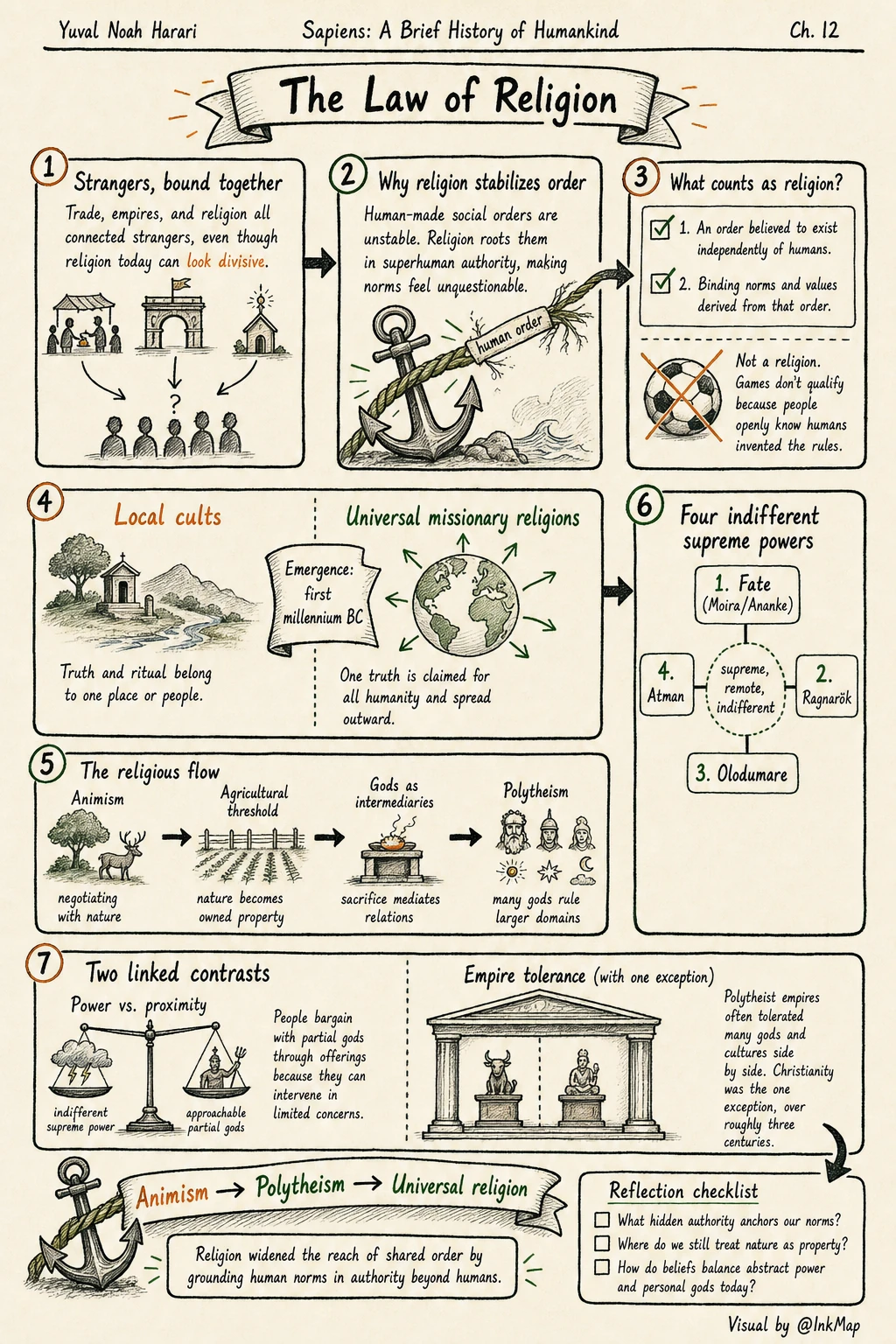
Religion's power comes from a trick of definitions. If religion just means rituals or strong beliefs, then football counts. Harari tightens the standard: a religion must ground its norms in a superhuman order and claim that order exists independently of human choice. That move excludes a lot of what feels religious. But it also reveals why religion has been so effective at unifying strangers. Local animisms couldn't scale. Negotiated polytheisms could scale a bit, because they paired an indifferent supreme force with many approachable partial gods—tolerant of other peoples' gods, as long as political loyalty held. Universal missionary religions scaled further by claiming eternal truth and making conversion an obligation. Polytheism tolerates because its structure allows it. Monotheism converts because its structure demands it. Neither is morally better. Each pays a price for what it achieves.
 Open full image ↗
Draw It
The relationship between constraint and cost matters more than any single belief. I placed polytheism and universal monotheism in the same frame because they face the same problem: how to get strangers to accept one order. The polytheistic answer trades away coercive unity—its cost is weak integration. The monotheistic answer trades away tolerance—its cost is exclusion. The visual makes clear there's no free option. Rome's harsh treatment of Christians wasn't about theological disagreement. It was about a system that demanded political loyalty encountering a group whose universal claim made that loyalty conditional. Putting the trade-off on a single axis turns a moral debate into a structural one.
Rethink It
Team values run into the same fork. Rules that are concrete and specific are easy to enforce but hard to extend to people from different backgrounds. Rules that are abstract and universal include more people but get interpreted in wildly different ways. A team culture that demands enthusiastic adoption of its mission can unify fast—and drive out anyone unwilling to convert. The choice isn't between good and bad. It's between two forms of cost: fragmentation or exclusion. Decide what you're trying to integrate, and name the price you're paying.
Take It With You
A belief system's reach depends on what it sacrifices for universality. Tolerance and unification don't coexist for free. The structure sets the price.