CHAPTER 05
History's Biggest Fraud
Read It
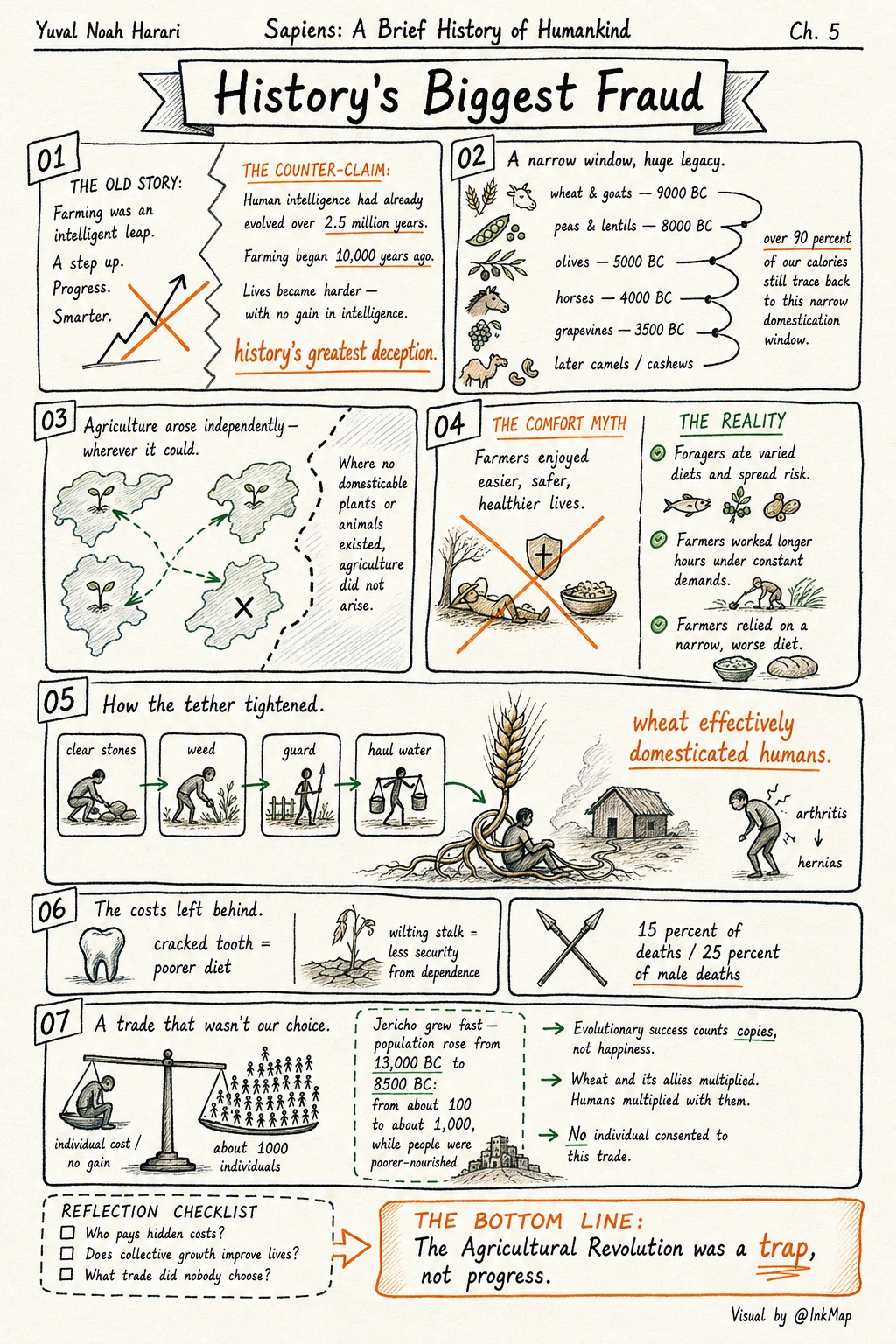
The Agricultural Revolution is usually framed as humanity's great leap forward. Harari flips the frame: from the perspective of individual well-being, it was a disaster. Farmers worked longer hours for a narrower, less nutritious diet than foragers. Settling down made them more vulnerable to famine and violence, not less. The real beneficiary was wheat, which went from a wild grass to a global staple by getting humans to clear, weed, water, and guard it. The chapter's core insight is that the revolution succeeded only by a species-level measure—population growth—while offering no benefit, and often great cost, to the people who actually lived through it. No single person agreed to this trade; it emerged from thousands of small decisions, each one locally rational but collectively trapping.
 Open full image ↗
Draw It
The reversal of perspective is the key move, and it's easy to lose if the chapter is summarized as 'farming was bad'. The real structure is a trade-off between two levels of analysis: species success versus individual well-being. Mapping this as a two-axis tension makes the point visible. Population goes up; quality of life goes down. The two are not just different; they are inversely related in this transition. The visual choice is to foreground the mismatch between the metric of success and the experience of the people being measured. Wheat's perspective is a rhetorical device, but it works because it forces the reader to ask: who is the subject of this story?
Rethink It
This same two-level confusion appears in engineering organizations. A system can be 'successful' by metrics—uptime, throughput, adoption—while the engineers maintaining it are burned out and miserable. The metric says growth; the experience says decline. The trap is assuming that one implies the other. A company can grow headcount while individual autonomy shrinks; a codebase can expand while the average developer's understanding of it collapses. The Agricultural Revolution is a warning about optimizing for the wrong level of analysis. The species-level metric is real, but it is not the only one that matters.
Take It With You
The boundary of this argument is that it applies to transitions, not steady states. Once agriculture was established, there was no going back, and later developments did improve some aspects of life. But the transition itself was a trap, and the mechanism—small decisions that lock in a worse equilibrium—is still relevant. The takeaway is to ask, whenever a metric is improving, whose experience is being left out of the measurement.