CHAPTER 04
The Flood
Read It
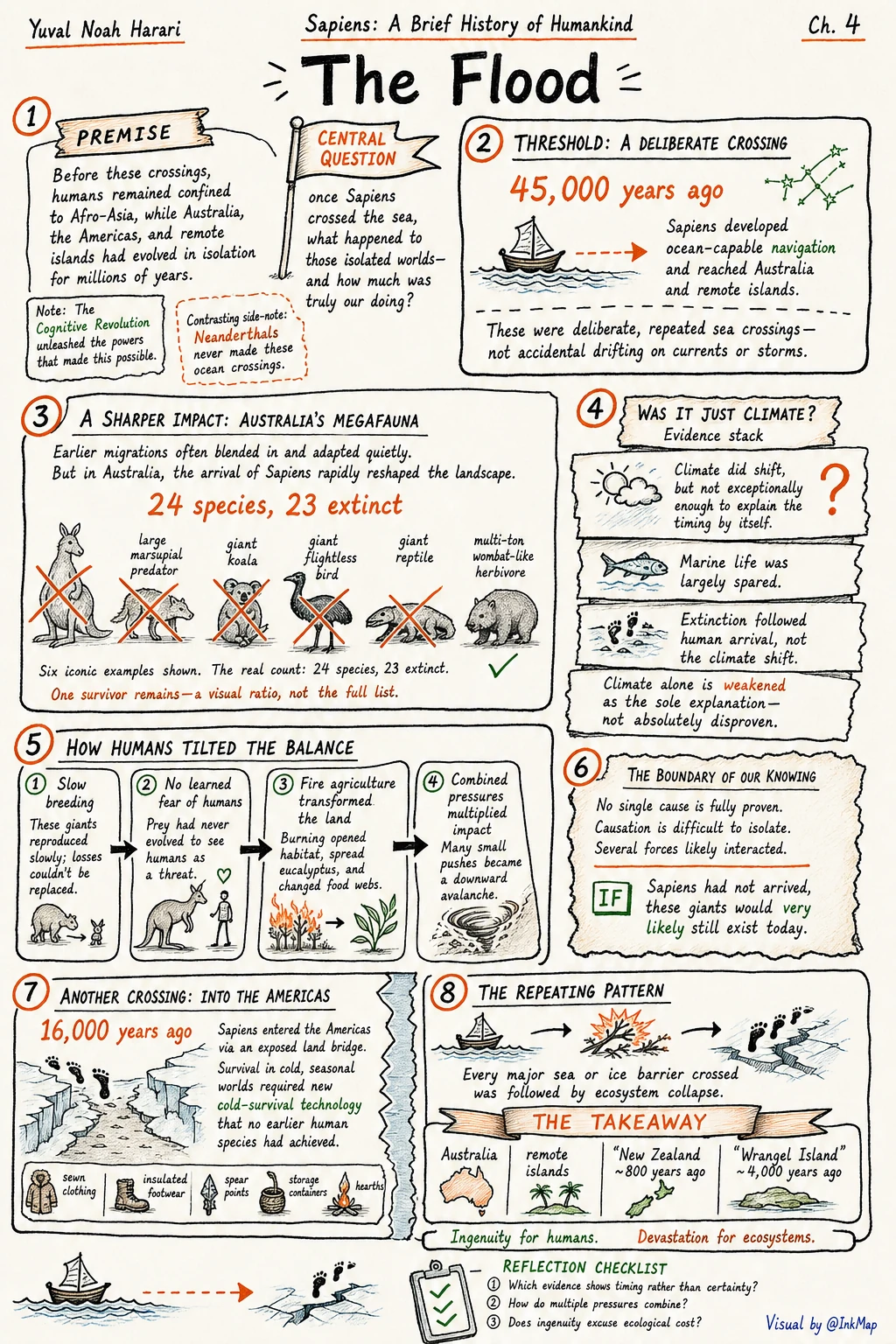
The first crossing into Australia is usually told as a triumph of courage and technology. Harari tells a different story: the arrival was real, but so was the aftermath. Within a few thousand years, twenty-three of twenty-four large Australian species were gone. The same pattern repeated in New Zealand, on Wrangel Island, and in the Americas. Climate change alone can't explain it; the timing is too tight to human arrival. The megafauna had no evolved fear of humans and bred too slowly to recover from even occasional hunting. Deliberate burning to create hunting grounds compounded the damage. The chapter's uncomfortable point is that the same ingenuity that let Sapiens cross oceans also made them uniquely destructive. The ability to breach a barrier and the consequences of breaching it are not the same thing, but they are causally linked.
 Open full image ↗
Draw It
The causal chain here is easy to lose in prose, because the narrative naturally foregrounds the crossing itself. Mapping it makes the sequence explicit: cognitive leap → seafaring → arrival in naive ecosystem → hunting and burning → extinction → food chain collapse. Each step follows from the previous one, and the final step is not an accident but a predictable consequence. The visual choice is to show the chain as a single direction, not a set of parallel factors. Climate change is a background condition, not an alternative explanation. The point is not to blame ancient hunters, but to make the mechanism visible: capability without foresight produces consequences that arrive later and are harder to reverse.
Rethink It
A successful feature launch can have the same structure. The launch is celebrated, but the downstream effects—an old module pushed past its limits, a downstream team forced to rewrite adapters—arrive weeks later. The decision to launch was evaluated on 'can we do it', not 'what happens after'. By the time the consequences appear, the window for cheap rollback has closed. The same applies to architectural migrations, data model changes, or any decision that crosses a boundary into a system that hasn't co-evolved with the new capability. The risk isn't in the crossing; it's in the unowned ecosystem on the other side.
Take It With You
Every 'we did it' must be followed by 'and then what'. If that second question can't be answered, the capability isn't ready to be used. This isn't a call for paralysis; it's a call for extending the evaluation window. The cost of foresight is lower than the cost of remediation, but only if the foresight happens before the crossing.