CHAPTER 15
The Marriage of Science and Empire
Read It
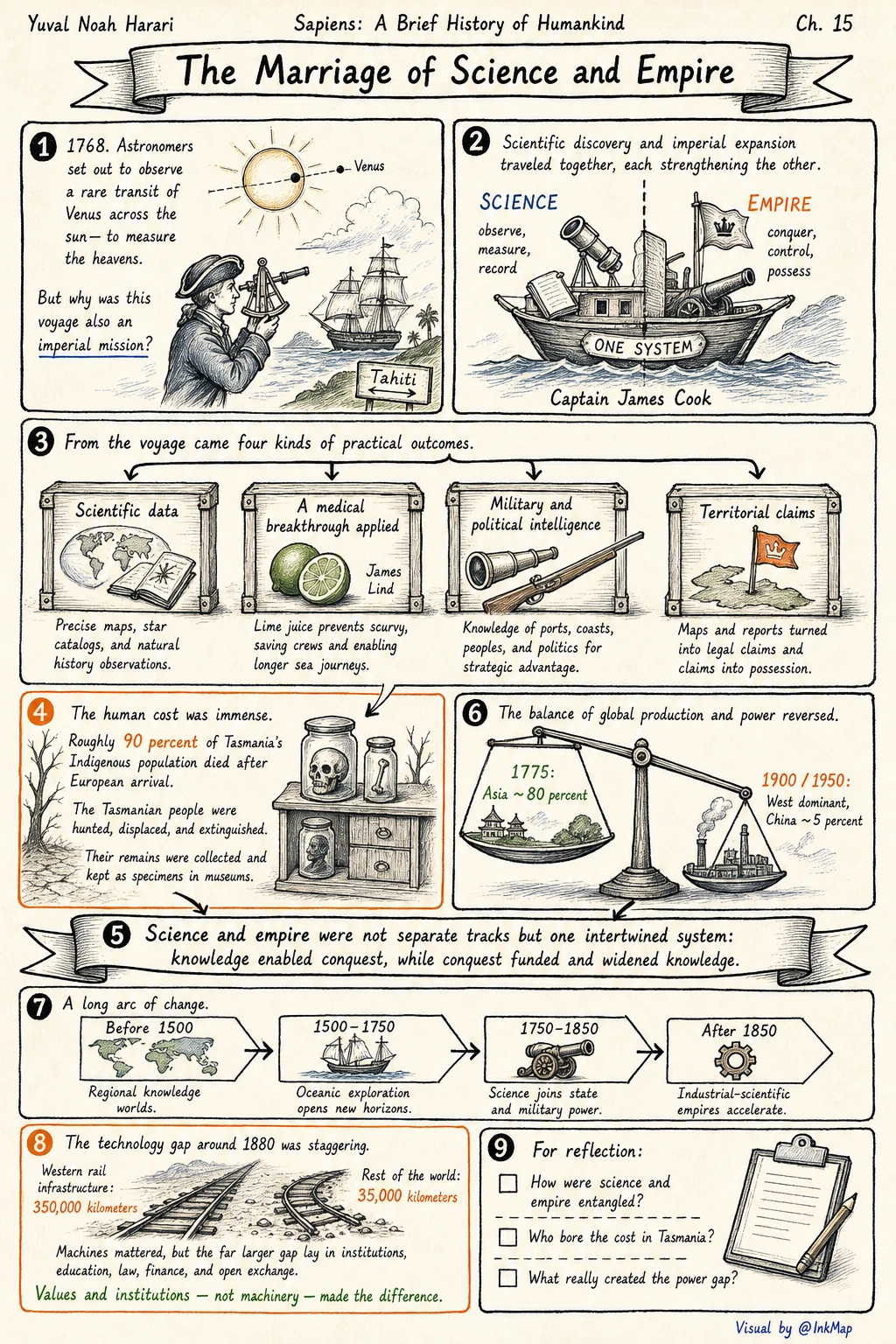
Science and empire did not happen to coincide. They needed each other. The question Harari is really answering is not "why did Europe rise" but "why Europe, and why then." Cook's 1768 voyage makes the structure visible: astronomical observation was science, the Royal Navy's ships and firepower were empire, and together they turned a seemingly pure research mission into the opening move of territorial claim. Lind's scurvy treatment, adopted by Cook, converted medical knowledge into the capacity to project naval force across oceans. The destruction of the Tasmanians was not a side effect of this history but the other face of the same structure. Before 1750 Europe was an economic backwater compared to Asia's dominant empires, and Asia still produced roughly 80% of global output as late as 1775. The reversal was not about technology, since railroads and steam engines were easily copied. It was about institutions, legal structures, and values that took centuries to build and could not be quickly imported.
 Open full image ↗
Draw It
Reading this chapter as "science was used by empire" or "empire was powered by science" misses the structure. Science and empire were partners in a mutual relationship: empire supplied money, ships, and armed protection; science supplied knowledge, technology, and legitimacy. I mapped it to show that two-way dependence rather than listing details of Cook's expedition. I deliberately left out the specifics of the Tasmanian violence, keeping only its position as the other face of the structure, so the reader sees that the reversal of global power came from a whole set of institutions and values, not a single cause.
Rethink It
In technology strategy people often ask "why did this company succeed," and the answer is rarely pure technical superiority. Europe overtook Asia not because of the steam engine itself but because of the surrounding legal, capital, and organizational systems. A team can turn technical advantage into real power only if it also builds the institutions that let the technology land. Looking only at code or only at the market misses the other half.
Take It With You
The marriage of science and empire is not a history we can morally quarantine. It is a structure: whoever controls the production and legitimation of knowledge controls the capacity to expand. That structure still runs between technology companies and geopolitics today.