CHAPTER 06
Building Pyramids
Read It
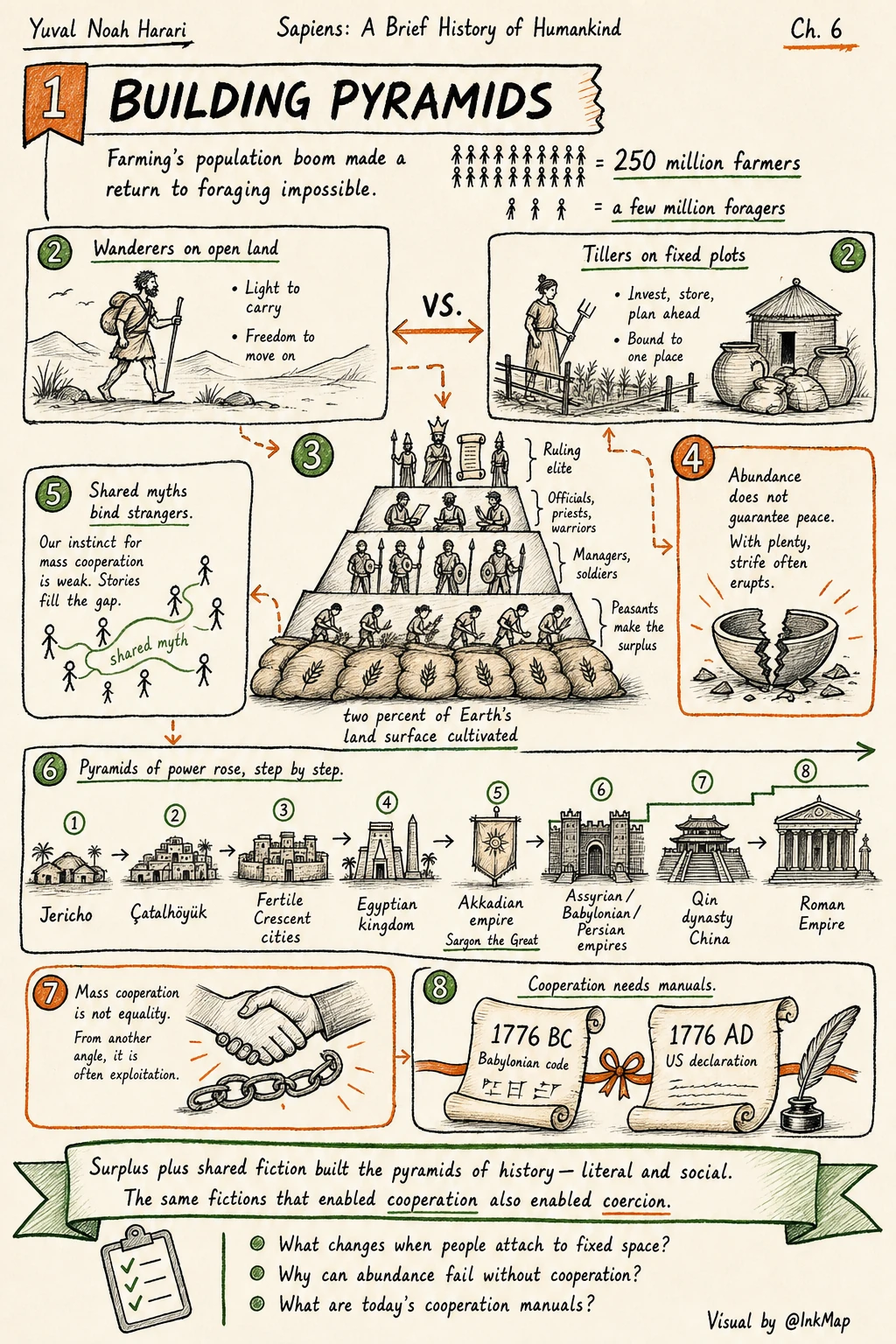
The pyramids were not built by technology; they were built by stories. Agriculture produced surplus grain, but surplus alone doesn't create cooperation. It creates a resource to be fought over. What turned surplus into civilization was the invention of shared myths—legal codes, founding declarations, divine mandates—that let strangers coordinate at a scale no biological instinct could support. But the same fictions that enabled cooperation also enabled exploitation. The peasant majority labored to support a small elite of kings, priests, and soldiers. The chapter's uncomfortable point is that large-scale cooperation and systemic oppression are often the same structure seen from opposite sides. The hierarchy that coordinates millions also extracts from them.
 Open full image ↗
Draw It
The chapter is easy to read as a list of separate points: agriculture changed time perception, surplus fed elites, myths enabled cooperation, cooperation isn't fair. But the real structure is a chain: surplus → elites → need for mass cooperation → shared fictions → both coordination and extraction. Mapping this as a single causal sequence makes the dual nature of the fictions visible. They are not a neutral tool; they are the load-bearing structure of a system that benefits some people more than others. The visual choice is to show that 'cooperation network' and 'oppression machine' share the same skeleton. The difference is not in the structure but in who benefits from the story being told.
Rethink It
Company processes are the same kind of fiction. A review process can make cross-team collaboration smoother, or it can become a tool for a few people to control the pace of work. An OKR system can align goals, or it can become a performance for upward management. The mistake is treating 'it made collaboration bigger' as 'it made everyone better off'. Scale and fairness are different dimensions. A process that scales coordination can simultaneously concentrate power. The question is not whether the fiction exists—it must—but who writes it and who benefits from it.
Take It With You
When a system is praised for 'enabling more people to work together', the first question should be: are those people beneficiaries of the collaboration, or resources being organized by it? The answer is not always obvious, and it can change over time. But the question is the only way to see the structure clearly.