CHAPTER 01
An Animal of No Significance
Read It
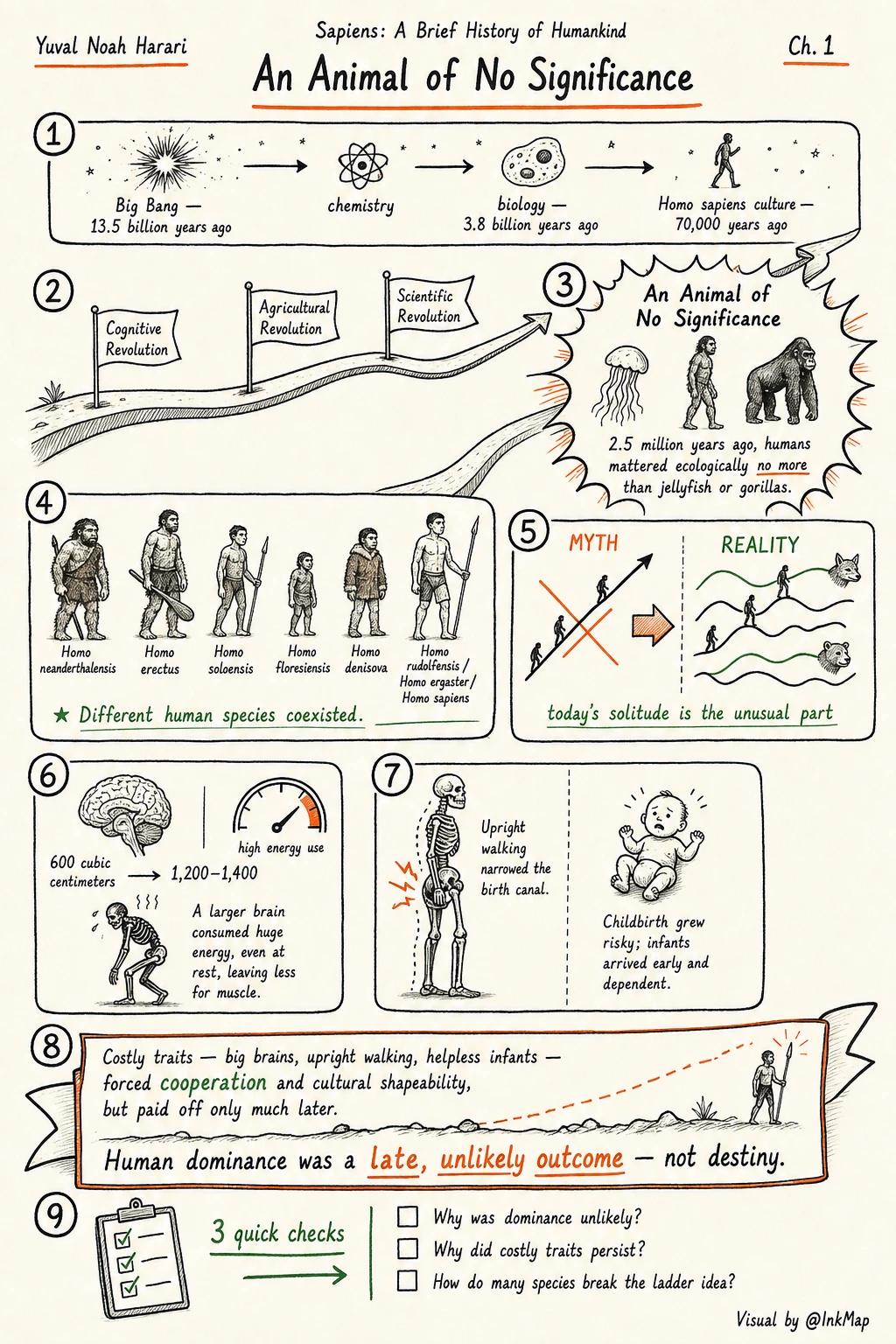
Homo sapiens looks like a species with a destiny, but rewind two million years and that judgment falls apart. Several human species lived on Earth at the same time, and sapiens was one of the least remarkable. The brain we're so proud of burns energy at an alarming rate. Walking upright made childbirth dangerous. Premature infants meant years of vulnerable dependency. None of these traits offered a clear advantage at the time. They looked more like expensive bills evolution had issued.
The point isn't that humans were born special. It's that these costs later got converted into capacities for cooperation and learning. Our current status as the only surviving human species is the anomaly, not the norm.
 Open full image ↗
Draw It
In prose, it's easy to confuse "unique" with "advantageous." A big brain, bipedalism, and premature birth are usually cited as proof of human superiority. But when this chapter puts them back into the evolutionary context, they show up first as burdens. A diagram can lay out the contrast: on one side, the trait; on the other, the cost it imposed at the time; in between, the potential that only paid off much later. Without that visual separation, readers slide into the familiar "humans are inherently great" story and miss what the author is actually saying—advantage is assigned after the fact. Cost is what had to be paid in the moment.
Rethink It
Teams make the same mistake with people. Someone picks up a complex system quickly, so everyone assumes they should immediately own a core module. Someone communicates well, so all cross-team coordination lands on their desk. Potential is not current ability. It needs time, context, and a lot of trial and error before it becomes real. Treating potential as if it were already an advantage is like treating a premature infant as a survival asset. It confuses future possibility with present capacity.
Take It With You
When I look at a species, a person, or a team, I try to see what they're paying right now, not what they might have later. Only when the cost is clear can potential be used without crushing the person carrying it.