Read It
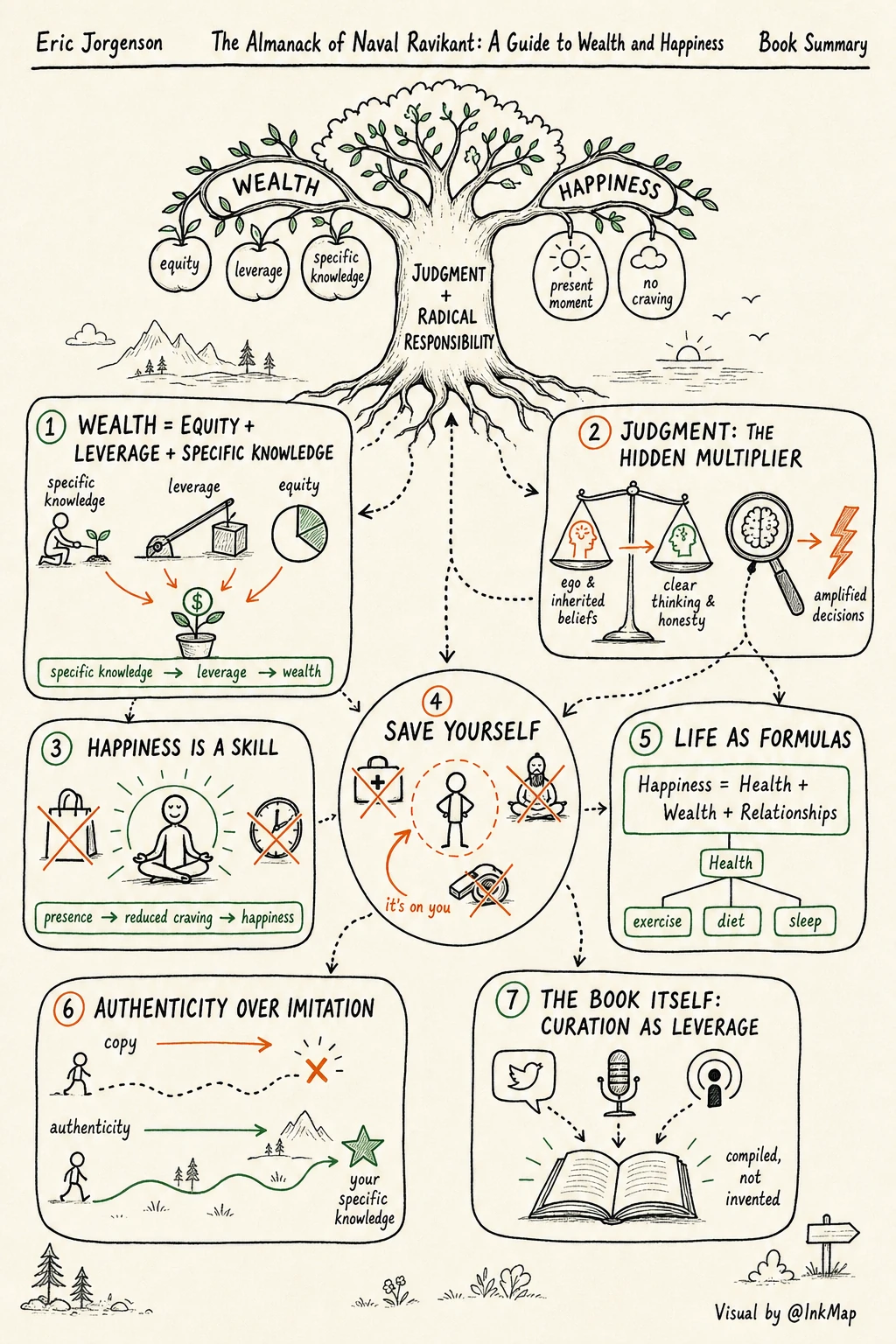
Naval’s real question isn’t “How do I get rich?” or “How do I become happy?” It’s “Why do we keep treating these as opposites?” His answer is that wealth and happiness share the same underlying structure: judgment. Wealth comes from making the right choices at the right time; happiness comes from making the right trade-offs between desire and reality. So this book isn’t a list of aphorisms. It’s a relationship map. Specific knowledge, leverage, judgment, self-responsibility, honesty, and presence aren’t parallel concepts—they support each other. The editor’s act of turning scattered tweets and podcasts into a book is itself a demonstration of leverage: one person’s thinking, organized and distributed, multiplies in value. That’s the book’s quiet meta-argument.
 Open full InkMap ↗
Draw It
I didn’t follow the original order. I put judgment at the center, because the wealth half and the happiness half are really answering one question: how do you make better choices? Specific knowledge and leverage are inputs to judgment. Self-responsibility is its precondition. Honesty is its quality control. Presence is its time horizon. Once I reorganized it that way, the seemingly scattered one-liners snapped into a structure. I deliberately left out the more purely philosophical material—like the claim that life has no ultimate meaning—because it would have diluted the core judgment. The book’s value isn’t in any single insight; it’s in the way the insights reinforce each other when you see them as a system.
Take It With You
The one sentence worth carrying out of this book: wealth and happiness aren’t two goals. They’re the same capability projected onto different situations. That capability is judgment.
CHAPTER BY CHAPTER