CHAPTER 08
Building Wealth
Read It
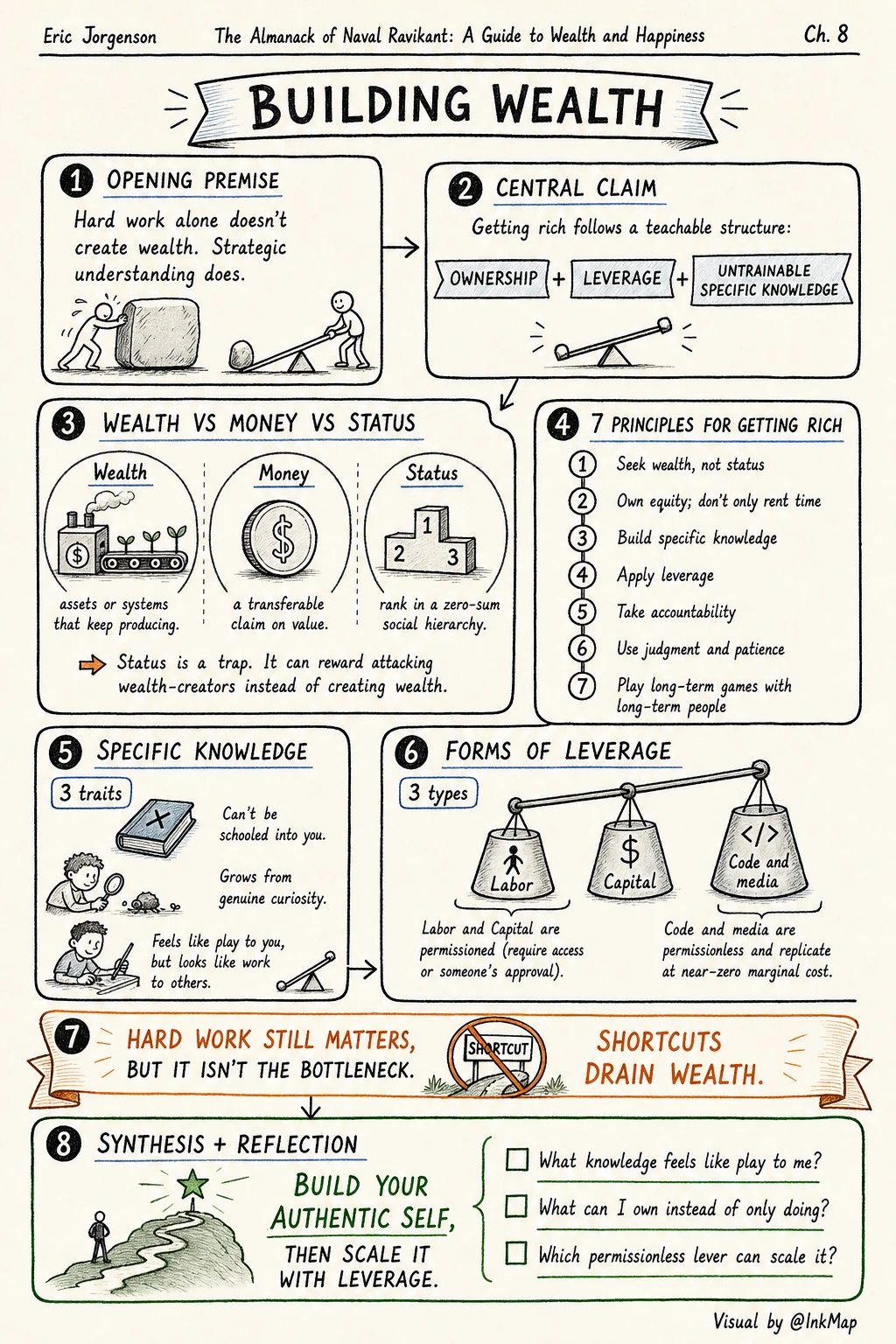
Most people never get rich because they never question the default: trading hours for money. As long as income is tied to your labor, it stops when you stop. Naval's distinction between wealth, money, and status isn't wordplay—it's a way to see which layer you're stuck in. Wealth is assets that earn while you sleep. Money is just a settlement mechanism. Status is a zero-sum trap that pits you against wealth creators. The real question isn't "How do I make more?" but "How do I own something that scales without me?"
 Open full image ↗
Draw It
Read as prose, this chapter feels like scattered advice: own equity, build specific knowledge, use leverage. But the underlying structure is a system, not a list. Specific knowledge is the starting point—something that feels like play to you but looks like work to others. Leverage is the amplifier, and code and media are the only permissionless forms. Judgment determines whether the leverage multiplies gains or mistakes. "Productize yourself" isn't a slogan; it's an instruction to combine these three into a repeatable engine. Flattening that hierarchy into bullet points loses the causal chain.
Rethink It
In software, we understand leverage intuitively: a library beats copying code, a document beats repeating explanations. But leverage doesn't create value—it magnifies judgment. A bad architectural decision, amplified through code, causes rework at scale. The scarce skill isn't using leverage; it's knowing where to point it. That's why Naval's emphasis on judgment, not effort, resonates with anyone who has watched a well-leveraged bad call undo months of work.
Take It With You
Wealth starts with abandoning the time-for-money default. But that only works if you already have something productizable. Without specific knowledge, quitting the default just means losing income. The boundary condition matters: leverage without judgment is just a faster way to fail.