CHAPTER 04
Foreword by Tim Ferriss
Read It
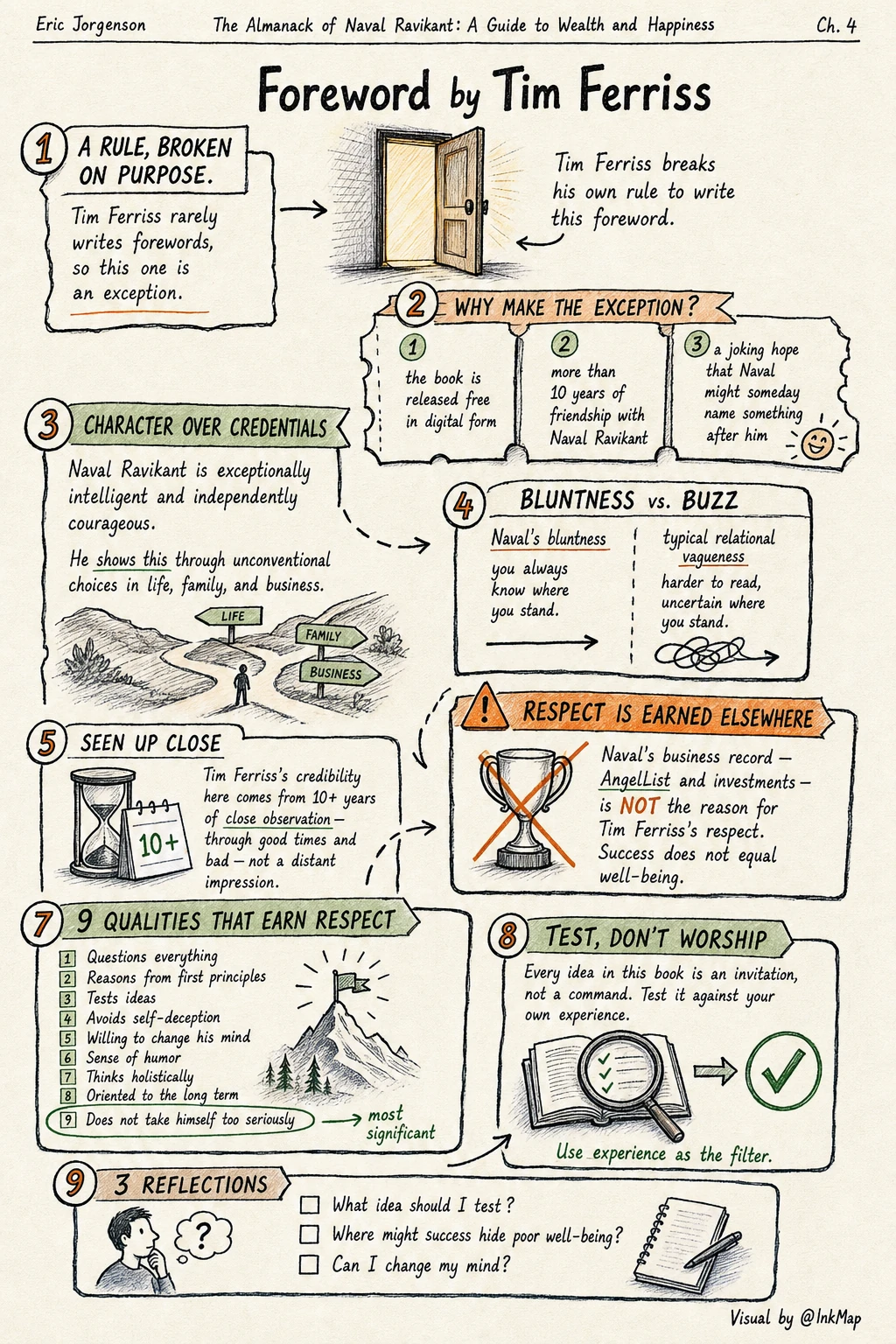
Tim Ferriss doesn't usually write forewords. He made an exception here, and the reason matters more than the praise. He's not endorsing Naval because Naval is rich or successful. He's endorsing him because of how Naval thinks. Ferriss separates the visible outcomes—the companies, the investments, the reputation—from the underlying habits that produced them. Those habits include reasoning from first principles, changing his mind when the evidence shifts, and not taking himself too seriously. The foreword's real function is to give you a filter. Don't believe something just because a successful person said it. Don't dismiss it just because you're skeptical. Test it. Ferriss is saying: here's a person whose thinking has been stress-tested over a decade of close friendship, and it holds up. But the test is yours to run.
 Open full image ↗
Draw It
The text mixes two things that are easy to confuse: what Naval has done and how Naval thinks. The diagram separates them. Business achievements are the background, not the argument. The nine intellectual habits are the evidence chain that supports Ferriss's respect. Among them, the lack of self-importance stands out. It's the habit that prevents the others from hardening into dogma. If you're willing to be wrong, you can keep learning. If you think you're important, you'll defend your positions instead of testing them. That's why Ferriss highlights it. The map makes the hierarchy visible: outcomes are downstream of thinking, not the other way around.
Rethink It
In code review, a proposal can be approved simply because a senior engineer wrote it. Seniority then becomes a substitute for reasoning. Ferriss's approach suggests three questions: what's the actual argument, what problem does it solve, and what constraints does it assume? Seniority is a reason to listen more carefully, not to skip verification. The same applies to conference talks and blog posts from big companies. Their scale may be impressive while their context remains irrelevant to the problem at hand. The credibility of the source and the validity of the idea still need to be separated.
Take It With You
Respect the thinking, not the resume. A person's ideas deserve attention when they can survive questioning, not when they come attached to a success story.