CHAPTER 12
Philosophy
Read It
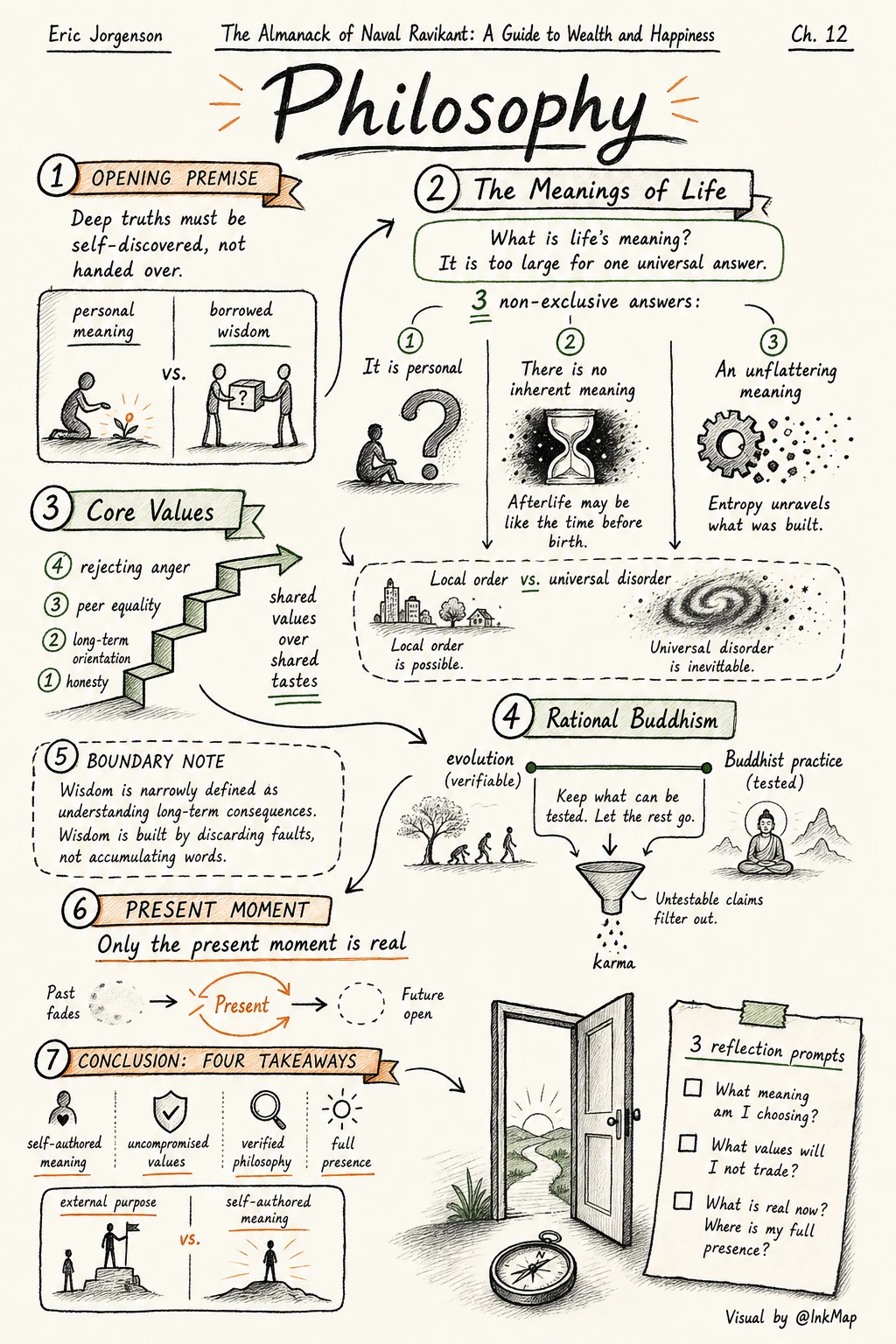
This chapter is easy to misread as "there's no answer." But it actually says: life's meaning isn't a question to solve; it's a practice. The author offers three responses—meaning is self-discovered, meaning is absent, or meaning exists but is unflattering—then stops debating which is true. Instead, he turns to what can be relied on: core values, personally verified beliefs, and the present moment. That turn matters. If you keep asking "What's the meaning?" you slide into nihilism. If you ask "What can I uphold right now?" meaning starts to emerge.
 Open full image ↗
Draw It
The three views of meaning aren't hierarchical or causal—they're parallel possibilities. Visualizing them makes that clear: they don't exclude each other; different people adopt different ones at different stages. More importantly, the map reveals the author's real emphasis isn't the meaning views at all. It's the practical anchors—values, verification, presence. Those are actionable; the meaning views are just background. Prose can bury that distinction.
Rethink It
When choosing a career, people ask "What's the meaning of this job?" That question often has no answer, because meaning isn't given by work—it's assigned by the worker. Better questions: What values do I uphold here? Can I test my own judgment? Am I present, or just anxious about the future? Those are more concrete and more useful than chasing an abstract "meaning."
Take It With You
Don't ask "What is the meaning?" Ask "What am I upholding right now?" Meaning is a byproduct, not a target.