CHAPTER 16
Next on Naval
Read It
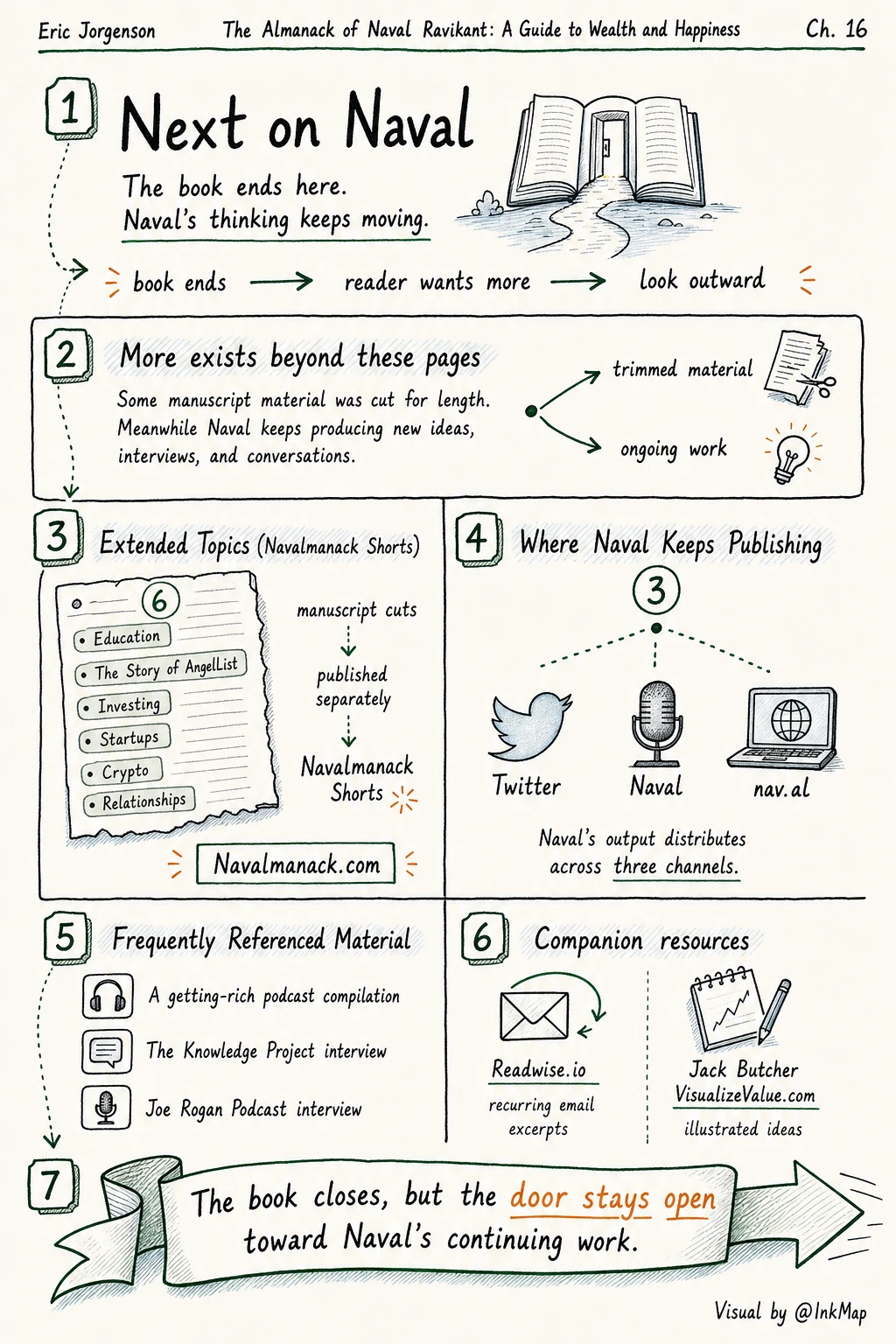
A book's last chapter usually signals an ending. This one does the opposite: it points outward, insisting that the book is only an entrance. Naval's thinking didn't stop at the final page—it continues in podcasts, tweets, a personal website, and the material that got cut from the manuscript. The counterintuitive move is treating a published book as incomplete by design. We're trained to see a book as a finished artifact, but the author here frames it as a snapshot of a moving target. The pieces support each other: the unpublished essays show the thought has boundaries; the ongoing channels show it's still evolving; the Readwise excerpts show reading can become long-term internalization; the original illustrations show that how an idea is presented shapes how it's understood. Together they make one point: don't read this as a final word. The book is a map, and the territory keeps changing.
 Open full image ↗
Draw It
The chapter is easy to read as a resource list—here are some links, go explore. But the relationships matter more than the links. The core judgment is that the book is an entry point, not a conclusion. Everything else—the trimmed content, the podcast, the Twitter feed, the email excerpts, the illustrations—is evidence for that judgment. If you map the resources as parallel items, you get a directory. If you map them as spokes around a central claim, you see that they're all saying the same thing in different media. The visual choice was to make the "entrance, not endpoint" claim the anchor, because that's the idea that changes how a reader behaves after finishing the book.
Rethink It
We treat official documentation the same way we treat books—as the final answer. But a doc describes a specific version's behavior. The community forum may have moved past it. The author's blog may reveal design intent the doc never mentions. Reading a book as an entrance means actively tracking the thought's later life, not stopping at the last page. The cost of not doing this is subtle: you build on a frozen snapshot while the world has moved on. In fast-moving technical fields, that gap can be the difference between a working mental model and a legacy one.
Take It With You
The thing worth following is not the book. It's the person still thinking behind it. A book is a timestamp; a thinker is a stream.