CHAPTER 18
Sources
Read It
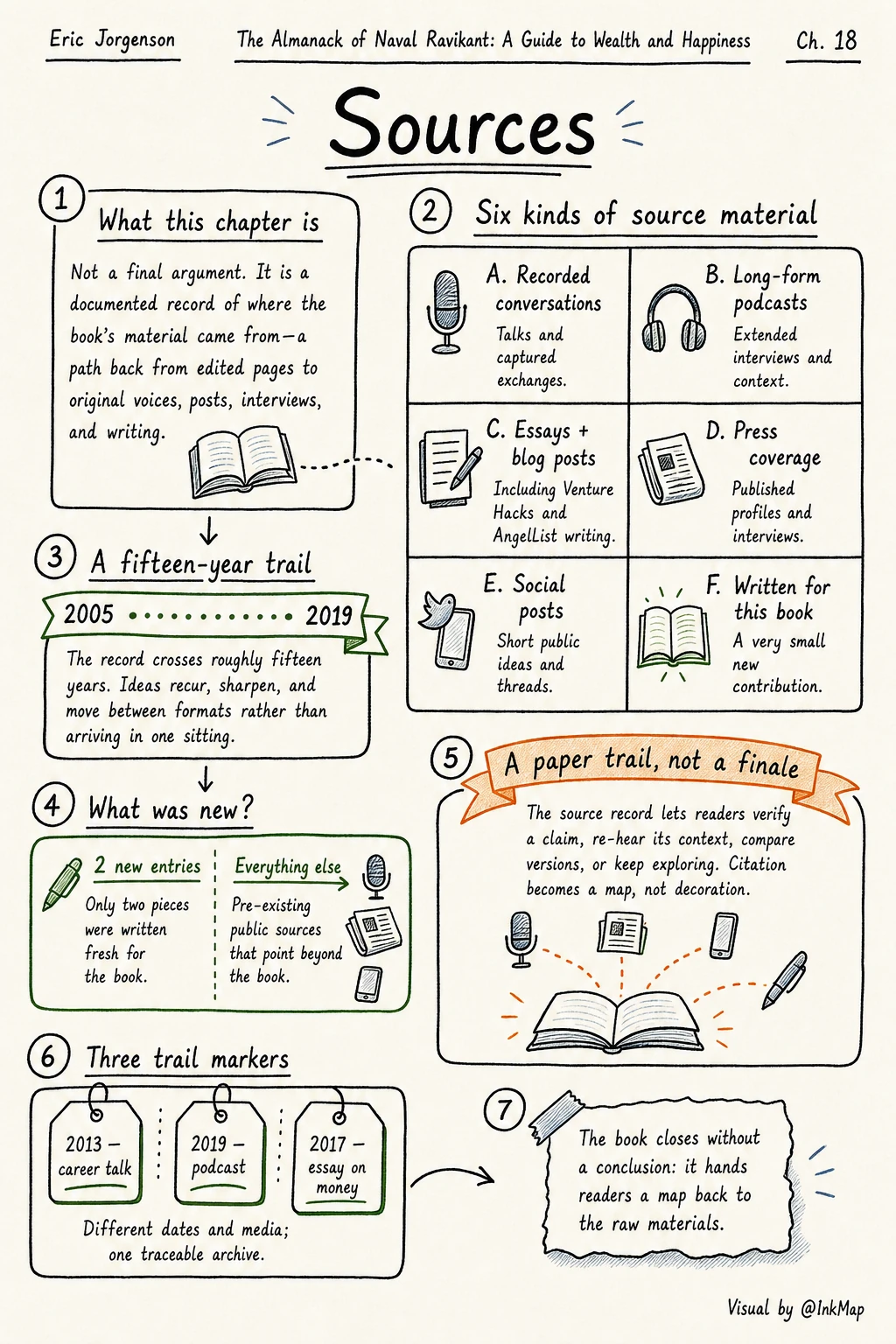
The sources chapter looks like an appendix, but it's actually correcting a quiet misunderstanding about how ideas work. We tend to imagine that a thinker sits down and produces a coherent philosophy in one go. The reality here is messier: the book was assembled from over a decade of interviews, essays, tweets, podcasts, and press coverage, spanning roughly 2005 to 2019. Only two pieces were written specifically for the book. Everything else existed in public, scattered and often repetitive, before an editor pulled it together. The coherence is a post-hoc achievement, not an original state. That distinction matters because it changes how you read the book. If the ideas were always this tidy, you could treat them as a finished system. If they were fragments that got organized, you should treat the organization itself as an interpretive act—one possible arrangement, not the only one. The chapter's presence is a credibility signal: every claim can be traced back to its original context, and that traceability is what separates curation from invention.
 Open full image ↗
Draw It
A list of sources can't show the relationship between the fragments and the finished text. But that relationship is the whole point. The visual contrast is between dispersed raw material—a tweet from 2011, a podcast from 2015, an essay from 2018—and the integrated chapters that resulted. The same idea may appear in multiple places, in different words, at different times. The editor's job was to distill and sequence, not to create. Once that contrast is visible, the book stops looking like a single declaration and starts looking like a sedimented record. The mapping choice was to foreground the gap between source and synthesis, because that gap is where the reader's critical judgment should live.
Rethink It
We read technical blogs and company docs as if the clean architecture diagrams were there from the start. They weren't. There were messy discussions, wrong turns, and decisions made under pressure, and only later did someone write the story that made it all look inevitable. The sources chapter is a reminder to ask, when reviewing a proposal or a postmortem: where did this conclusion come from? What were the raw discussions, the abandoned alternatives, the constraints that got edited out? If the answer is "nowhere—it's just how we think," then the proposal is a story, not an analysis. The cost of ignoring this is building on narratives that feel true but can't be checked.
Take It With You
A claim is only as trustworthy as its sources. If there's no trace back to the raw material, I treat the polished conclusion as a hypothesis, not a fact. Traceability is the difference between a map and a myth.