CHAPTER 14
Naval's Recommended Reading
Read It
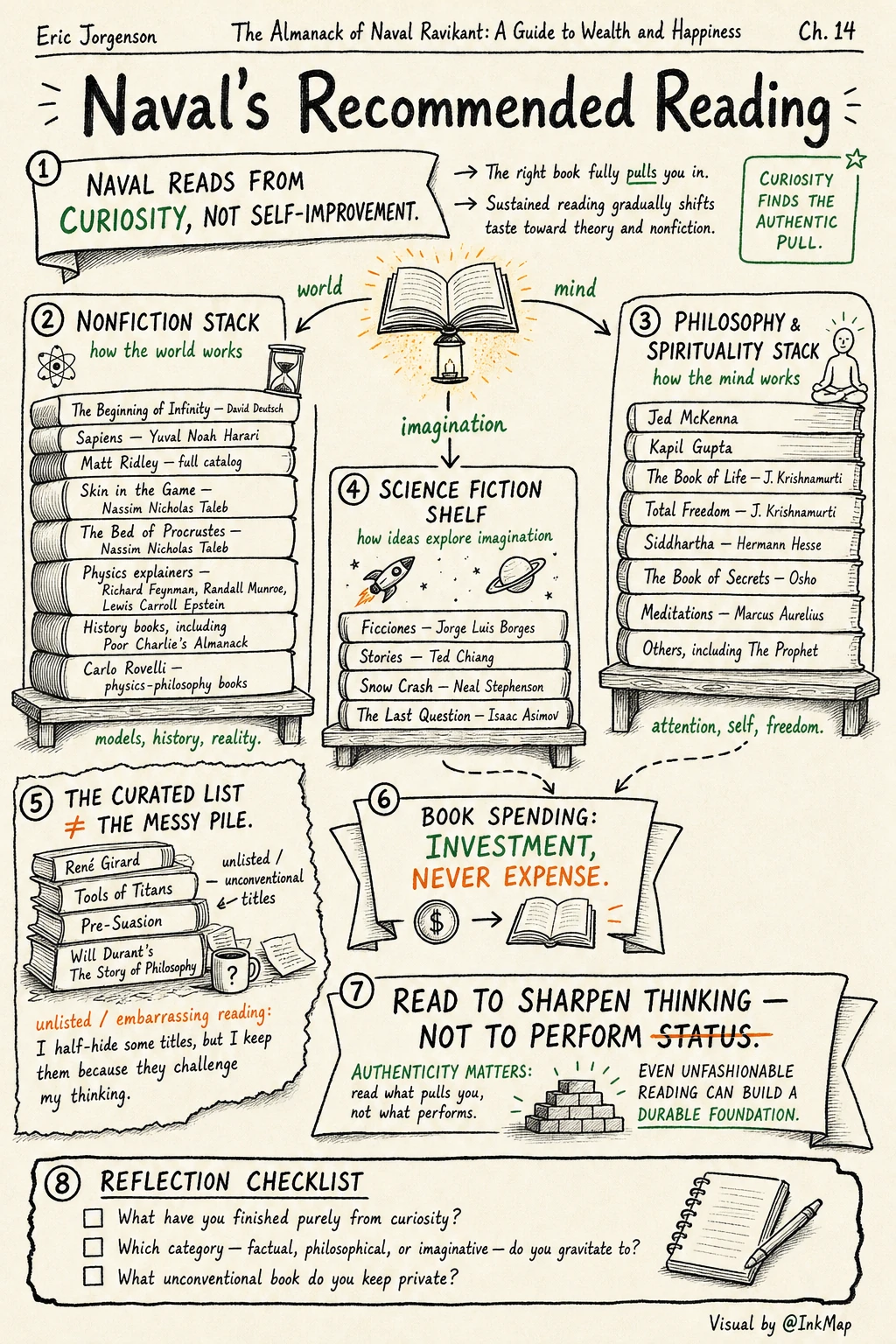
Naval's reading list is not a syllabus. It's a snapshot of a mind that refuses to read out of obligation. The chapter opens with a quiet dilemma: if you read only what you're supposed to, you'll never develop the taste to know what's worth reading; if you read only what you enjoy, you risk staying inside a comfortable bubble. Naval's answer is to let curiosity do the filtering, but to feed it deliberately—nonfiction for how the world works, philosophy for how the mind works, science fiction for how ideas could work. He also keeps much of his actual reading private, because the books that challenge him most would look trivial or weird to an outsider. That privacy is the tell. It means reading is a personal practice, not a performance. And the money he spends on books? He treats it as investment, not expense. That one shift changes everything: you can buy too many books, leave them half-read, and still come out ahead, because the cost of a bad book is nothing compared to the cost of a missed idea.
 Open full image ↗
Draw It
In prose, the chapter reads like a list: categories, titles, blogs, a reflective exercise. But the real structure is a dependency chain. The bottom layer is the attitude—books as investment, curiosity as filter. That attitude makes two seemingly contradictory behaviors possible: reading broadly for pleasure and deliberately seeking views you disagree with. The categories are just the visible output of that underlying stance. If you map the categories without the attitude, you get a book list. If you map the attitude first, you see why the list can be so idiosyncratic and still work. The visual choice was to foreground the tension between comfort and challenge, because that's the actual problem Naval is solving, not "what should I read next."
Rethink It
Technical people face the same fork every time we choose learning materials. Official docs and classic textbooks give structure but lag behind practice. Blogs, talks, and Twitter threads are current but fragmentary. Naval's approach suggests a way through: start from the premise that learning is an investment, then let curiosity pick the materials, while deliberately reserving time for sources that make you uncomfortable. The judgment changes with context. Early in a field, you need more structure and fewer hot takes. Later, the opposite. The cost of getting this wrong is real: read only what's comfortable and you'll plateau; read only what's assigned and you'll burn out. The chapter doesn't resolve the tension—it just makes the trade-off visible enough to manage.
Take It With You
The value of a reading list is not the titles. It's the selection principle behind them. If I can articulate why I read what I read, I can adjust that principle as my needs change. If I can't, I'm just accumulating books.