CHAPTER 02
Contents
Read It
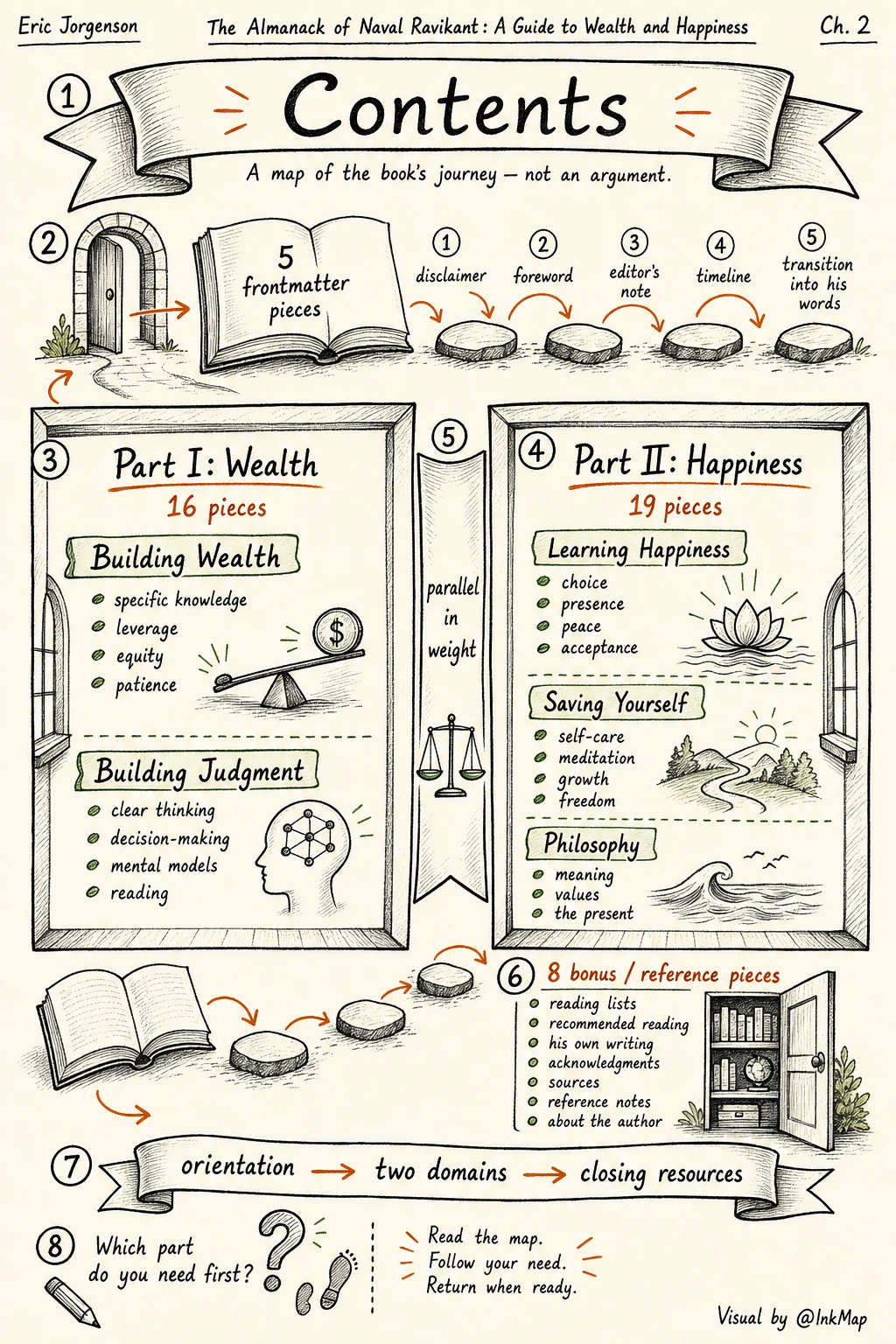
A table of contents usually just tells you where things are. But this one answers a different question: why wealth and happiness have to sit in the same book. Naval isn't giving you two separate manuals. He's making a claim about what a complete life requires. Wealth is the external game—building things, using leverage, making judgments under uncertainty. Happiness is the internal game—training yourself to want less, to see clearly, to choose your responses. The structure says these aren't sequential stages. You don't get rich first and then figure out how to be happy. They run in parallel, and they share the same underlying skill: judgment. That's why the wealth section splits into building and thinking, and the happiness section splits into learning, self-rescue, and philosophy. The table of contents is a map of priorities, not just a list of topics.
 Open full image ↗
Draw It
If I just listed the chapters, the page would be a directory. What's worth showing is the relationship between the parts. The frontmatter sets the context—who Naval is, why the book exists, how to read it. Then two parallel pillars rise: wealth and happiness. They aren't stacked one on top of the other; they're side by side, each with its own internal structure. Wealth breaks into the mechanics of building and the discipline of judgment. Happiness breaks into learning, self-rescue, and philosophy. The backmatter is a path for going deeper. This layout makes visible what prose hides: the book is not a linear argument but a balanced system. The two pillars calibrate each other. Wealth without happiness is hollow; happiness without wealth is constrained.
Rethink It
System design often begins with a list of components. But a list doesn't tell us how data flows, where the bottlenecks are, or which parts are load-bearing. The table of contents suggests better questions: what are the core paths, and what are the supports? If the dependencies cannot be drawn, the system is not yet understood. The same applies to career planning. People often treat wealth and well-being as separate tracks—work hard now, relax later. Naval's structure argues that's a mistake. The skills that make you good at building wealth—patience, clear thinking, willingness to say no—are the same skills that make you content. You can't defer one without damaging the other.
Take It With You
Putting wealth and happiness side by side isn't a layout choice. It's a redefinition of success. The book refuses to treat financial achievement as the main event and inner peace as an optional add-on. That's a judgment I want to keep in view.