CHAPTER 11
Saving Yourself
Read It
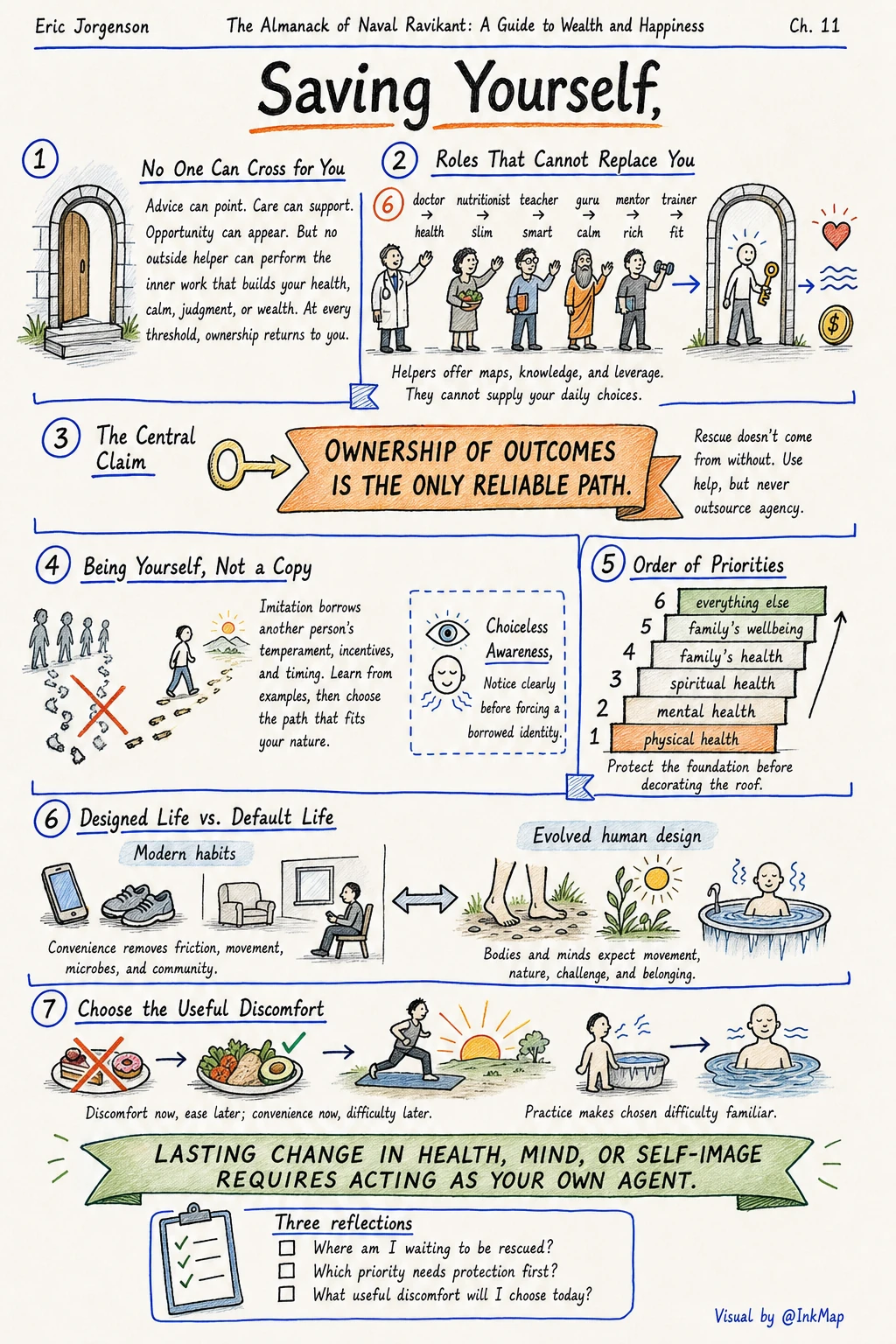
The real question here isn't "How do I take care of myself?" but "Why can't anyone else do it for me?" Doctors, mentors, and coaches can advise, but the change depends entirely on what you actually do. That's harsh because it returns all responsibility to the individual. But the chapter doesn't stop at "take responsibility." It gives a priority order: physical, mental, spiritual, then family. The sequence matters—settle yourself before investing outward. Many people reverse it: family first, then spirit, then mind, body last. Then they collapse.
 Open full image ↗
Draw It
As a list, this chapter is just wellness advice. But it's really a structure: priorities determine resource allocation. Physical health is the foundation; mental health is the second layer; spiritual health the third; family is an extension. Laying out the levels makes the sequence non-negotiable—you can't skip the body to chase spiritual growth, and you can't sacrifice basic health for family. The structure also explains the pairing of short-term discomfort and long-term ease: each layer requires a harder choice now to stabilize the next one.
Rethink It
Tech teams are full of people who stay up late, eat badly, and still debate "career growth" and "life meaning." That's the priority order inverted. When the body fails, mind and spirit follow, and neither team nor family gets your best. Self-care isn't selfish; it's the precondition for sustained output. Someone who can't manage their own health rarely delivers stable value over time.
Take It With You
Priorities aren't moralizing—they're resource constraints. With limited energy, spending it on the body first yields the highest return.