CHAPTER 15
Naval's Writing (Life Formulas)
Read It
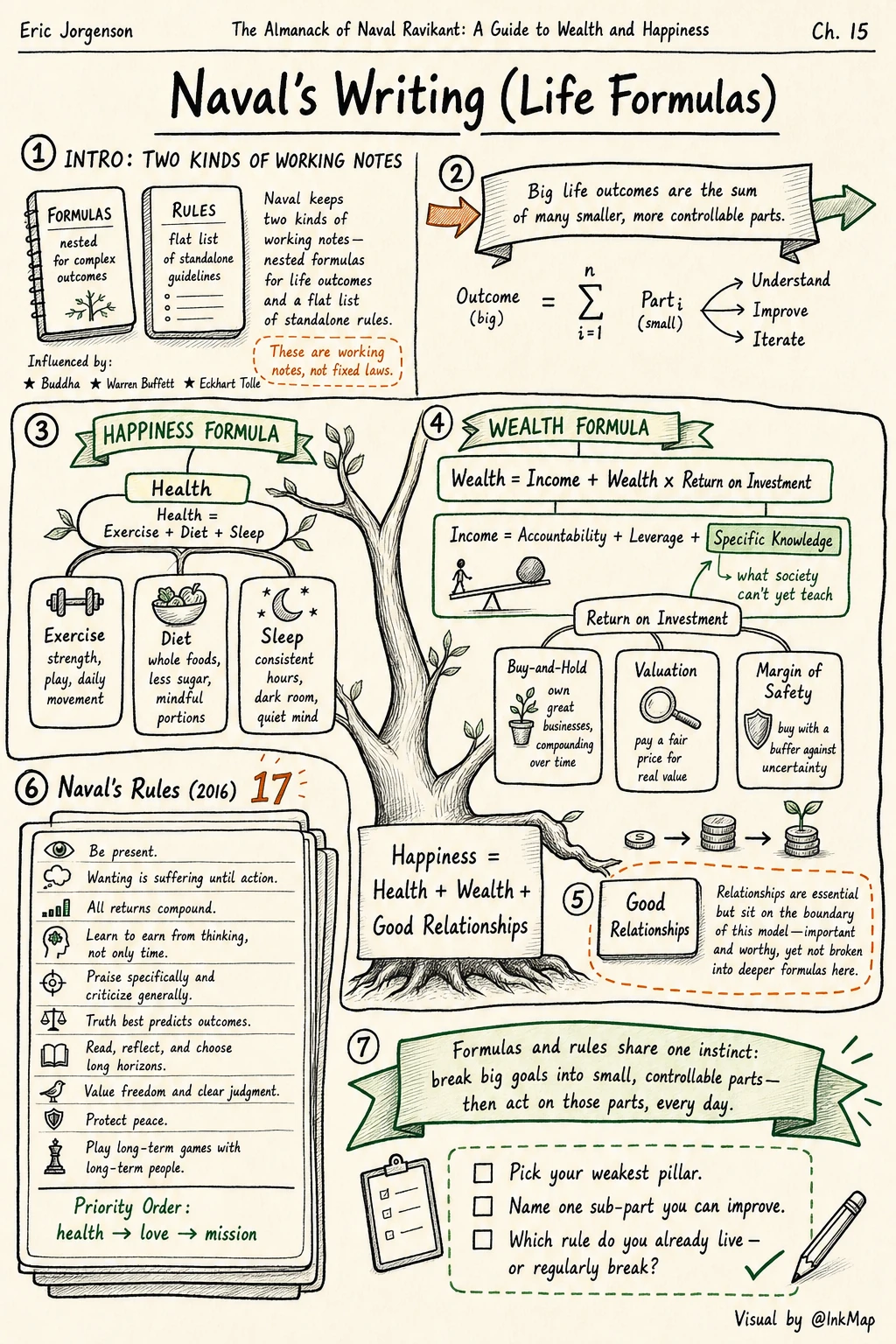
Naval's formulas look like math, but they're really a warning about what happens when you mistake a model for a map. Happiness equals health plus wealth plus good relationships. Health equals exercise plus diet plus sleep. Wealth equals income plus compounding. Each branch splits into smaller, more actionable pieces—down to specific daily practices. The most easily missed consequence is that once a formula is written down, it starts to feel like a law. But Naval himself labels these as personal approximations, not definitions. The causal chain matters more than any single equation: health, wealth, and relationships are not just variables to optimize; they point toward a deeper ordering—health, love, mission. If you optimize one variable in isolation, say return on investment, while ignoring that ordering, you can end up with impressive numbers and a life that's worse, not better. The formulas are scaffolding, not the building. And the fact that relationships are left undecomposed is not an oversight. It's a boundary marker: some things resist being broken into parts, and forcing them into a formula would be its own kind of error.
 Open full image ↗
Draw It
The text mixes formulas and standalone rules, which invites readers to treat "happiness = health + wealth + relationships" as an equation to apply. But the real structure is a hierarchy. Health sits at the base, decomposing into exercise, diet, and sleep. Wealth sits above it, splitting into income and return on investment, with income further dependent on accountability, leverage, and specific knowledge. The 17 standalone rules sit outside the hierarchy entirely—they're ground rules, not derived results. Mapping this way shows that the formulas are an intermediate product, not the conclusion. The actual judgment lives in the final ordering: health, love, mission. If you flatten the hierarchy into a list, you lose the fact that some variables are means and others are ends.
Rethink It
Technical decisions have the same shape. A team that optimizes for delivery speed, sprint after sprint, is optimizing a single variable. Each individual choice looks reasonable. But the accumulated effect can be a system that's impossible to maintain, a team that's burned out, and a product that's technically bankrupt. Naval's notes remind me to track not just the variable's performance, but whether it's moving me toward the deeper ordering. If the ordering is wrong, local optimization just accelerates the drift. The cost of ignoring this is invisible until it's catastrophic—technical debt, yes, but also the quieter debt of a career spent optimizing the wrong metric.
Take It With You
Formulas are thinking tools, not life answers. The moment I start treating a personal heuristic as a universal law, I've stopped thinking and started performing.