Read It
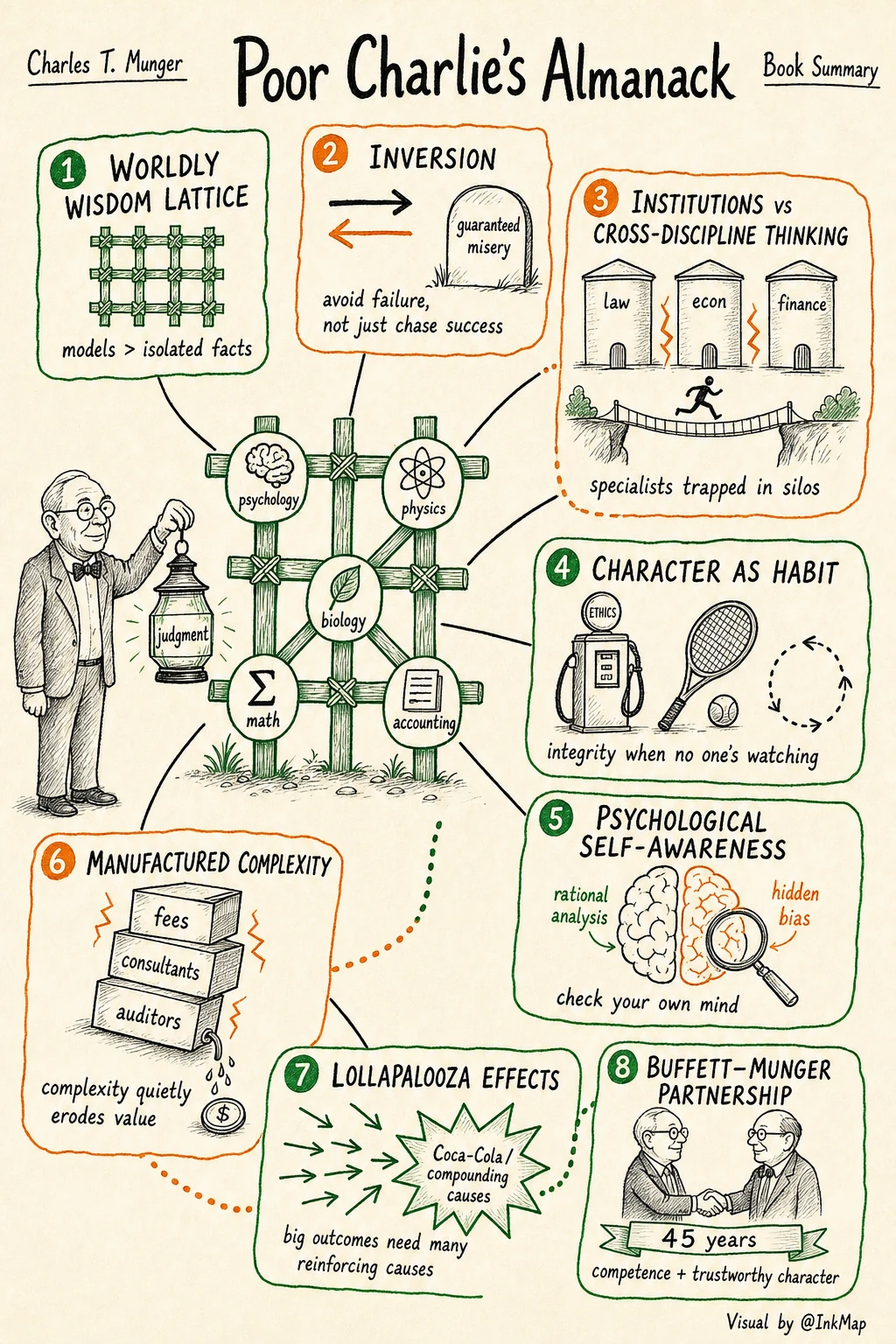
The most dangerous thing about this book is how easy it is to read it as a collection of clever ideas. Munger’s real subject is the quiet self-deception of expertise. We spend years drilling into one field, then mistake that depth for breadth. A single mental model doesn’t just limit what you see—it reshapes every problem until it fits the tool you already have. Munger’s answer isn’t more facts. It’s a lattice of models from different disciplines, cross-braced so that no single framework can dominate. What struck me most is that he was still revising his own thinking in his seventies and eighties. If that’s what real judgment looks like, then most of what I call “experience” is just repetition with confidence.
 Open full InkMap ↗
Draw It
The book doesn’t follow a linear argument. It’s speeches, letters, testimony, and family memories stitched together, and the same judgments surface in different forms across decades. I reorganized it around a causal chain. First, why multiple models are necessary: real problems don’t respect academic boundaries, and a single model breeds overconfidence in the wrong places. Second, how to actually do it: inversion, two-track analysis, checklists—not as tricks, but as forced procedures for seeing your own blind spots. Third, what it costs: Munger’s critiques of consultants, accounting fraud, and academic silos all point to the same failure. When a system rewards local optimization, overall judgment degrades. I separated these layers because the original text mixes them constantly, and readers tend to confuse knowing a model with using it, or criticizing others with having avoided the trap themselves.
Take It With You
Munger’s method has an implicit price. Building a cross-disciplinary framework takes years, and it’s overkill for deciding what to eat for lunch. But most people spend less time thinking about their biggest decisions than they do about their smallest ones. The method isn’t for every choice. It’s for the choices that echo.
CHAPTER BY CHAPTER