CHAPTER 02
Introduction
Read It
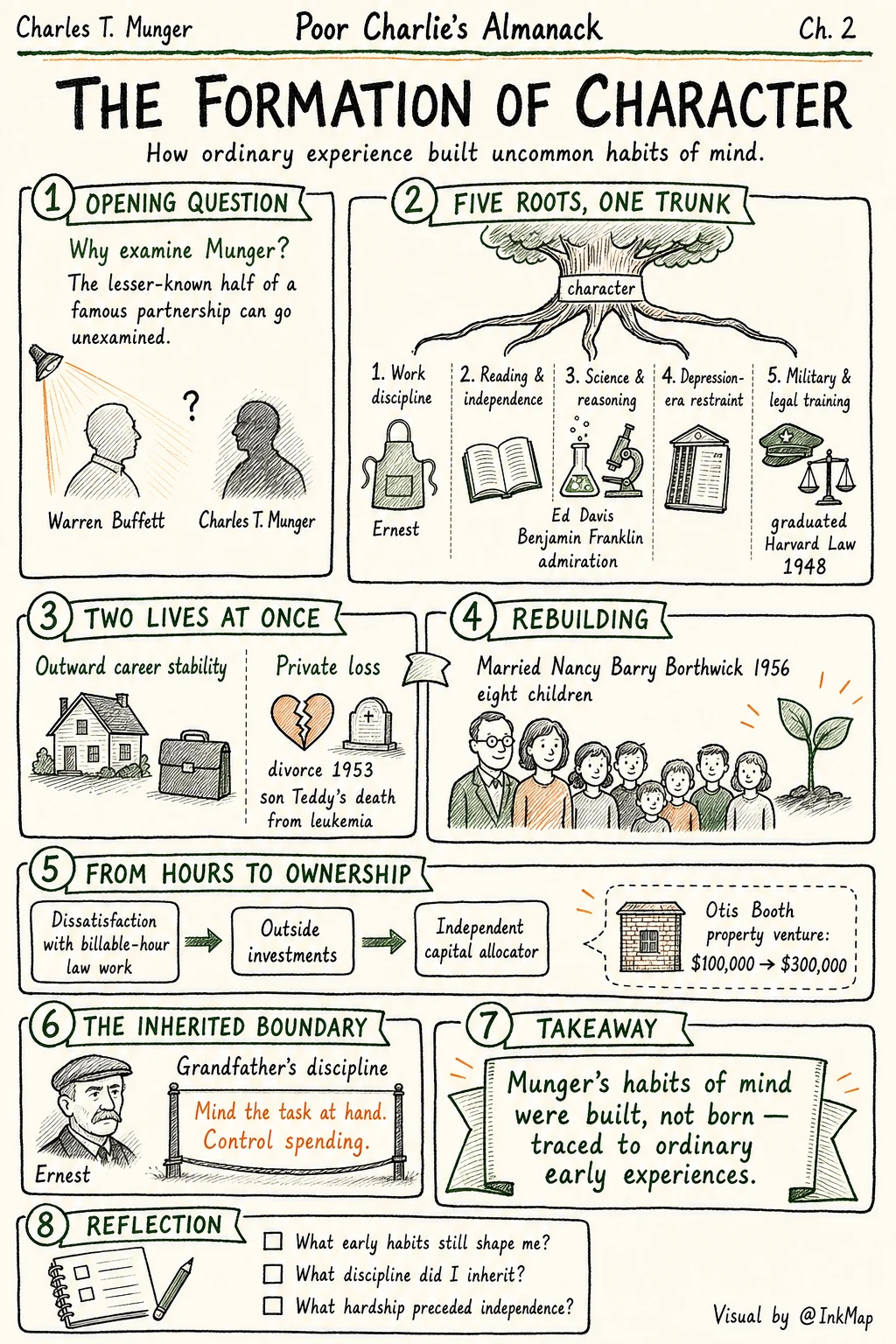
The most easily overlooked consequence of this chapter is that Munger's later, almost cold rationality grew out of a series of losses he could not control. Divorce, the death of a young son, the suffocation of billable-hour legal work—each alone is a setback, but together they forced him to separate what deserved investment from what had to be abandoned. Watching his grandfather rescue relatives during the Depression taught him that deliberate mutual support and restraint were not abstract virtues but concrete acts of survival. Physics gave him rigorous logic, and wide reading gave him a cross-disciplinary view, but what welded these together were the breaks that forced him to choose a different path. The chapter traces the habits of mind—childhood work discipline, early exposure to scientific reasoning, wartime education—not as a single flash of insight but as character built slowly through ordinary and difficult experience.
 Open full image ↗
Draw It
The causal chain here is easy to read as a simple linear story: experience determines character. But the actual relationship is closer to a filter. Experience does not produce ability; it forces choices between options, and the choices shape judgment. Family upbringing, Depression-era lessons, career dissatisfaction, and reading habits each provided different constraints. Together they produced a decision habit: look at the cost first, then the gain. If you only list the events, it looks like suffering automatically creates wisdom. Drawing the chain shows that wisdom comes from how a person responds to suffering, not from the suffering itself.
Rethink It
Many engineers go through an early period when nothing seems to work: projects get cancelled, promotions fail, teams reorganize. These events do not create growth by themselves, but they force the question "What problem am I actually trying to solve?" Munger left law for investing not because investing was easier, but because he saw that billing by the hour could not accumulate long-term value. Similarly, an engineer who realizes they are only trading time for salary, without building reusable judgment, has found the signal that a real change is needed.
Take It With You
The value of an experience is not how painful it was, but whether it forced a choice that could not be undone. If you just endure it, nothing changes.