CHAPTER 01
Rebuttal: Munger on Buffett
Read It
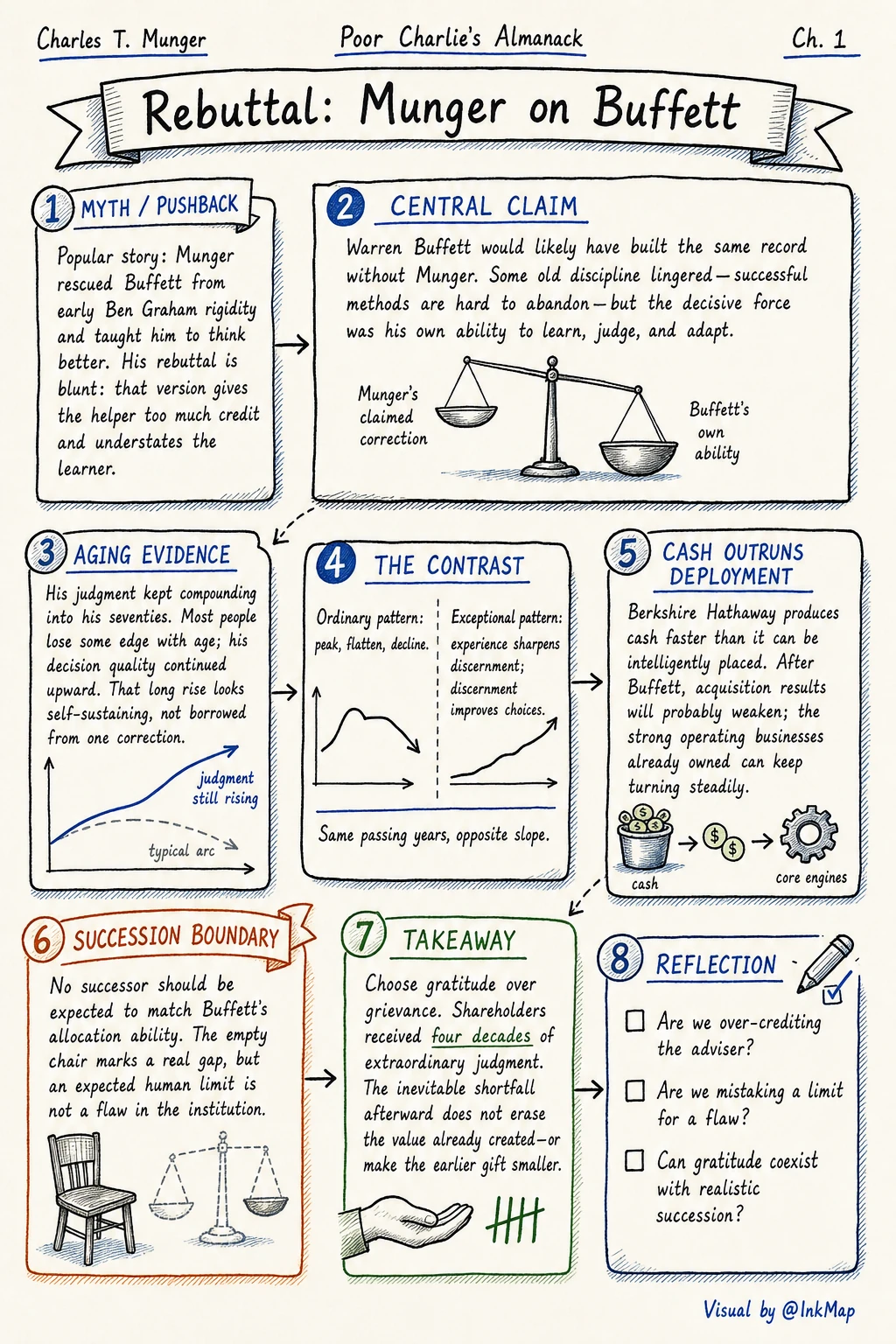
Munger is often cast as the man who freed Buffett from the rigidity of Ben Graham-style investing, but he refuses the role. He says Buffett would have done about as well without him. The evidence he offers is Buffett's judgment, which kept sharpening into his seventies—a pattern Munger reads as self-driven skill, not outside guidance. Yet he also admits he may have helped Buffett break free of early Graham-era habits. The two claims sit side by side, and the tension between them is the real point: influence is not the same as necessity. A catalyst changes the speed or path of a result; it does not create the result. Munger places himself in the first category and leaves the credit for Buffett's growth with Buffett. The chapter closes by turning to succession. Berkshire's core businesses already generate more cash than can easily be redeployed, so future success depends less on acquisition genius than on operations that are already strong. The inevitable decline in acquisition skill after Buffett is a natural limit, not a shortcoming. Munger reframes the anxiety as misplaced: decades of access to Buffett's rare ability should inspire gratitude, not dread of what comes after.
 Open full image ↗
Draw It
"Necessary condition" and "catalyst" collapse into each other in prose. Munger denies the first and admits the second. If you read only the words, you might take "I wasn't necessary" to mean "I had no influence," or "I helped him" to mean "I was the key." Putting the two relationships on different levels makes the distinction visible. A necessary condition determines whether the result happens at all; a catalyst determines how fast or along what path. Munger places himself as a catalyst and attributes Buffett's continued improvement to Buffett's own ability. Those two lines have to be kept separate, or the humility gets misread.
Rethink It
In technical teams, the same confusion appears in discussions of who developed whom. An engineer grows quickly, and the credit goes to a mentor or a key project. But what actually mattered may have been a single code review comment—"Are you sure you want to design it this way?"—that made the person question an old habit. The mentor was a catalyst, not a necessary condition. Mixing the two up leads to misallocated credit in promotion discussions and gives mentors an unrealistic sense of control.
Take It With You
The boundary of Munger's claim is that a catalyst only matters if the other person already has the capacity and willingness to change. If Buffett had not been self-driven, no amount of prompting would have worked. So the better question is not "Who influenced me?" but "Why was I willing to be influenced at that moment?"