CHAPTER 12
Talk Six: Investment Practices of Leading Charitable Foundations
Read It
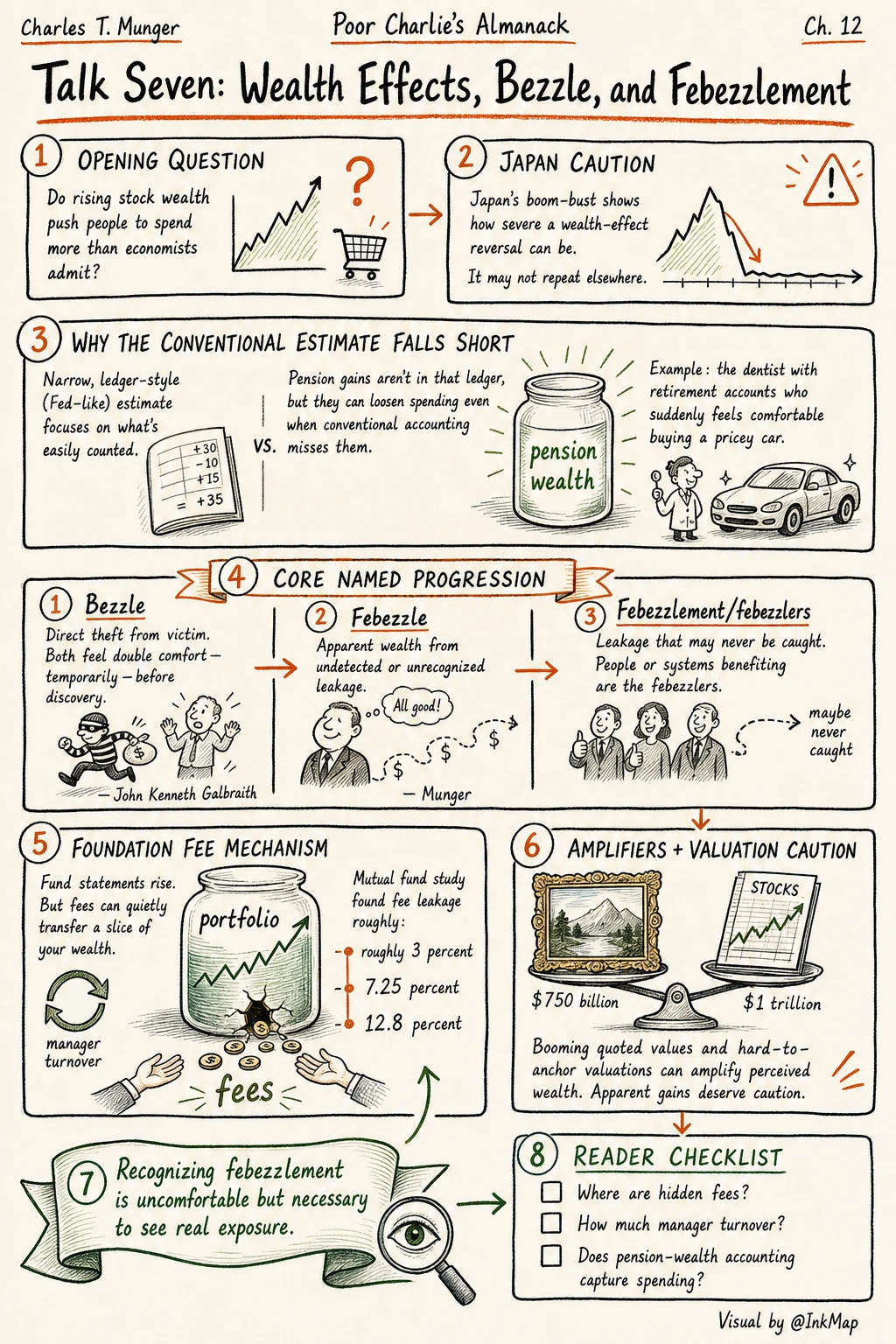
The stock market's rise boosts consumer spending far more than economists calculate. Munger doesn't need a complex model to see it; he points to a channel they've missed: pension accounts. When people watch their retirement balances climb, they feel richer even without cashing out, so they spend more freely. What's counterintuitive is that he drags the "wealth effect" out of the spreadsheets and back into human psychology.
 Open full image ↗
Draw It
The wealth effect, febezzlement, and the foundations' own behavior are three mutually supporting ideas in this chapter. In prose they look like three separate puzzle pieces; the diagram shows how they fit. The wealth effect is underestimated because febezzlement—this hidden waste—never enters the statistics. And febezzlement persists because rising asset prices make foundation managers feel good, so they don't bother calculating returns after fees. Together, the three points lead to one conclusion: paper prosperity systematically hides real losses.
Rethink It
Personal investing has its own febezzlement. Checking the account too often, chasing rallies, switching funds—each action feels like the right move, but over time the actual return trails the fund's own performance by more than five percentage points. It's not an intelligence problem; it's a behavioral one. Munger aims at foundations, but ordinary investors manufacture their own febezzlement too, just on a scale too small to notice.
Take It With You
The sharpest edge of febezzlement is that it needs no one to act maliciously. As long as everyone takes fees according to industry practice and switches managers according to convention, the waste accumulates on its own. So judging an investment system can't stop at "how much did it go up." You have to ask what's left after every hidden cost is stripped away.