CHAPTER 04
Remembering: The Children on Charlie
Read It
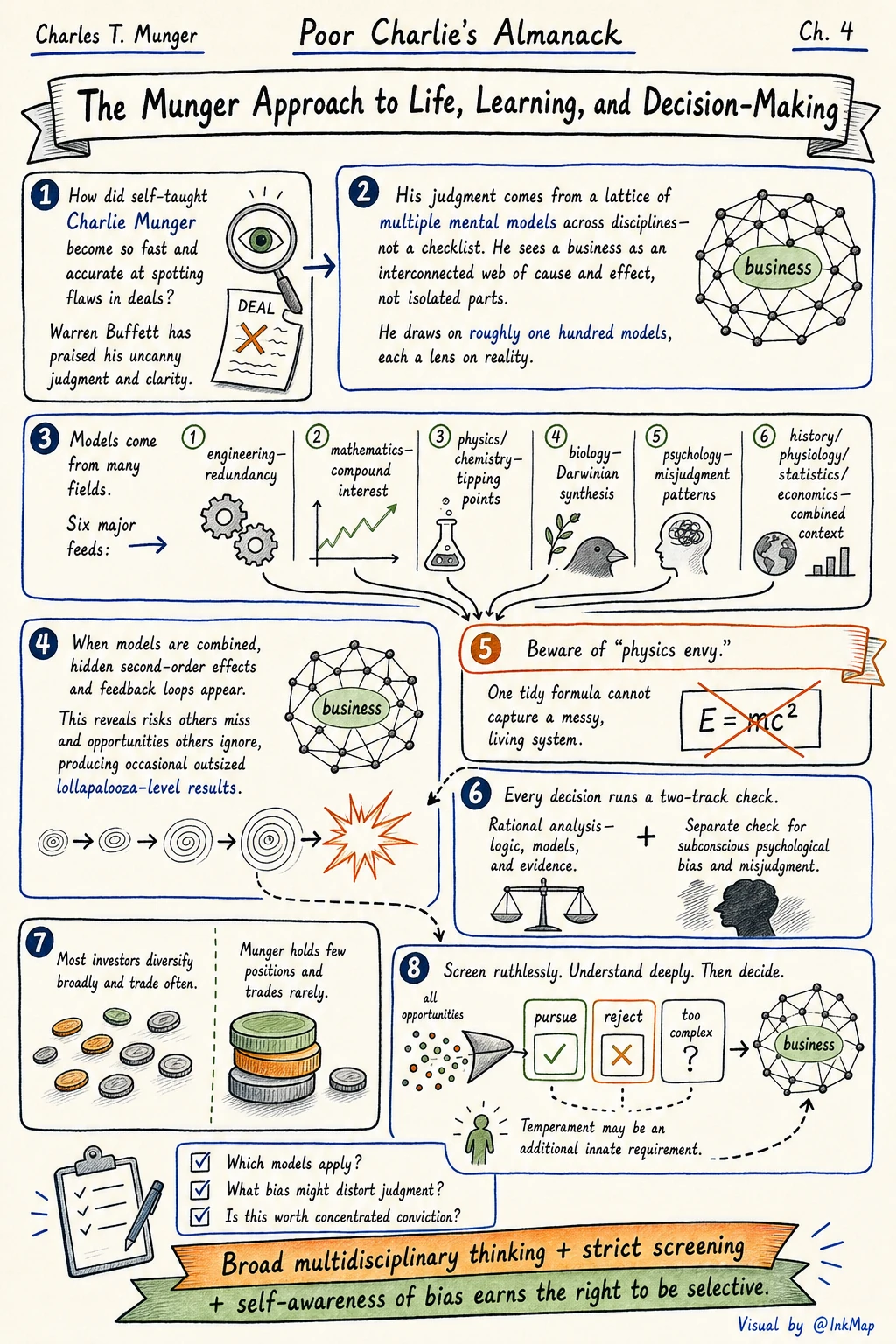
Munger's real question is not "How do I pick good companies?" but "Why do smart people looking at the same financials reach completely different conclusions?" The answer is not more information but how information is organized. He treats principles from history, psychology, physics, and biology as a set of lenses, not used one at a time but all at once on the same object. Financial numbers are just one lens; alone, they distort. The most counterintuitive part of the method is that it starts not with finding opportunities but with eliminating errors. First cross out what is clearly wrong, then analyze the few that remain in depth, and only then act. Getting the order wrong means working hard in the wrong direction. The chapter also stresses a second check for psychological distortion, treating misjudgment patterns as essential to analysis, and a concentrated, low-turnover portfolio that deliberately contrasts with mainstream diversification.
 Open full image ↗
Draw It
The hardest thing to separate in prose is "number of models" and "relationship between models." Many people think multidisciplinary thinking means reading more subjects. Munger means letting principles from different disciplines check each other on the same problem. The diagram pulls the "eliminate first, then investigate deeply, then act decisively" flow out of the list of ideas, making it clear that decision-making does not start by searching for answers but by narrowing the field. Rational analysis and psychological bias are parallel tracks, not sequential steps—a contrast that prose easily turns into "first be rational, then check for bias."
Rethink It
In technical design reviews, the most common question is "What are the advantages of this solution?" A better one is "Under what conditions will this solution definitely fail?" Listing exclusion criteria—data volume above a threshold, latency below a limit, no one on the team who can maintain it—can cut half the candidates quickly. The survivors get deeper comparison, instead of writing a full design document for every option. The same logic applies to promotion materials: cross out projects that cannot show clear impact, and keep only the two or three where the causal story is solid.
Take It With You
Judgment is not knowing more models. It is knowing which model fits which constraints, and when to admit the model is not enough.