CHAPTER 09
Talk Three: Worldly Wisdom Revisited
Read It
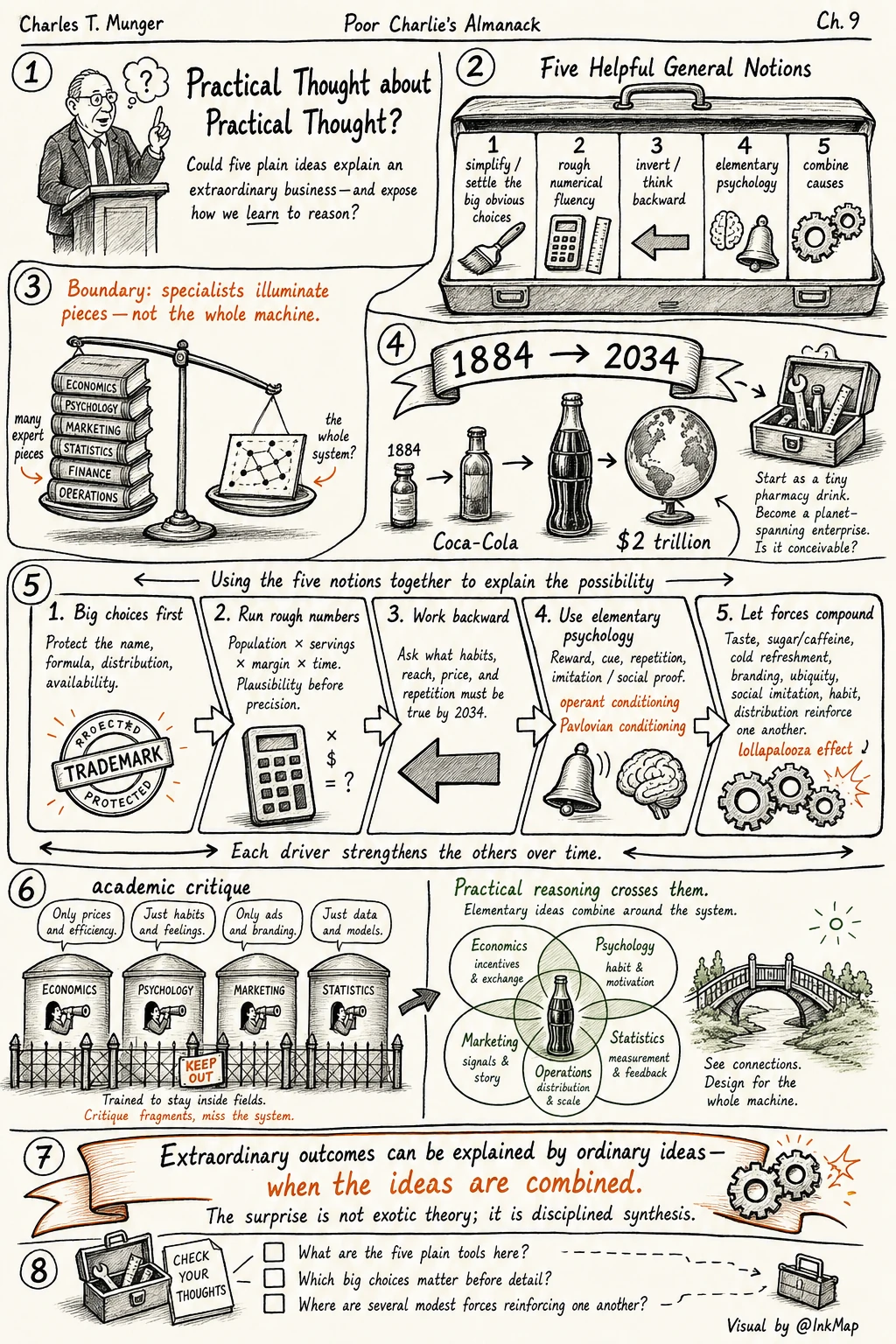
Munger uses the knowledge available in 1884 to reason Coca-Cola into a two-trillion-dollar company. The most counterintuitive thing about this thought experiment is that every ingredient is common sense—nothing that wasn't already known at the time. The scarce resource isn't information; it's the ability to combine common sense into a coherent whole.
Of the five tools, backward reasoning is the most underestimated. Working backward from a target forces you to translate "want" into "must." Reasoning forward, you get lost among countless "maybe we could" options; reasoning backward, every "if not" points directly at failure.
But what Munger is really after is the lollapalooza effect. Operant conditioning and Pavlovian conditioning, each on its own, isn't enough. Coca-Cola didn't succeed because of one selling point; it succeeded because several factors stacked and amplified each other. That explains why many products with a single excellent feature still die—they lack synergy among their strengths.
 Open full image ↗
Draw It
The five tools aren't five parallel techniques; they form a mutually supporting structure. Locking down the no-brainer premises frees up energy for backward reasoning; numerical verification keeps backward reasoning from becoming self-indulgent; drawing lightly on many disciplines supplies material for the lollapalooza effect. Once the relationships are in the diagram, it's clear they aren't "five good habits" but a complete path from simplifying the problem to amplifying the result.
Rethink It
When designing technical solutions, many people start from "what technology do we have" rather than "what outcome does the business need." Backward reasoning forces you to define success first: if the system must handle a million concurrent users, what's missing now? If data can't be lost, which components must be redundant? Those "musts" will cut away half the flashy but useless proposals.
Take It With You
This method has a hidden premise: the problem must be complex enough to justify combining multiple models. If you're just deciding what to have for lunch, backward reasoning will only make you hungry by dinnertime.