CHAPTER 07
Talk One: Harvard School Commencement Speech
Read It
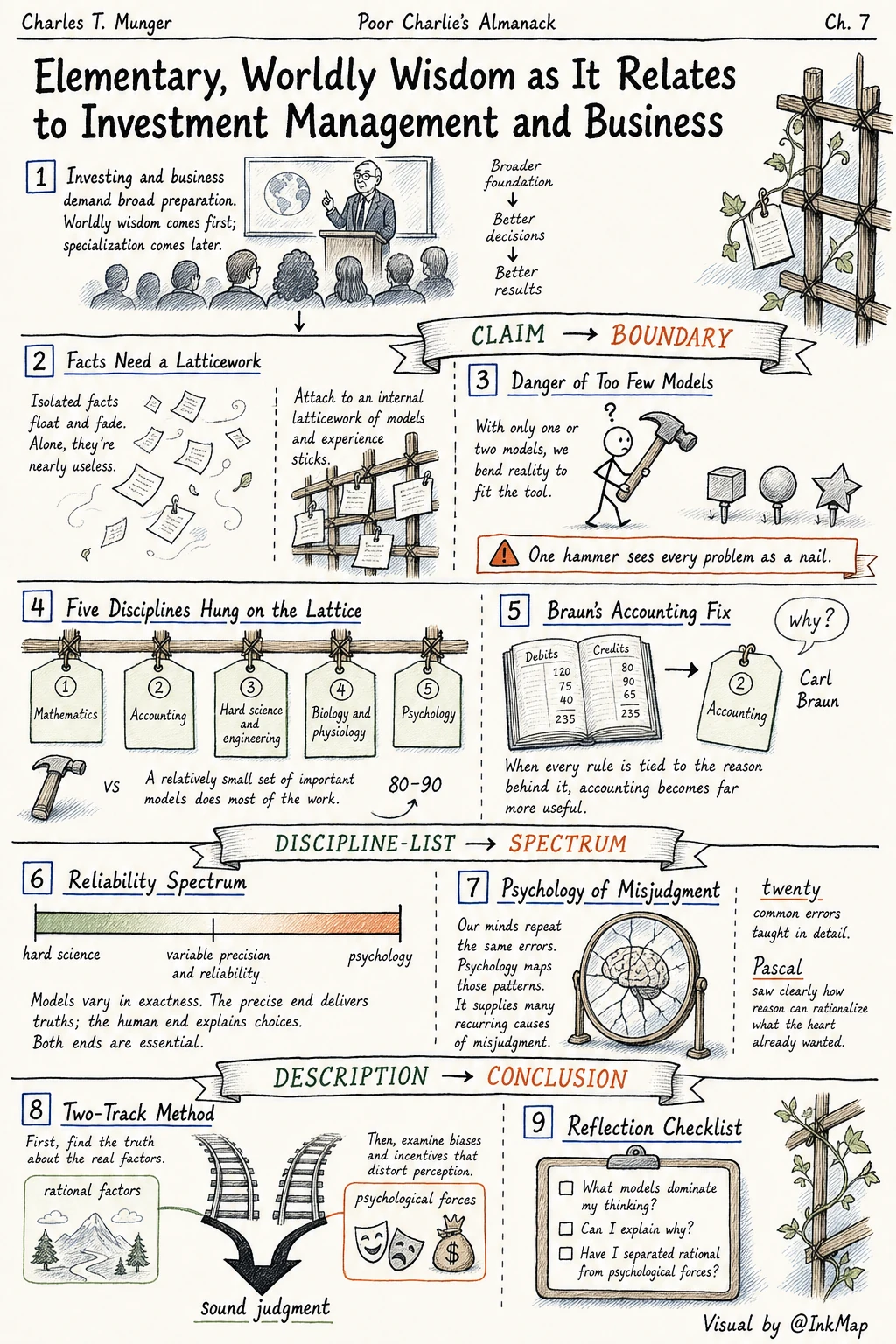
The man with a hammer sees every problem as a nail. We've all heard it, and it's become so familiar it almost sounds like a platitude. But Munger isn't really saying we lack tools. He's saying we can't bear to put the hammer down, because putting it down means admitting that the craft we spent ten years mastering might not fit the next problem.
His answer isn't to buy more hammers. It's to change the toolbox entirely: mathematics, accounting, engineering, biological psychology—eighty or ninety models, a handful of which do most of the work. It sounds like a plea for erudition, but it's really a plea for a more exhausting way of living. Every time a problem appears, don't rush to act. First ask: which models apply here? Will they conflict with each other?
The two-track analysis—rational interest-based reasoning alongside honest scrutiny of subconscious psychological forces—is the sharpest cut in the talk. We assume bad judgment comes from knowing too little. Munger says no: it comes from believing we already know enough. Even deeply learned people get manipulated, because manipulation happens where rationality hasn't had time to start.
 Open full image ↗
Draw It
In a continuous narrative, three layers blur together: models are the tools, two-track analysis is the method of using them, and "don't rely on one hammer" is the operating principle. Many readers only remember the principle, without realizing it needs concrete models to land, and without seeing that two-track analysis is the fuse that keeps models from being misused. The diagram separates these layers: models provide perspective, two-track analysis tests that perspective, and the principle reminds you to change perspective.
Rethink It
In design reviews, the person I dread is the "microservices expert" or the "Kubernetes fundamentalist." Whatever the business, they arrive with one standard architecture. Ask why, and they say it's best practice. That's a single model bending reality to fit itself. A mature engineer asks first: where is the bottleneck? How strong are the consistency requirements? What can the team actually operate? Then they pull from a broader toolbox. If all you have is a hammer, you won't even think to ask those questions.
Take It With You
The biggest cost of interdisciplinary learning isn't time. It's tolerating the feeling of being an amateur in a new field. Many people don't persist, not because they're lazy, but because they can't stand the gap between "I'm good at my own field" and "I know nothing here."