CHAPTER 06
Harvard School Commencement Speech
Read It
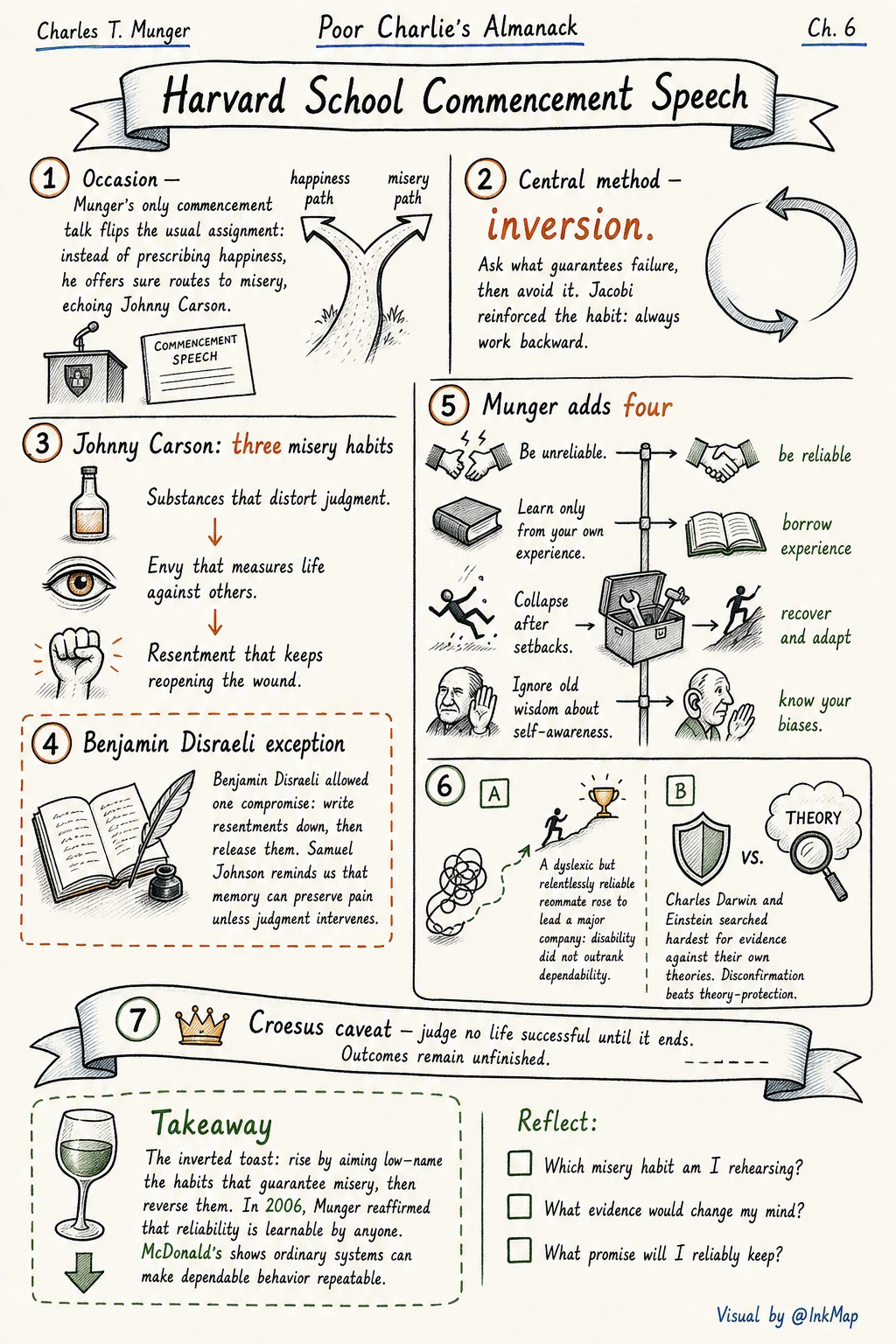
Munger's only commencement address, given at his son's graduation, appears to teach students how to avoid misery. The real question underneath is sharper: why do smart people make a mess of their lives? His answer is not "they didn't try hard enough" but "they never studied failure seriously." Listing seven prescriptions for guaranteed misery turns a vague fear into a concrete checklist. Once specific, each item can be checked and avoided. This is the same logic an engineer uses when debugging: list all the conditions that could cause a crash, then eliminate them one by one, rather than guessing where the fault lies. The chapter builds on Johnny Carson's earlier version of the trick and the mathematician Jacobi's habit of inversion. The positive lesson is inferred by reversal: reliability, learning from others' experience, resilience, and self-aware caution matter because their absence leads directly to pain. The talk closes by noting that basic dependability—the kind McDonald's instills in first-time workers—is a lesson elite institutions often overlook.
 Open full image ↗
Draw It
"Inversion" and "negative checklist" are often treated as the same thing. Many people think inversion just means "think backwards." But Munger does something more specific: he breaks the reversed result into actionable items. The diagram makes the hierarchy explicit: the seven prescriptions are not seven parallel pieces of advice; they are seven counterexamples that together point to one judgment—reliability, borrowed experience, resilience, and risk avoidance matter because their absence causes misery. Prose tends to read this as "Munger gave seven life tips."
Rethink It
In system design, the easiest mistake is to start drawing the architecture diagram. A more stable approach is to first list the conditions under which the system will fail: traffic spikes, single points of failure, data inconsistency, dependency timeouts. Writing down the failure conditions before designing the architecture makes the direction much clearer. The same applies to onboarding new engineers: instead of telling them to "write good code," show them a few real incident reports so they learn what kind of code causes production problems.
Take It With You
Knowing what will fail is closer to wisdom than knowing what will succeed.