CHAPTER 14
Talk Nine: Academic Economics — Strengths and Faults
Read It
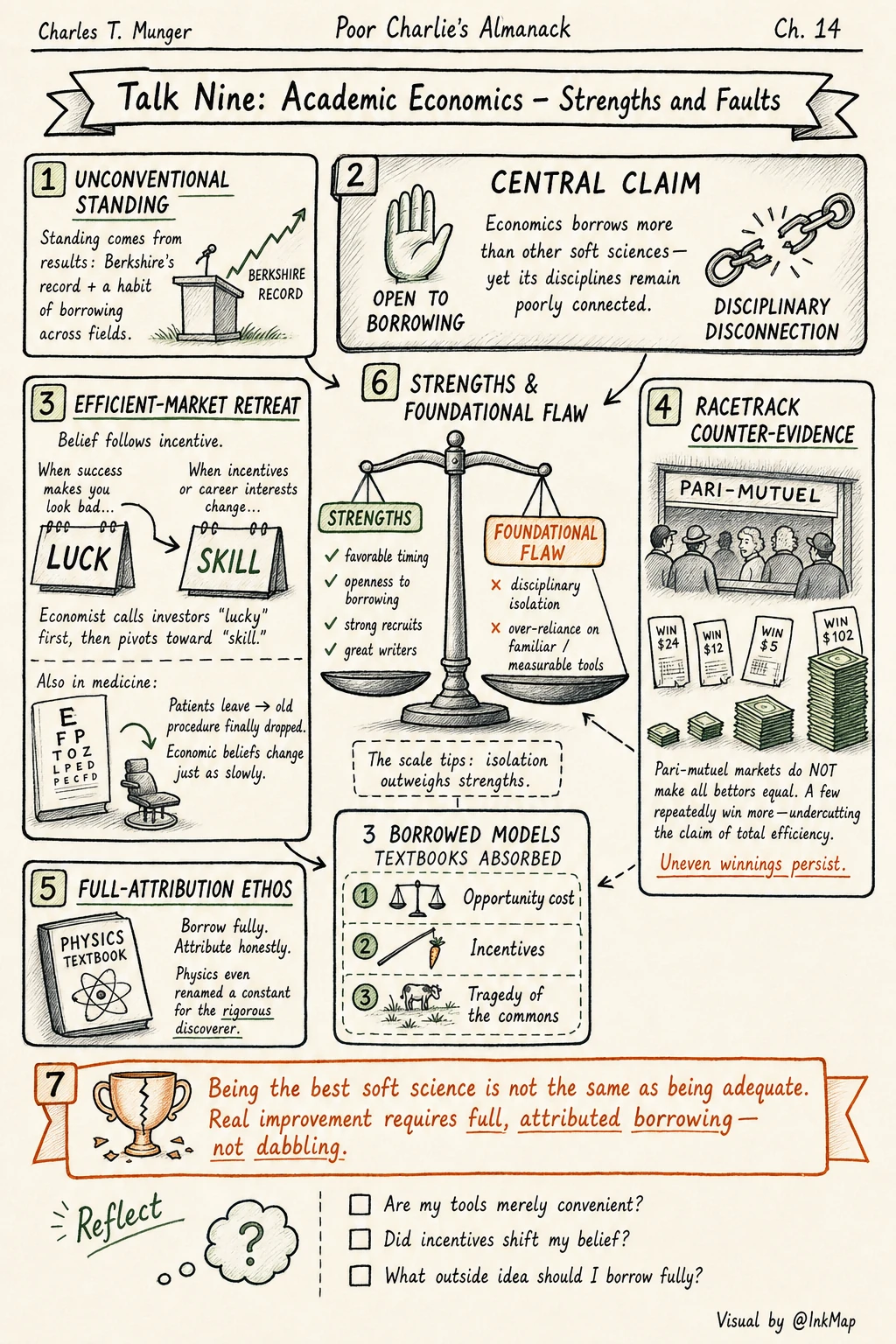
The easy reading of this lecture is "economists only have a hammer." But Munger actually says something more interesting: economics is the soft science most willing to borrow tools from other fields, and it still isn't willing enough. He credits the field for absorbing opportunity cost, incentives, and the tragedy of the commons. He also points out that being the best of the soft sciences is not the same as being good enough.
The efficient-market story is the sharpest example. A theorist dismissed Berkshire Hathaway's record as luck. When the outperformance continued, he reversed his position—not because new evidence arrived, but because the old explanation became professionally untenable. That's incentives, not science. Munger had seen the same flaw years earlier at a racetrack, where pari-mutuel betting already showed that outcomes aren't uniformly efficient. The physics training he got during the war taught him to borrow the most fundamental explanation from any field and credit it explicitly. Soft sciences rarely practice that discipline.
 Open full image ↗
Draw It
This chapter tempts you to draw two columns: strengths on one side, faults on the other. But that misses the point. The strengths and faults are the same thing seen from different angles. Economics borrows tools, which makes it better than its peers. But it only borrows certain tools, which keeps it trapped in the same hammer-and-nail pattern. A two-column diagram would imply balance. The real structure is a boundary: the field's openness has a limit, and the limit is where the problems start.
Rethink It
Technical teams have their own version of this. A group might be excellent at borrowing from distributed systems papers but completely uninterested in organizational behavior or cognitive psychology. So every problem gets translated into consistency and availability. Even "why won't anyone take ownership of this project" becomes a resource scheduling issue. Munger's question is simpler and harder: what discipline does this problem most fundamentally belong to? Answer that first, then pick the tool.
Take It With You
The test of an analytical framework isn't how many disciplines it borrows from. It's whether it's willing to attribute a problem to the most fundamental discipline, even when that discipline isn't the one you're comfortable with.