CHAPTER 08
Talk Two: A Lesson on Elementary, Worldly Wisdom (I)
Read It
The most easily missed consequence of building a lattice of mental models is this: the earlier you build it, the sooner you realize how narrow your own specialty is. It's not the joy of sudden insight. It's a persistent, low-grade vertigo, because you start seeing several disciplines standing behind every decision while your colleagues explain everything in the vocabulary of one.
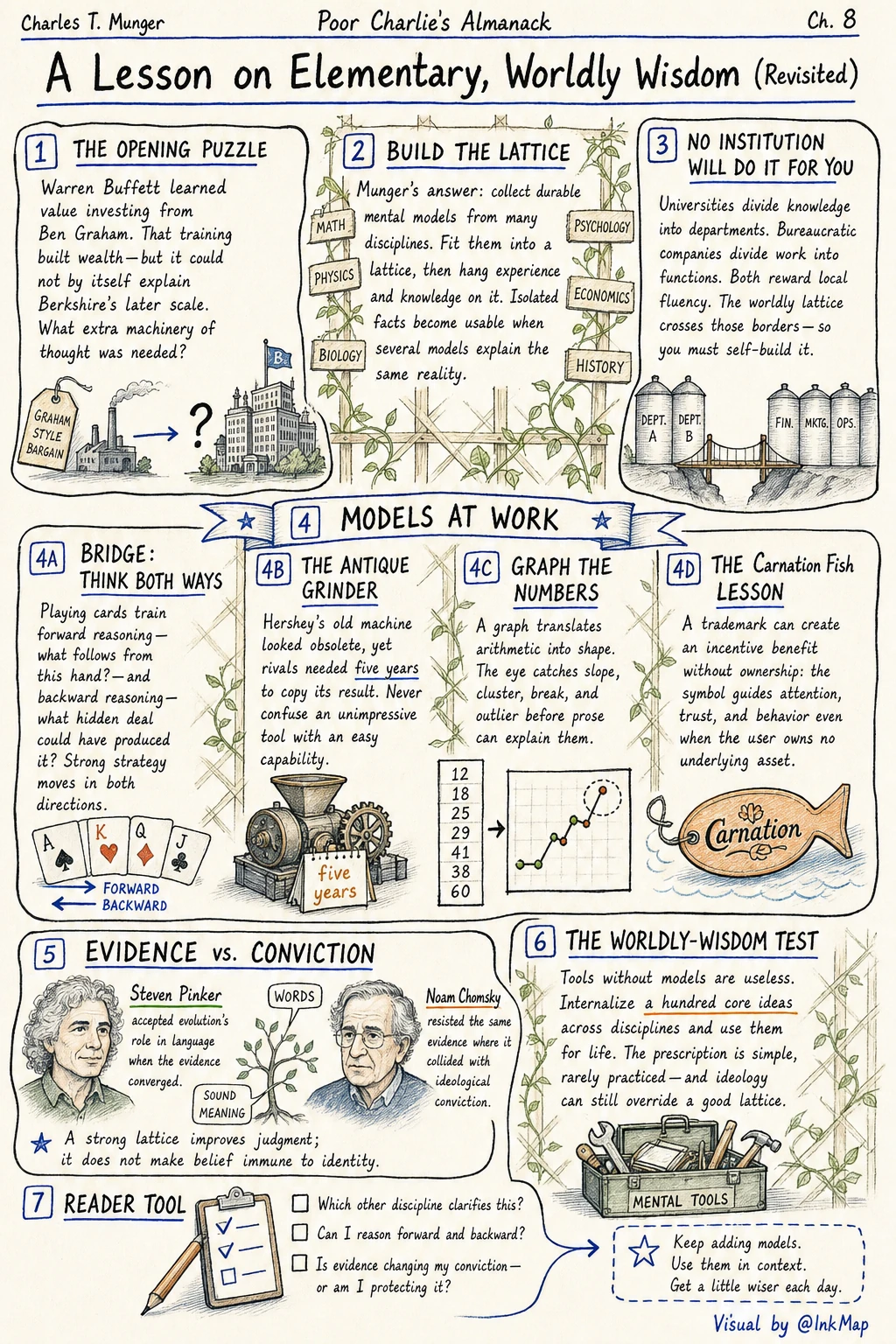
The bridge example is concrete. Reasoning forward toward the goal and reasoning backward to spot risks sound like two tasks, but they're two faces of one. People who only reason forward lose the whole game at the most comfortable moment; people who only reason backward never dare to bid. Graphs work the same way—they translate numerical reasoning, which our brains handle poorly, into spatial intuition, which we're born with.
But the Chomsky example is what unsettles me most. A first-rate intellect, once captured by ideology, still hesitates on questions that should be clear. That means the lattice is not a talisman. Positional bias can bypass every model and rewrite your inputs before you notice.
 Open full image ↗
Draw It
The lattice, bridge technique, graphs, and positional bias look like four parallel ideas in this chapter, but they form a causal chain. The lattice is the goal; the bridge technique is the method; graphs are the aid; positional bias is the biggest threat. Without a diagram, they're easy to memorize as four separate "knowledge points," and you miss what Munger is actually saying: wisdom isn't collecting models, it's making them check each other while staying alert to the one variable that can bypass them all.
Rethink It
A common technical failure: the architecture diagram is beautiful, the forward reasoning is flawless, but after launch an edge case appears that nobody considered. That's forward reasoning without backward checking. More insidious is positional bias—your team has used microservices for three years, and when someone proposes a monolith, you won't even evaluate it seriously, because that would mean questioning the team's last three years of choices.
Take It With You
The biggest enemy of interdisciplinary thinking isn't disciplinary boundaries. It's your attachment to your professional identity. Admitting another field has value means admitting part of your past effort was inefficient.