CHAPTER 33
Reversals
Read It
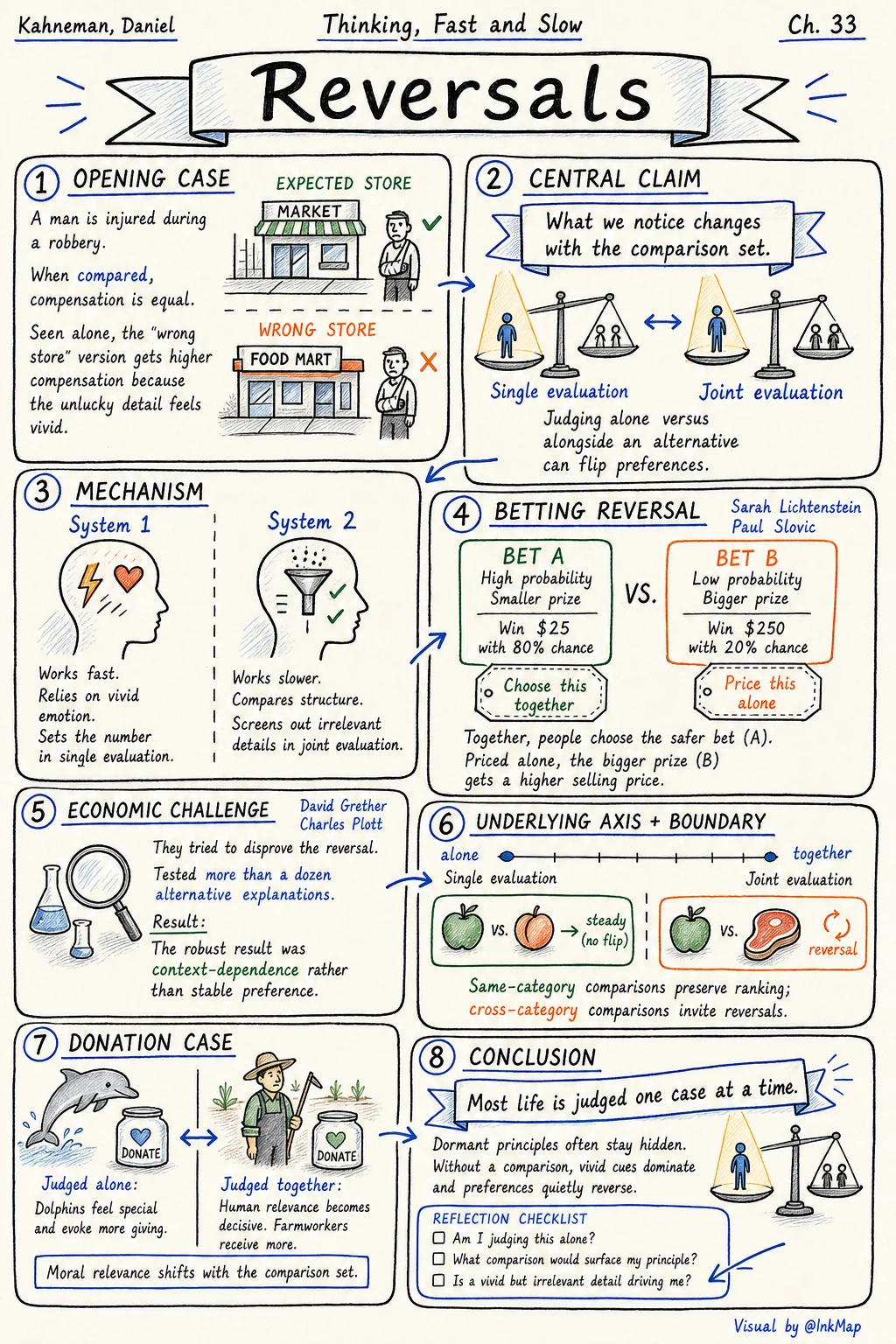
When we evaluate something in isolation, we think we're making a moral judgment, but we're really just responding to the emotion stirred by a specific scene. In the compensation case, people give a higher payout because of the detail "he often went to that store," without realizing that if it were a different store, their answer would change completely. Joint evaluation puts two cases side by side and forces out the key variable that emotion had buried: whether the victim is a person or an animal. Kahneman's real point isn't that we're irrational, but that our judgments only stay coherent within the same reference category; once we step outside it, we lose the stable anchor. In reality, most decisions are made alone, with no control group to remind us, so the contradictions stay invisible for a long time.
 Open full image ↗
Draw It
The thing most often treated as the same in the prose is "the content of a judgment" and "the way a judgment gets triggered." In single evaluation, emotion hands over the answer directly; in joint evaluation, the comparison process gets activated. If I only listed the points, readers would think these are two parallel biases. After visual sorting, single and joint aren't two options but two paths the same person walks in different situations: one jumps straight from System 1 to a number, the other has to pass through a "find the difference" waystation. The compensation, betting, and donation cases are all instances of the same structure, not three independent findings.
Rethink It
In design reviews, we often say "this design won't work" or "this change is too risky" based on first reaction, but rarely ask: if a comparison option were placed next to it, would my judgment change? Evaluating a migration plan in isolation might make the downtime seem too long; but once the long-term maintenance cost of not migrating is laid side by side, the conclusion often reverses. Kahneman's reminder isn't to use joint evaluation more, but to know that in single evaluation we're actually answering a narrower question while believing we're answering the global one.
Take It With You
Preference reversal isn't an exception; it's the default product of single evaluation. So important decisions can't rely on intuition alone—we have to actively create joint comparison, even if it's just writing two options on the same piece of paper.