CHAPTER 34
Frames and Reality
Read It
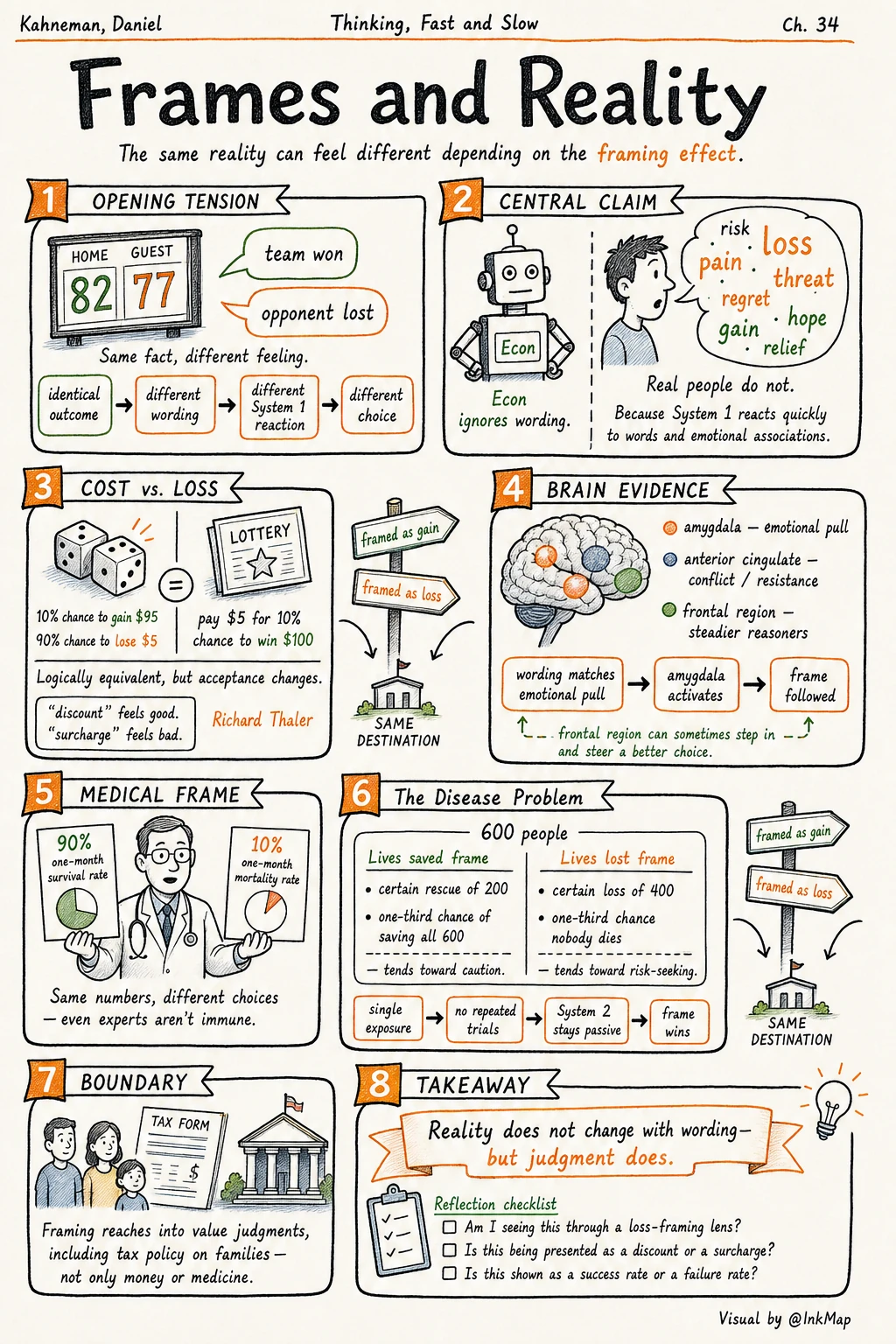
The framing effect is most easily misunderstood as "using different wording to trick people." But Kahneman's argument is harsher: it's not that we occasionally get led astray by phrasing, but that preferences themselves are attached to phrasing—there is no "true preference" independent of expression. When a doctor says "90% survival rate one month after surgery" versus "10% mortality rate," patients react completely differently, and doctors themselves can't escape it. In the Asian disease problem, the same option gets rejected under a "lives saved" frame and accepted under a "deaths" frame, not because participants don't understand probability, but because the word "loss" directly triggers System 1's risk-aversion impulse. Resisting a frame requires extra cognitive effort, and most people default to the easier path.
 Open full image ↗
Draw It
The core of this chapter is the contrast relationships: gain frame versus loss frame, emotional response versus cognitive control, linguistic wording versus institutional defaults. Reading only the prose, it's easy to treat the framing effect as an isolated linguistic phenomenon. Following the structure in the map, you can see that "cost" and "loss" are logically equivalent but diverge on the emotional channel; "survival rate" and "mortality rate" are just two labels for the same fact, yet they push people toward opposite choices. More importantly, this divergence doesn't only happen in individual judgments—it seeps into the institutional design of tax credits versus surcharges. Neutrality itself is also a frame.
Rethink It
When writing technical proposals, we often say "rollback cost" instead of "migration risk," or "data loss probability" instead of "data retention rate." In a review meeting, the same number with different wording can produce completely different levels of support. This isn't about learning to manipulate phrasing; it's about realizing that when someone opposes a proposal, they may not be opposing the proposal itself, but the emotional label activated by how it was described. So agreeing on the frame before the discussion matters more than arguing about the data.
Take It With You
A frame isn't a filter you can remove; it's a component of judgment. So instead of chasing "neutral wording," it's better to explicitly tell people: this is the frame you're seeing now, and here's what the other frame looks like.