CHAPTER 32
Keeping Score
Read It
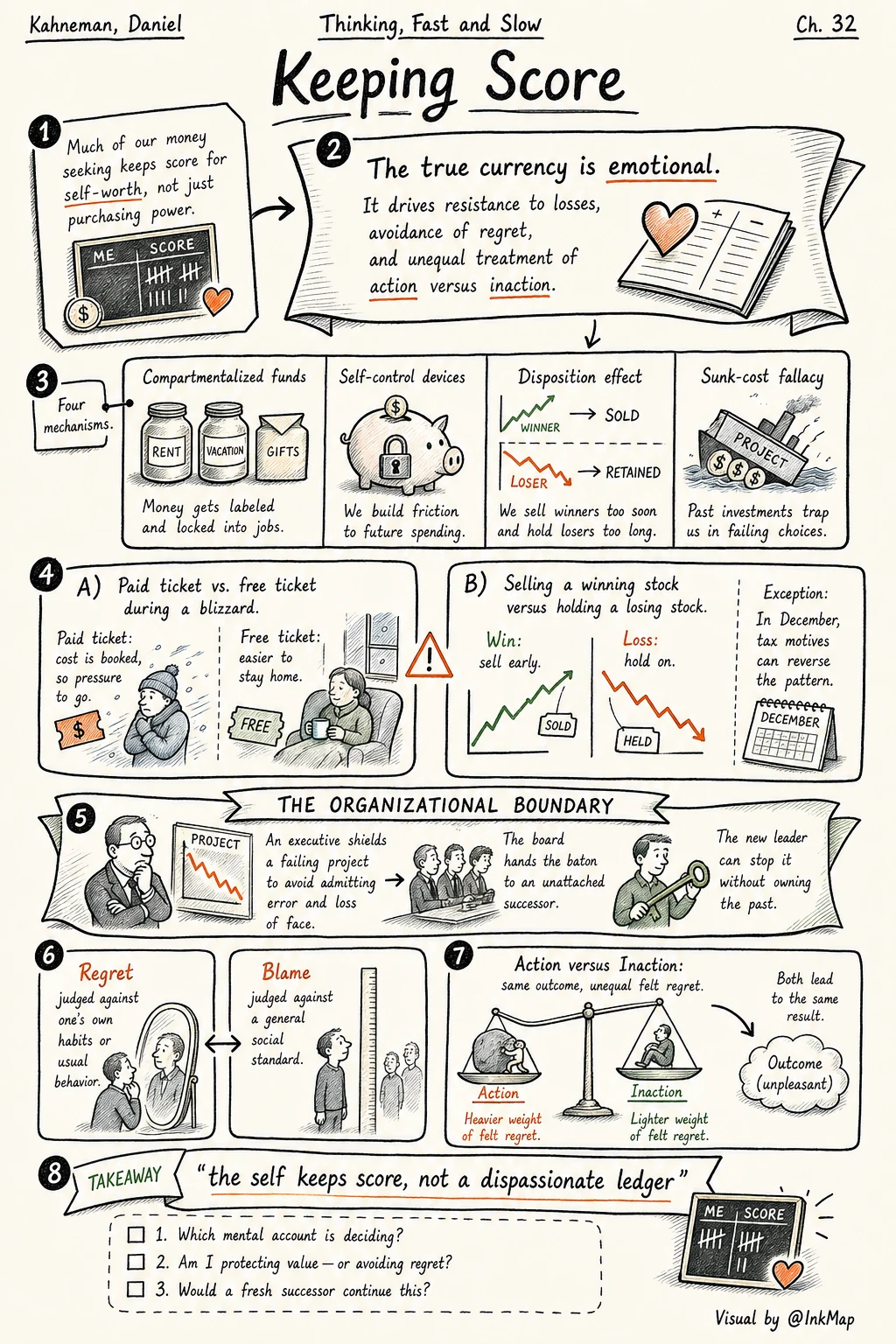
Everyone keeps an internal ledger, and it doesn't record money—it records self-worth. This ledger makes people refuse to sell at a loss because selling means admitting they were wrong; it makes an active mistake hurt more than an equivalent passive miss because "doing" attracts more blame than "not doing." Kahneman contrasts this mental accounting with the rational economic agent: the latter only looks at future outcomes, while the former clings to the historical record. The sunk-cost fallacy, the disposition effect, and the asymmetry between regret and blame all come from the same source—we aren't optimizing wealth, we're maintaining a narrative about ourselves. That narrative demands every account be closed with dignity, even if the price is throwing more money into the pit.
 Open full image ↗
Draw It
The two evaluation standards most often compressed into one problem in this chapter are regret and blame. Regret is measured against one's own habitual behavior; blame is measured against general norms. In prose they get mentioned side by side, but drawing them shows they drive different behaviors. Regret makes people avoid active moves because an active failure hurts more than a passive miss; blame makes people shift responsibility in teams because "not acting" looks safer than "doing wrong." If I only drew "mental accounting causes irrationality," I'd miss this asymmetry—it explains why some mistakes get repeated and some opportunities get repeatedly missed. The value of visualizing is turning the "keeping score" metaphor into a visible structure: every transaction settles money and self-esteem simultaneously, and the latter is often the real decision variable.
Rethink It
It's most common in code refactoring. A module is so rotten nobody dares touch it, but the team refuses to rewrite because rewriting means admitting the original design was wrong; continuing to patch is painful but at least avoids the narrative of "we screwed up." More subtly, actively deleting an unused feature is much harder than never having built it, because deletion is an action that triggers regret and blame, while the original omission was just inaction. The keeping-score mindset makes technical debt repayment extraordinarily difficult: it's not that we don't know where the debt is, but that repaying it means recording a loss in the psychological ledger.
Take It With You
Mental accounting isn't a defect; it's a self-management tool. It helps us categorize, constrain, and maintain self-control, at the cost of letting the historical record over-influence future decisions. The boundary of this judgment: when consequences are reversible, information is sufficient, and emotions are calm, we should force ourselves to ignore sunk costs; but when decisions involve identity, social evaluation, or long-term commitment, the stability mental accounting provides may be worth more than pure rational calculation. The real question isn't "should I keep accounts?" but "what should this ledger record, and when should I tear it up?"