CHAPTER 31
Risk Policies
Read It
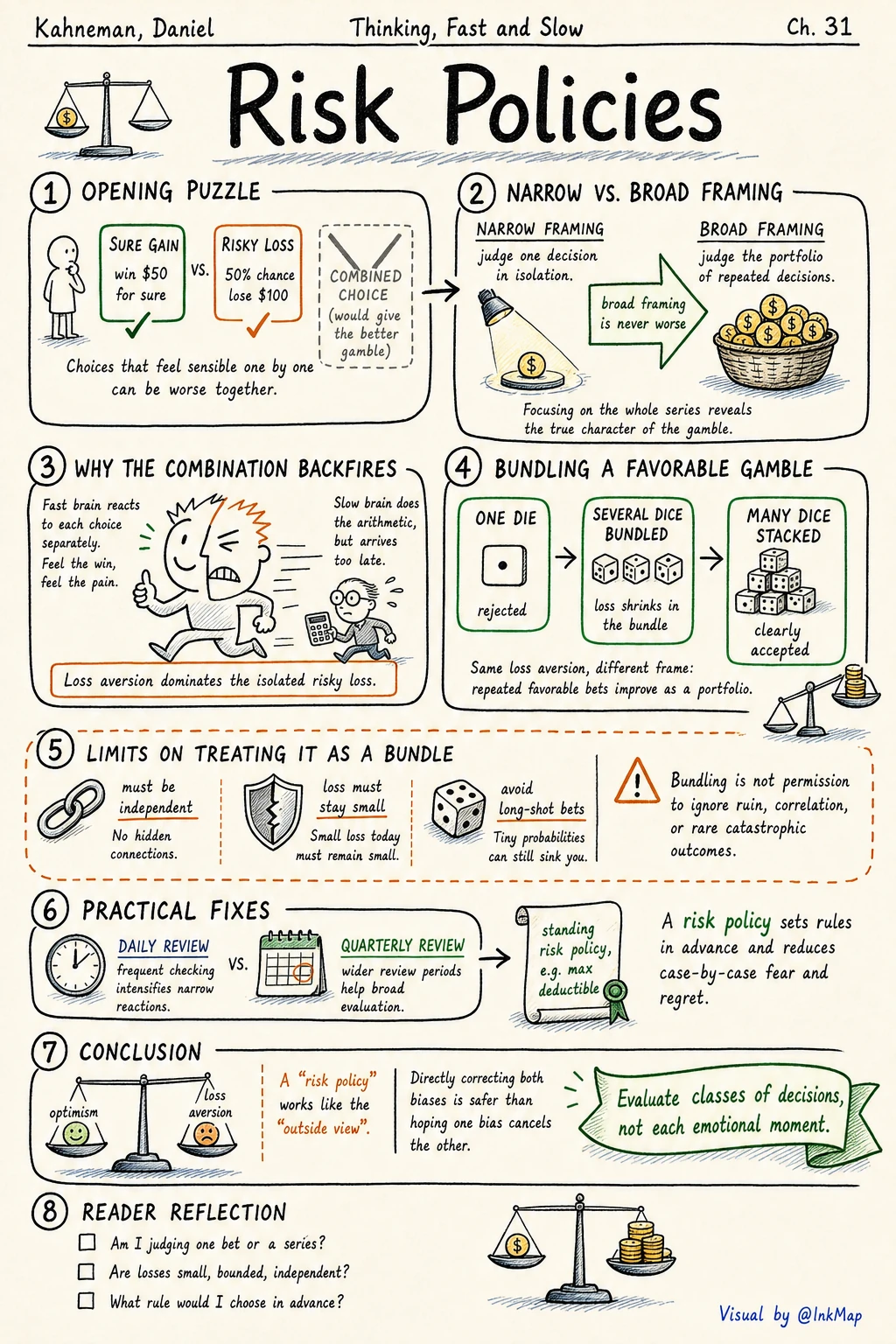
Decisions that look reasonable one at a time can add up to a losing deal. Kahneman's paired-gamble experiments expose a hidden trap: when people evaluate each risk separately, they instinctively prefer a certain small gain and avoid a certain small loss, but stacking those choices together produces a combination that is mathematically worse than the option they almost never pick. Narrow framing turns every decision into a miniature emotional trial, while broad framing bundles multiple decisions so extreme outcomes cancel each other out and the whole becomes better. This doesn't mean we should become cold expected-value calculators; it means that if we re-weigh every time in the moment, loss aversion will repeatedly beat rationality. A standing risk policy—like always choosing a high deductible—institutionalizes broad framing so the future self doesn't have to wrestle with emotion again.
 Open full image ↗
Draw It
The core structure is "how narrow framing leads step by step to systematic loss," but the prose can compress that causal chain into a single conclusion. I drew it to unpack the chain: isolated evaluation → preference for certain gains / avoidance of certain losses → each choice looks reasonable → combined outcome deteriorates → a preset policy is needed to cut the chain. If I only drew "narrow framing bad, broad framing good," I'd lose the key mechanism in the middle—loss aversion's intensity doesn't change in a single decision, but bundling makes extreme outcomes cancel out, which is what raises overall attractiveness. The visual shows that broad framing doesn't change psychology; it changes how often psychology gets triggered.
Rethink It
Narrow framing is almost everywhere in technical team architecture decisions. Each service independently chooses the "safest" option, and the whole system becomes overly conservative: every component adds retries and timeouts, but cascading them amplifies avalanche risk; every team rejects cross-team dependencies to protect its own SLA, and global delivery speed gets dragged down. The counterpart to a risk policy here is an architecture principle: agree in advance under what conditions we sacrifice local certainty for global resilience, rather than re-arguing every time a concrete problem appears. Without such a preset, every review meeting becomes a battlefield for loss aversion.
Take It With You
Broad framing isn't a cure-all. Kahneman himself draws the boundary: bundling only works when risks are independent, losses don't threaten overall safety, and it's not a small-probability large-payout situation. Remove those conditions and broad framing can mask genuine tail risk. So the value of a risk policy isn't that it's always right, but that it pulls the decision out of the emotional present and places it at a calmer moment. The real question isn't "should I take this risk now?" but "have I already set a rule for this kind of risk?"