CHAPTER 30
Rare Events
Read It
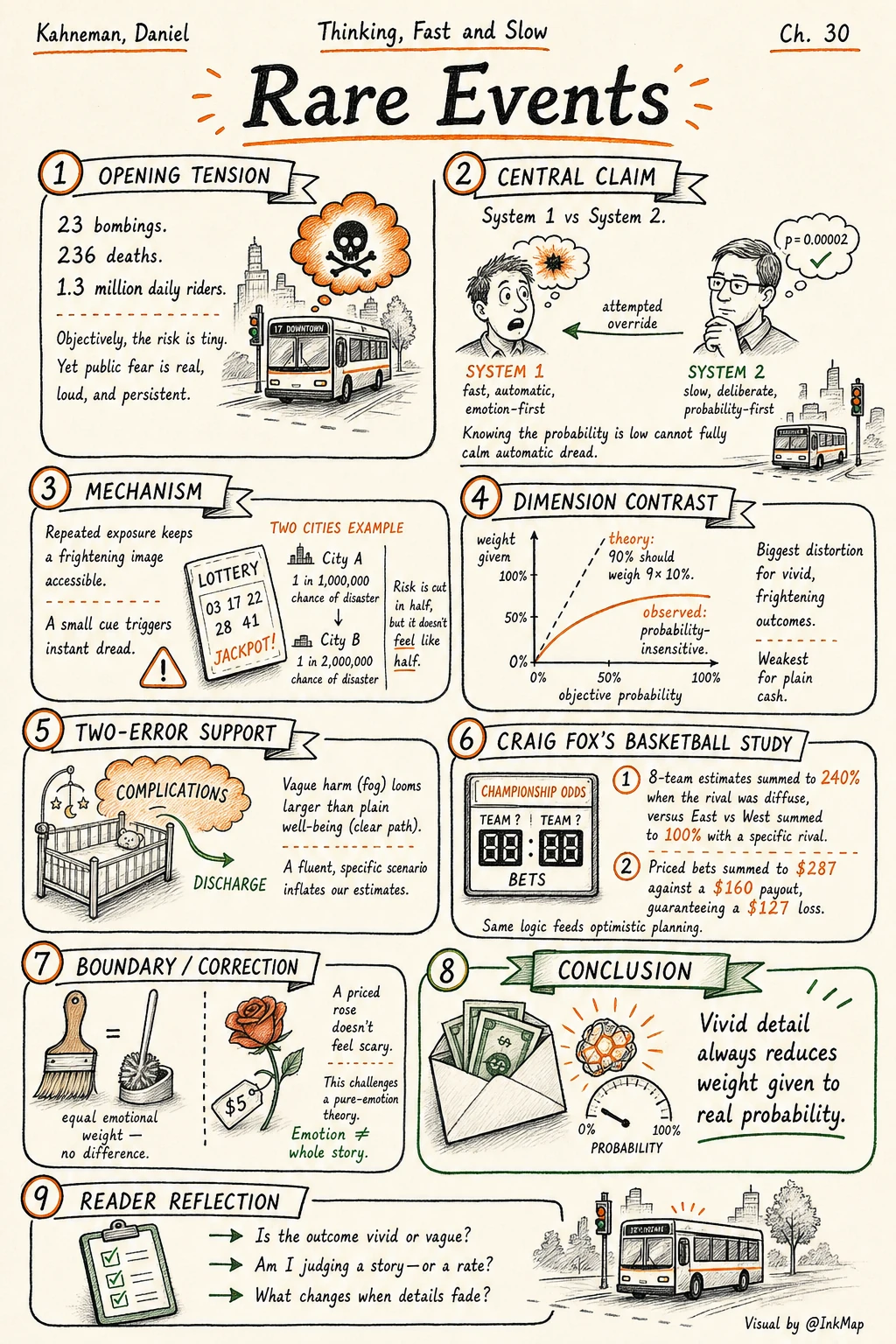
People don't fear probability; they fear pictures. A bomb exploding on a bus changes travel choices more than annual traffic statistics, even though the latter kills far more people. Kahneman uses his own experience in Israel to show that rare events get overweighted because once they can be imagined concretely, they acquire disproportionate weight in the mind. Conversely, outcomes that resist clear imagining—like the dozens of ways a startup can fail—get systematically underweighted. This isn't emotion beating reason so much as the cognitive system refusing to give probability an accurate interface: it only responds to what is vivid, specific, and easy to bring to mind. The psychological power of terrorism, the appeal of lottery tickets, and the entrepreneur's blind optimism all come from the same mechanism: availability sets the weight, not statistical frequency.
 Open full image ↗
Draw It
Two relationships get tangled in the prose: the decoupling between probability and emotional response, and the coupling between imaginability and decision weight. If I only drew "rare events are overestimated," I'd miss the more important flip side—equally rare events that can't be imagined get underestimated. Fox's NBA experiment pins this down: when each team is the focus, probability estimates sum to 240%, but nobody feels the contradiction because each focus carries its own picture. I wanted the map to show both directions at once: overestimation and underestimation aren't two different biases, but the natural outputs of one mechanism at the "imaginable" and "unimaginable" ends.
Rethink It
In technical design reviews, a past severe incident gets cited repeatedly even if the conditions that caused it no longer exist, while a new risk that has never materialized but has a higher probability gets dismissed because nobody has seen what it looks like. A database outage that took down the whole site makes the team overly cautious about every future database change, yet they might ignore a cache consistency problem that accumulates daily but has never exploded. This chapter reminds me to ask, when discussing risk: "Are we evaluating probability, or evaluating vividness?" If it's the latter, we need to bring in a statistical baseline, otherwise the decision gets led by whoever tells the best story.
Take It With You
Availability isn't a flaw; it's the default setting. It lets us react quickly when information is scarce, at the cost of systematically distorting the weight of rare events. The boundary of this judgment: when a decision can wait, data is obtainable, and the stakes are high, we should force ourselves into probabilistic thinking; but when the decision must be immediate and the vividness itself is a useful survival signal, following availability isn't necessarily wrong. The question is never whether to trust intuition, but whether we know what's feeding it right now.