CHAPTER 29
The Fourfold Pattern
Read It
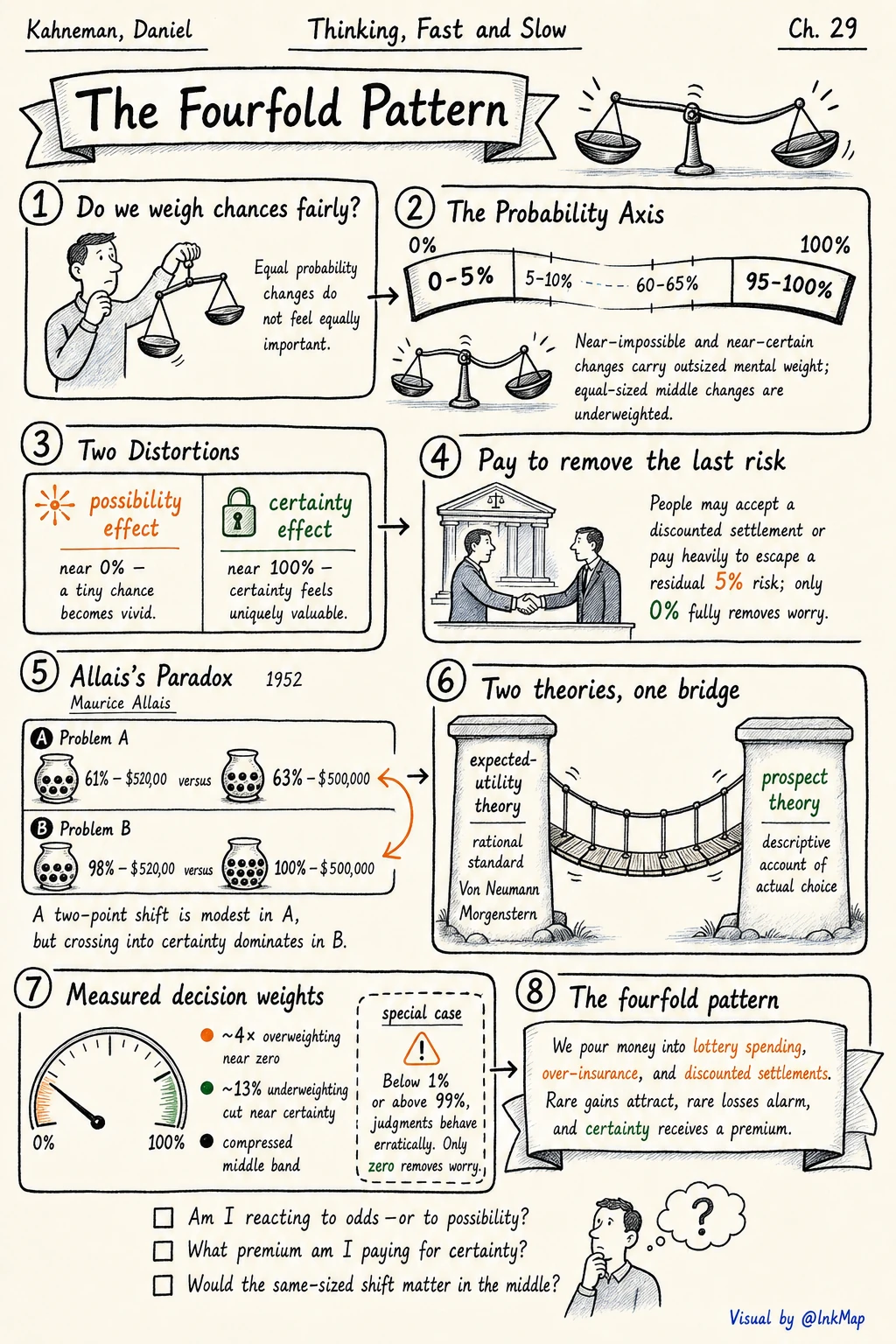
Probability isn't a uniform ruler. Going from 0% to 5% and from 50% to 55% are both five percentage points, but they feel completely different. The first is something appearing out of nothing; the second is just a bit more. At the other end, 95% to 100% is a cliff: almost certain and certain are different worlds. Kahneman splits this distortion into two effects—low probabilities get overweighted, high probabilities get underweighted—and then crosses them with gains and losses to produce four distinct, seemingly contradictory risk attitudes.
People buy lottery tickets and also over-insure against tiny risks. They accept a sure small gain over a larger expected value, and they gamble to avoid a sure loss. Each behavior looks irrational on its own. Placed in the fourfold pattern, they become different faces of the same underlying mechanism.
 Open full image ↗
Draw It
The hard part in prose is keeping two dimensions separate: probability level and outcome valence. If you just list four phenomena, they read like four independent pitfalls. But the real structure is a cross: the possibility effect and the certainty effect each produce opposite behaviors depending on whether the outcome is a gain or a loss. Drawing it as a quadrant shows that "low probability + gain" and "low probability + loss" both come from the possibility effect, yet one drives risk-seeking and the other risk-avoidance. The symmetry is invisible in linear text.
Rethink It
Product teams fall into this constantly. When assessing a feature's risk, they treat "might fail" and "almost certainly won't fail" as the same kind of probability event, leading to either over-engineering or total neglect. A one-in-a-million payment vulnerability gets escalated to top priority once a security researcher writes it up, while a daily minor bug gets ignored because everyone's used to it. The fourfold pattern is a reminder to ask which quadrant you're reasoning in: is the possibility effect amplifying fear, or is the certainty effect numbing vigilance?
Take It With You
The fourfold pattern isn't for predicting individual choices. It explains why groups systematically deviate from expected utility. Its boundary is clear: when stakes are high, probabilities are explicit, and people have time and motivation to calculate, the distortions weaken. But when decisions are intuitive, emotions are engaged, or probabilities are vague, the pattern takes over. So it's less a proof of human irrationality than a map of how much cognitive effort rationality actually requires.