CHAPTER 24
The Engine of Capitalism
Read It
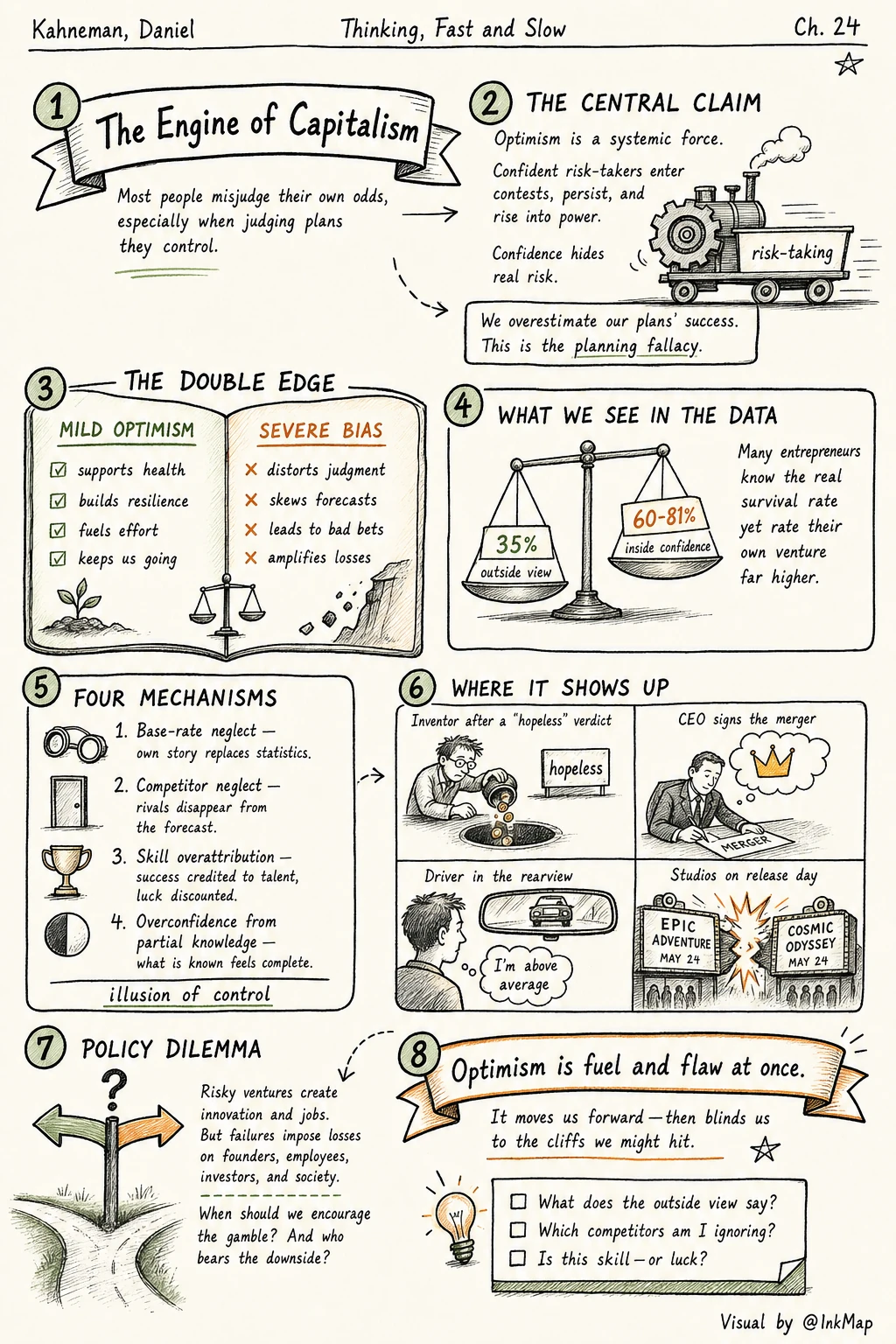
Optimism is the fuel that keeps the engine of capitalism running. Without it, few would start companies, push through setbacks, or bet years of their life on an idea that most people dismiss. But the same force that drives founders forward also blinds them to the base rates stacked against them. Most new ventures fail. Most entrepreneurs know this in the abstract, yet each one believes their own case is different.
Kahneman's real question isn't whether optimism is good or bad. It's under what conditions optimism tips from a productive force into a costly distortion. The answer, it turns out, has less to do with information than with how information is filtered. Entrepreneurs systematically ignore the outside view—the actual survival rates of similar ventures—and reason instead from the inside view of their own plan, their own team, their own vision. Even when presented with accurate negative evidence, they tend to double down rather than retreat.
The most insidious mechanism is competitor neglect. Founders focus on their product, their roadmap, their execution, while forgetting that rivals are doing exactly the same thing. Everyone believes they can win, but the market only has room for a few survivors. Executive overconfidence shows up in costly mergers and overpriced acquisitions, not because executives are reckless with other people's money, but because they genuinely believe they can beat the odds.
 Open full image ↗
Draw It
This chapter could easily collapse into a bland list of "optimism has upsides and downsides." What's worth mapping is the structure: how optimism simultaneously drives market entry and market failure, with competitor neglect as the bridge connecting the two. Once you see it as a system, optimism stops being a personality trait and becomes a mechanism. It ensures enough people enter the market to generate innovation, and it also ensures that most of them become part of the base rate they ignored.
Rethink It
When a team picks a new framework, they often evaluate only their own experience with it. They don't look at how similar teams in similar situations failed with the same choice. Everyone thinks they'll avoid the pitfalls others hit, and then they hit exactly those pitfalls. This isn't a competence problem. It's optimism bias showing up in technical decisions. Admitting that you're probably average—that your project will face the same failure modes as most others—is the first step toward making a better call.
Take It With You
Optimism is a tax that society pays for innovation. A few people create enormous value; many more absorb invisible costs. The question isn't whether to be optimistic, but where to place the boundary between useful confidence and willful blindness.