CHAPTER 25
Bernoulli's Errors
Read It
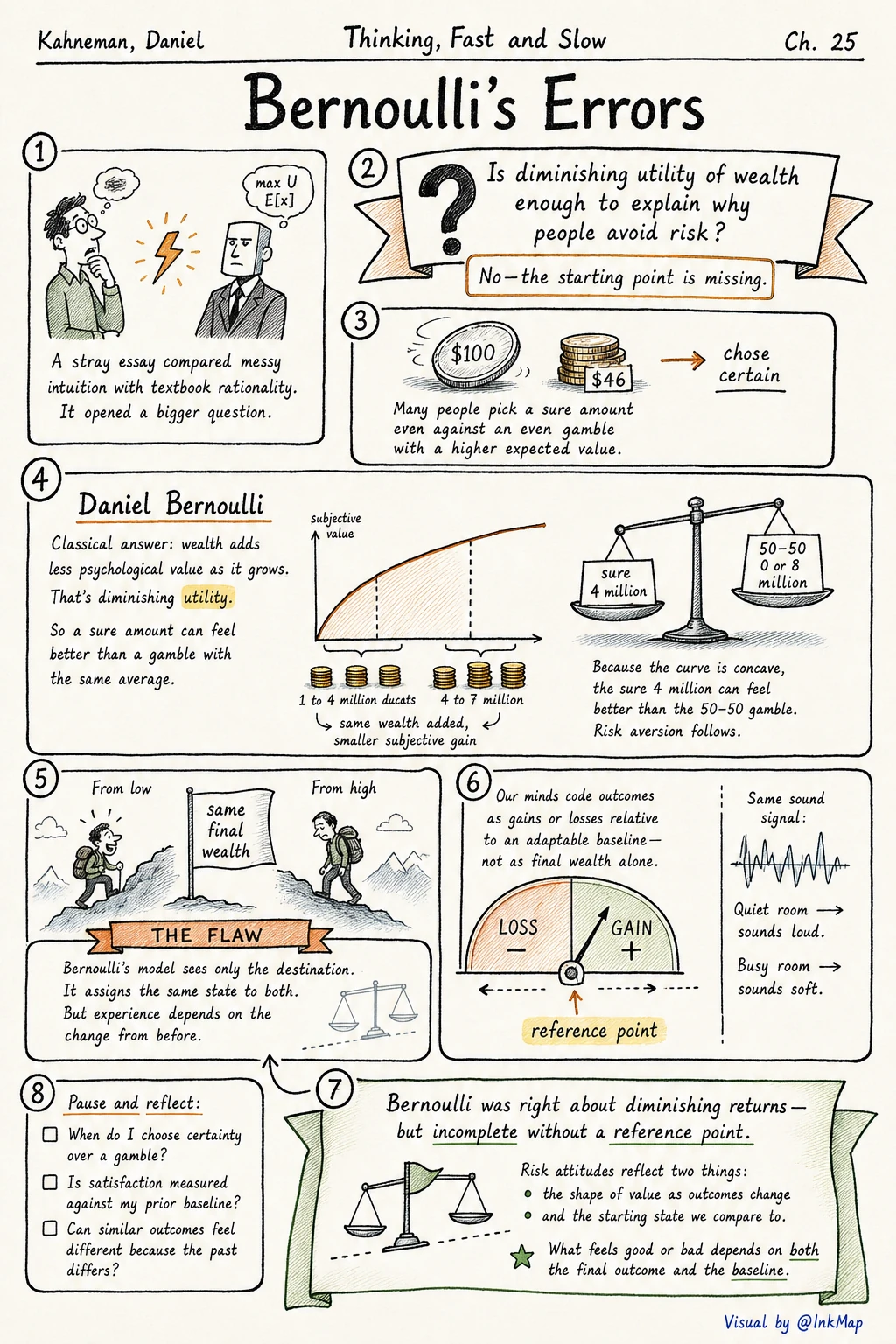
Bernoulli's error wasn't in his math. It was in treating satisfaction as a function of final wealth alone. A person with nine million dollars and a person who just rose from one million to nine million look identical on paper, but no one believes they feel the same. Utility theory explains risk aversion through diminishing marginal returns, which sounds elegant, but it misses something fundamental: people don't experience the world from zero. We always start from a position we already occupy, and we feel changes as gains or losses, not absolute levels as happiness.
The story of Jack and Jill makes this concrete. Same final wealth, different starting points, completely different psychological realities. The reference point isn't a detail. It's the foundation of the entire judgment.
 Open full image ↗
Draw It
In prose, it's easy to blur the distinction between wealth level and wealth change. Bernoulli only drew the first; prospect theory adds the second. Putting Jack and Jill on the same diagram isn't about comparing who has more money. It's about showing that when the x-axis is absolute wealth, they overlap; when the x-axis becomes change relative to their own starting point, they separate. Once that contrast is visible, Bernoulli's theory isn't refuted—it's demoted to a special case that only holds when everyone shares the same reference point.
Rethink It
In a design review, one person insists the metrics have hit target, while another says the change makes users feel worse. They're not arguing about the same thing. One is looking at absolute levels; the other is looking at relative change. If the team hasn't agreed on the reference point first, the discussion becomes two people talking past each other. Asking "Are we comparing against the last release, a competitor, or user expectations?" often surfaces the real disagreement faster than adding more data.
Take It With You
Before judging whether a decision was good, ask what the reference point was. Different reference points can make the same outcome both a success and a failure.