CHAPTER 23
The Outside View
Read It
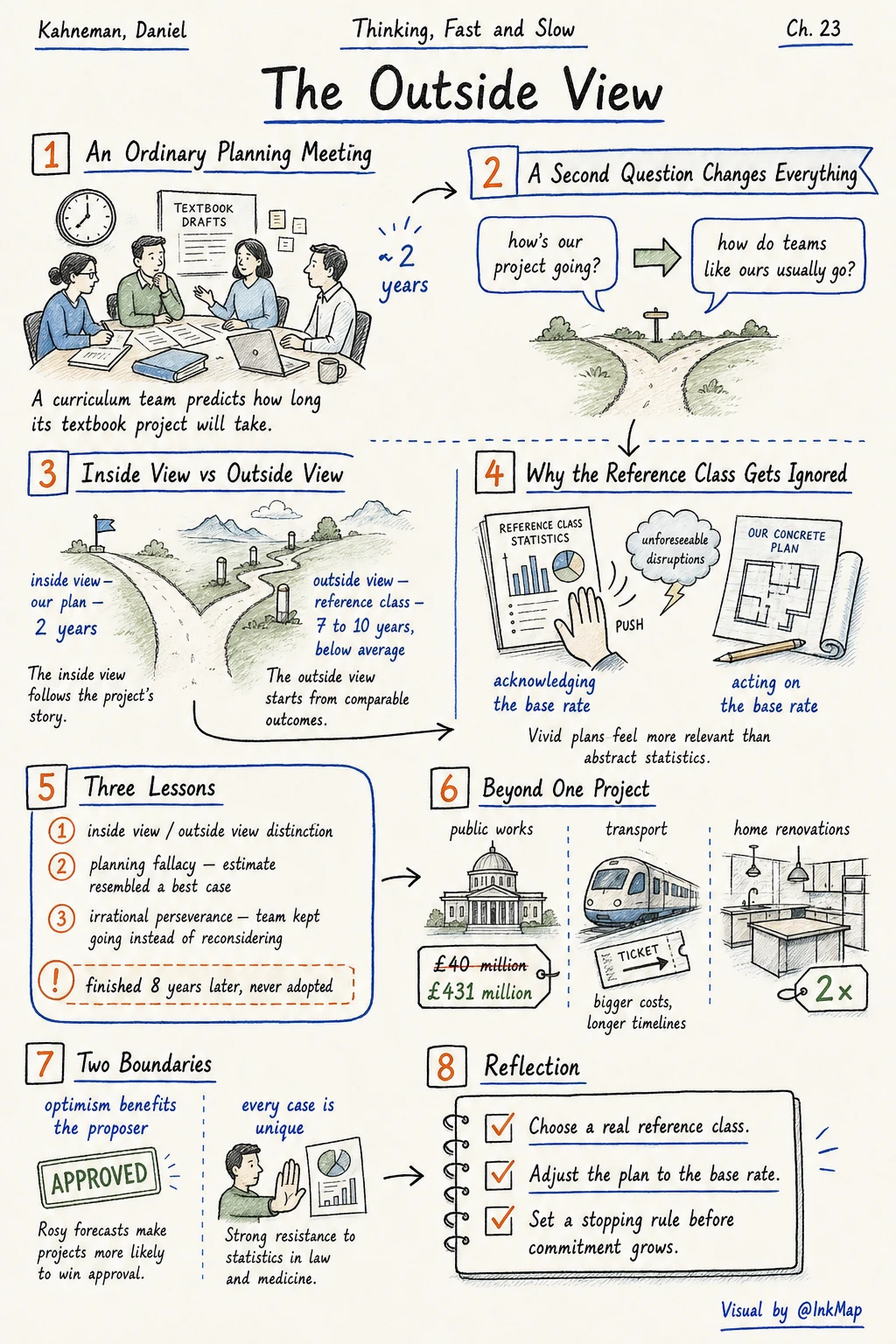
The same project, the same person, two different questions—and two completely different timeline predictions. That’s not a split personality; it’s a perspective switch.
The inside view starts from the case at hand: the team is in good shape, early progress is smooth, so the whole thing should be fine. The outside view asks first: how long do similar projects usually take? What’s the failure rate? Only then does it adjust with case-specific information.
In the curriculum project Kahneman joined, the team’s internal estimate was two years; the actual average for similar projects was seven. They knew the data and chose not to believe it applied to them. The planning fallacy isn’t ignorance—it’s the refusal to let statistics override the pull of a specific narrative.
Underestimating budgets is sometimes a cognitive bias, sometimes a strategic move. Contractors lowball to win approval; project sponsors hide true costs to get initiatives launched. These two cases need different responses, but the outside view helps with both.
 Open full image ↗
Draw It
This chapter is easily misread as “inside view bad, outside view good.” What’s actually worth mapping is how the two views support each other: the outside view provides the baseline, the inside view provides case-specific information. Without a baseline, case prediction is blind optimism; without case adjustment, baseline prediction is mechanical copying.
Once the relationship is drawn, the planning fallacy’s location becomes clear: it happens in the adjustment step from baseline to final forecast. People don’t fail to know the baseline; they refuse to let it constrain their optimism.
Rethink It
In technical design reviews, architects often evaluate only the proposal itself: module boundaries, technology choices, elegance. The more critical question is: how long have similar systems taken in the past, and what pitfalls did they hit?
If a team never does post-project reviews, there’s no comparable baseline data. Every new project starts from zero with fresh optimism, and the planning fallacy replicates itself generation after generation.
Take It With You
The value of the outside view isn’t precision. It’s that it forces you to admit your project isn’t as special as you think.