CHAPTER 22
Expert Intuition: When Can We Trust It?
Read It
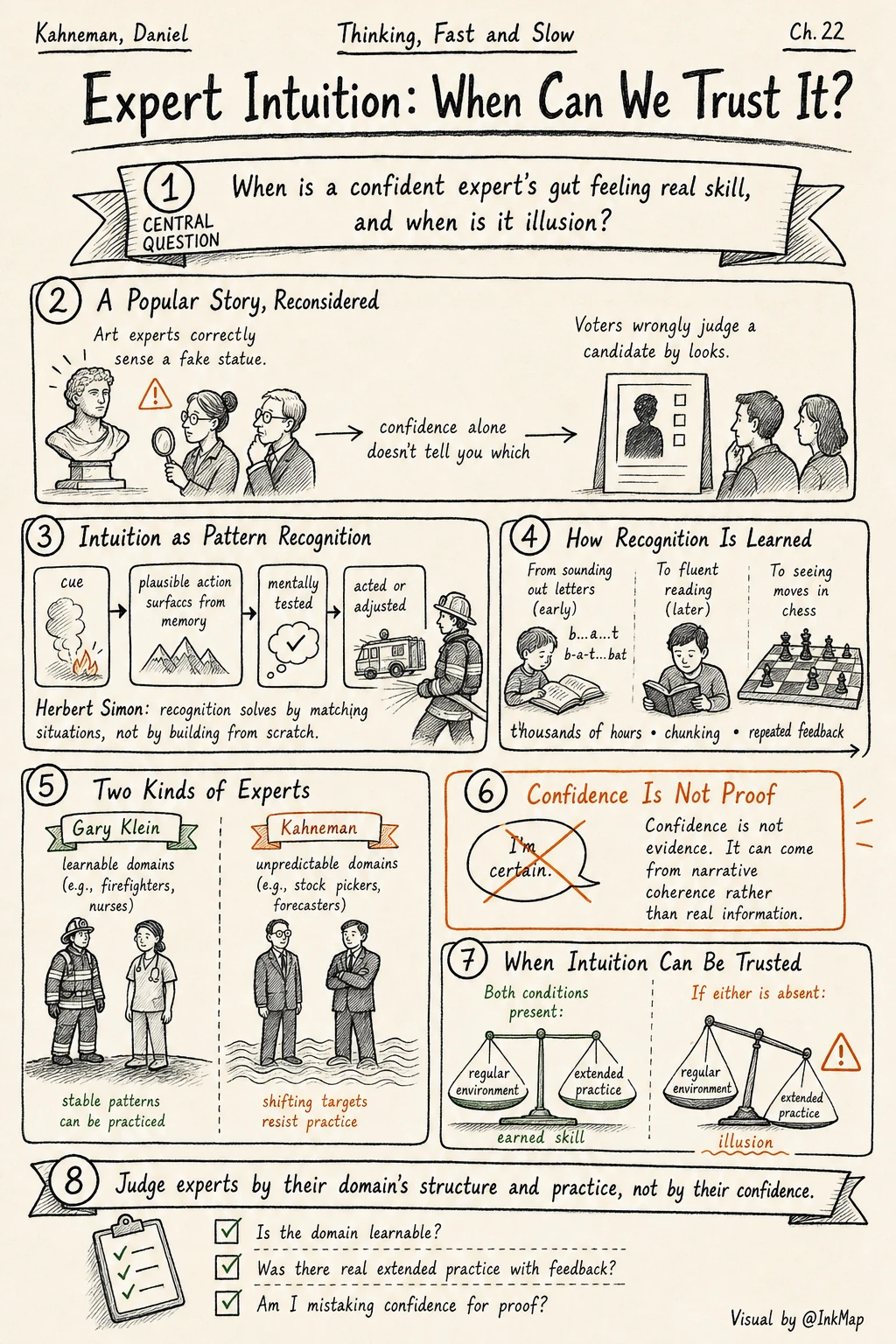
Intuition is most dangerous not when it’s wrong, but when it’s wrong and the person feels completely confident. Kahneman and Klein argued for years before realizing they were studying different kinds of intuition.
Klein watched firefighters, nurses, and pilots—people in regular environments with repeated practice and fast, clear feedback. Kahneman watched clinicians, political commentators, and stock analysts—people in low-validity environments with vague or missing feedback. The first group can trust intuition; the second cannot.
Intuition isn’t a gift. It’s pattern recognition compressed from long experience. System 1 quickly proposes an answer, and System 2 checks it through mental simulation. It’s no different in kind from recognizing an old friend. What determines reliability is whether the environment has learnable regularities and whether practice has been sufficient.
Subjective confidence is not evidence. Confidence comes from narrative fluency, not from awareness of missing information. The smoother the story, the more believable it feels—even when it omits key facts.
 Open full image ↗
Draw It
The core of this chapter is a causal chain: environmental regularity determines the quality of practice feedback; feedback quality determines the reliability of pattern recognition; reliability determines whether intuition deserves trust. In prose, these three layers are often compressed into “experienced people have better intuition,” turning a necessary condition into a sufficient one.
Once the layers are separated, confidence sits off to the side because it has no causal link to reliability. It’s just a byproduct of narrative fluency. Removing confidence from the causal chain is what makes the whole picture hold together.
Rethink It
An engineer who has worked in a codebase for five years usually has trustworthy intuition about system behavior—the environment is regular and every change gives direct feedback. But the same engineer moved into market forecasting would not have the same value in their gut feelings.
That’s not skill decay; it’s a changed environment. Many technical managers still rely on old intuition when making cross-domain decisions, and that’s exactly when it’s most dangerous.
Take It With You
The precondition for trusting intuition isn’t how confident the judge feels, but whether the environment allows continuous correction through feedback.