CHAPTER 21
Intuitions vs. Formulas
Read It
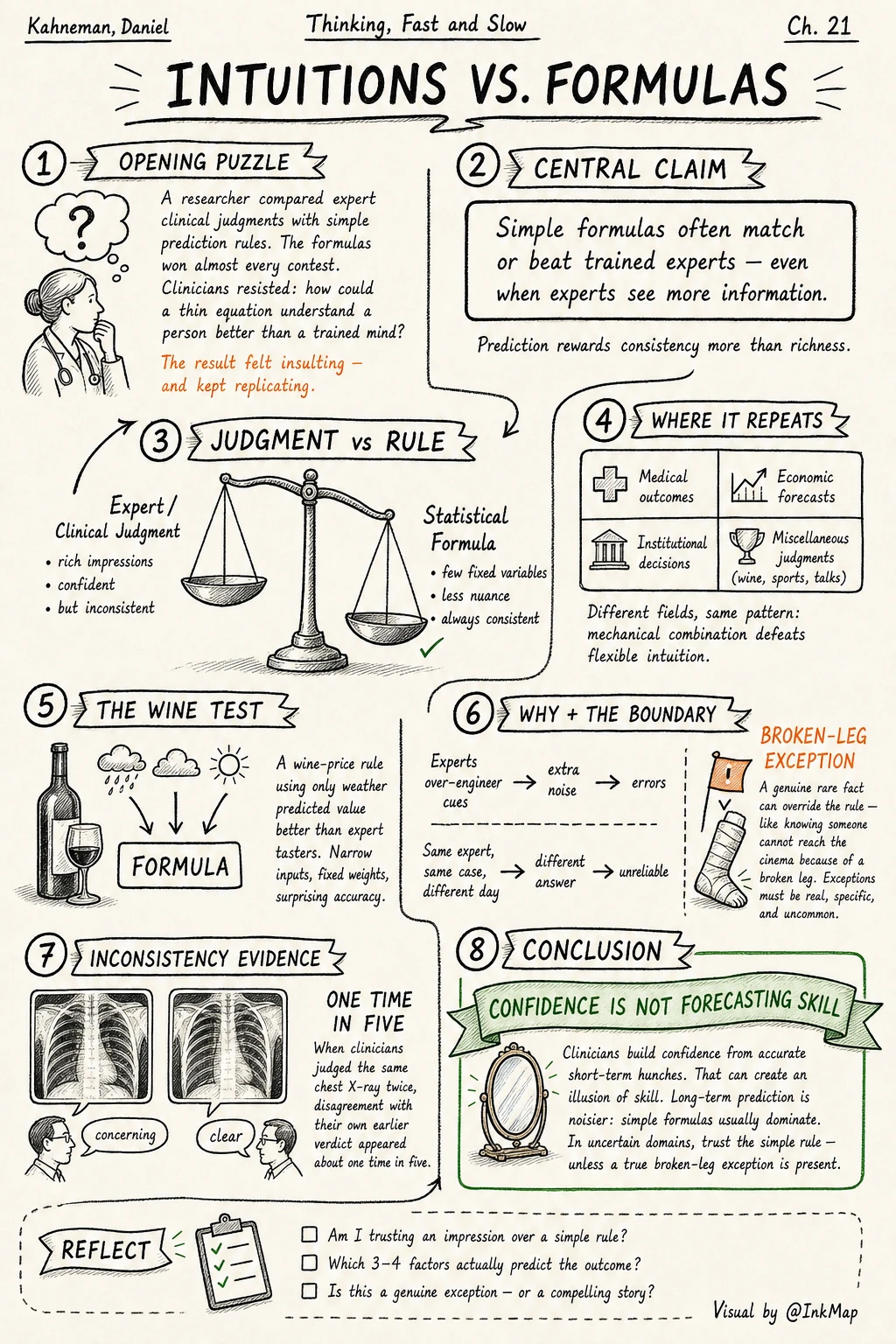
If forced to choose between a senior interviewer’s subjective rating and a simple formula, most people pick the interviewer. Meehl’s research turns that choice into a trap: in low-validity environments, formulas almost never lose to experts, and experts often lose to themselves.
The problem isn’t that experts lack intelligence. It’s that they try to prove judgment by adding more complex cues. Every extra variable raises confidence while lowering accuracy. More subtly, the same person can reach different conclusions from identical information on different days. Formulas have no mood and don’t change weights after a bad night’s sleep.
Ashenfelter’s wine pricing formula uses three variables; the Apgar score uses five signs. They win through consistency, not cleverness. What experts really excel at is pattern recognition in immediate interaction—and they mistake that ability for reliability in long-term prediction.
 Open full image ↗
Draw It
In a continuous narrative, two questions blur together: why experts lose, and why formulas win. The first points to flaws in human judgment; the second to a rule’s resistance to interference. Without separating the two lines, it’s easy to end up with the simplistic “people are worse than machines.”
Following the structure, the expert’s failure path becomes clear: chasing complexity lowers accuracy, and lack of consistency causes drift. The formula’s advantage mirrors both—simple weights avoid overfitting, fixed rules eliminate random fluctuation. This isn’t a comparison of two methods; it’s a contrast of two failure modes.
Rethink It
In promotion reviews, panelists face dozens of persuasive packets. Relying entirely on live discussion and subjective impression means the same candidate can get completely different results in different panels.
A more reliable approach is to first break hard indicators into a few fixed dimensions, score them with uniform weights, then allow small adjustments only for borderline cases. It sounds formulaic, and it does sacrifice some “comprehensiveness,” but it buys cross-panel consistency and explainability.
Take It With You
In domains where outcomes are hard to predict, giving up some flexibility in human judgment is the price of better overall accuracy.