CHAPTER 15
Linda: Less Is More
Read It
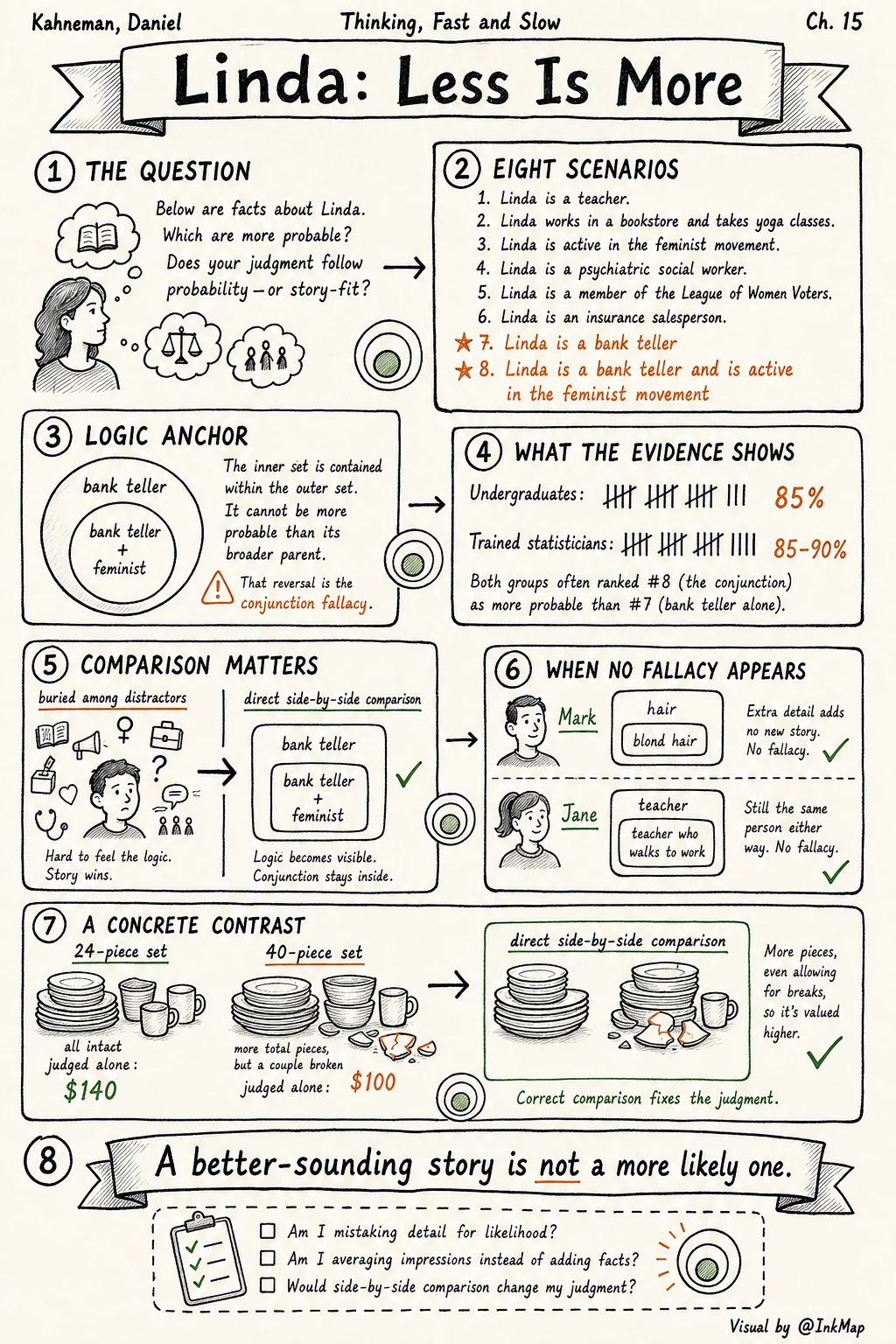
The Linda problem isn't really about people failing probability. It's about why a more specific description feels more likely. Kahneman's answer points to how intuition works: we judge likelihood by representativeness and narrative coherence, not by logical set relations. "Bank teller and feminist" fits Linda's profile better than "bank teller," so it gets rated as more probable, even though it's logically a subset. The stubbornness of this error is striking—even doctoral students in probability make it, which means it's not a knowledge gap but System 1's default mode. Presentation matters: when people are forced to compare the two options directly and deliberately, some avoid the fallacy; when they judge each in isolation, errors spike. Detail only triggers the error when it adds plausibility—"feminist" activates a stereotype and a story, while "blonde" does nothing.
 Open full image ↗
Draw It
Two levels get conflated in prose: logical set inclusion and psychological representativeness. One is mathematical structure, the other an intuitive shortcut. Visualizing them separately shows how the "less is more" paradox arises: a subset is judged more probable than its superset not because people miscalculate but because they aren't calculating probability at all—they're calculating similarity. This structure explains why training can't eliminate the bias: training changes System 2, but System 1 keeps answering with representativeness in the background.
Rethink It
In product requirement reviews, a feature described with rich scenarios feels more likely to succeed, even when data shows a broader version has higher usage. In technical design, a detailed, story-complete proposal can obscure that it's a subset of a simpler solution, inflating its perceived success probability. The countermeasure isn't to ban detail but to separate "does this resemble success?" from "is this actually more probable?"
Take It With You
The conjunction fallacy's root isn't stupidity; it's System 1 substituting coherence for logic. The only defense is to force System 2 into action at critical moments, reframing the question in terms of set relations rather than narrative fit.