CHAPTER 16
Causes Trump Statistics
Read It
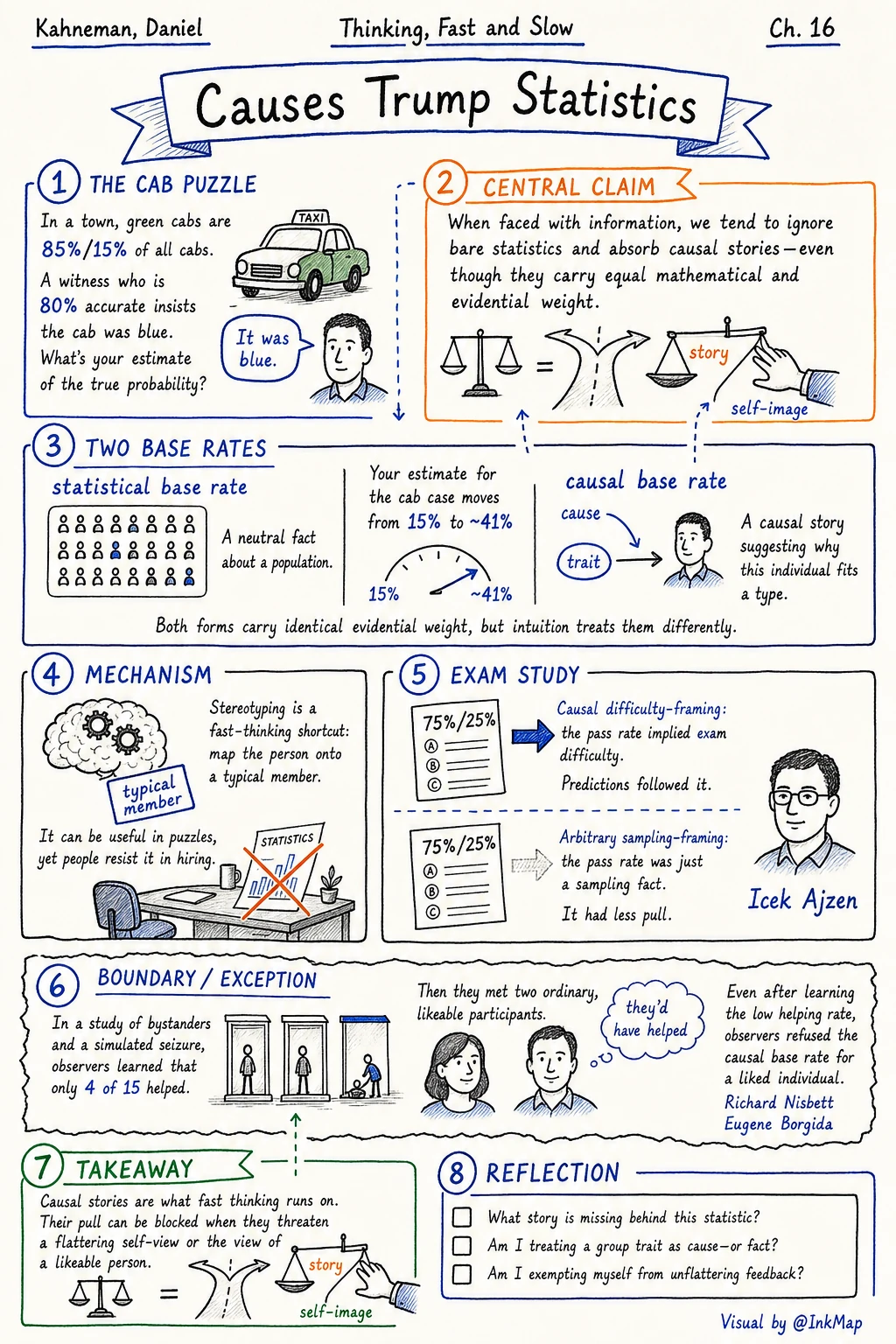
The cab problem shows that the same base rate changes its impact depending on how it's framed. "85% of cabs in the city are green" gets ignored; "the witness saw a green cab, and green cabs have an 85% accident rate" gets absorbed. The difference isn't the number but whether it can be embedded in a causal story about why this particular cab is more likely to be green. Kahneman distinguishes statistical base rates—abstract, about category frequencies, unable to explain a single case—from causal base rates, which describe mechanisms and can join other evidence in reasoning about individuals. The mind runs on causal narratives, so causal base rates get used and statistical ones get shelved. Stereotyping is psychologically neutral in this sense: it's just using category norms to understand individuals. But in social contexts, we need moral reasons to constrain it, even at some cost to accuracy.
 Open full image ↗
Draw It
In continuous prose, the two kinds of base rates blur together. They're mathematically equivalent but psychologically opposite. Mapping them shows how causal base rates enter individual reasoning through mechanism explanations, while statistical base rates lack that pathway and get set aside. This contrast explains why simply teaching statistical conclusions rarely changes people's expectations: abstract numbers have no causal grip, so they can't displace intuitive, individualized judgments.
Rethink It
In architecture reviews, an engineer says, "This module's failure rate is 0.1%," and nobody reacts. Then they say, "The last outage was caused by connection pool exhaustion, and this module has the same pool configuration," and everyone pays attention. The first is a statistical base rate; the second is causal. To make data matter, translate it into mechanism, not just numbers.
Take It With You
For individual judgments, prefer causal base rates. For group decisions or policy, keep statistical base rates on the table and use moral constraints to limit stereotyping. The choice isn't between accuracy and fairness but about which tool fits which context.