CHAPTER 14
Tom W's Specialty
Read It
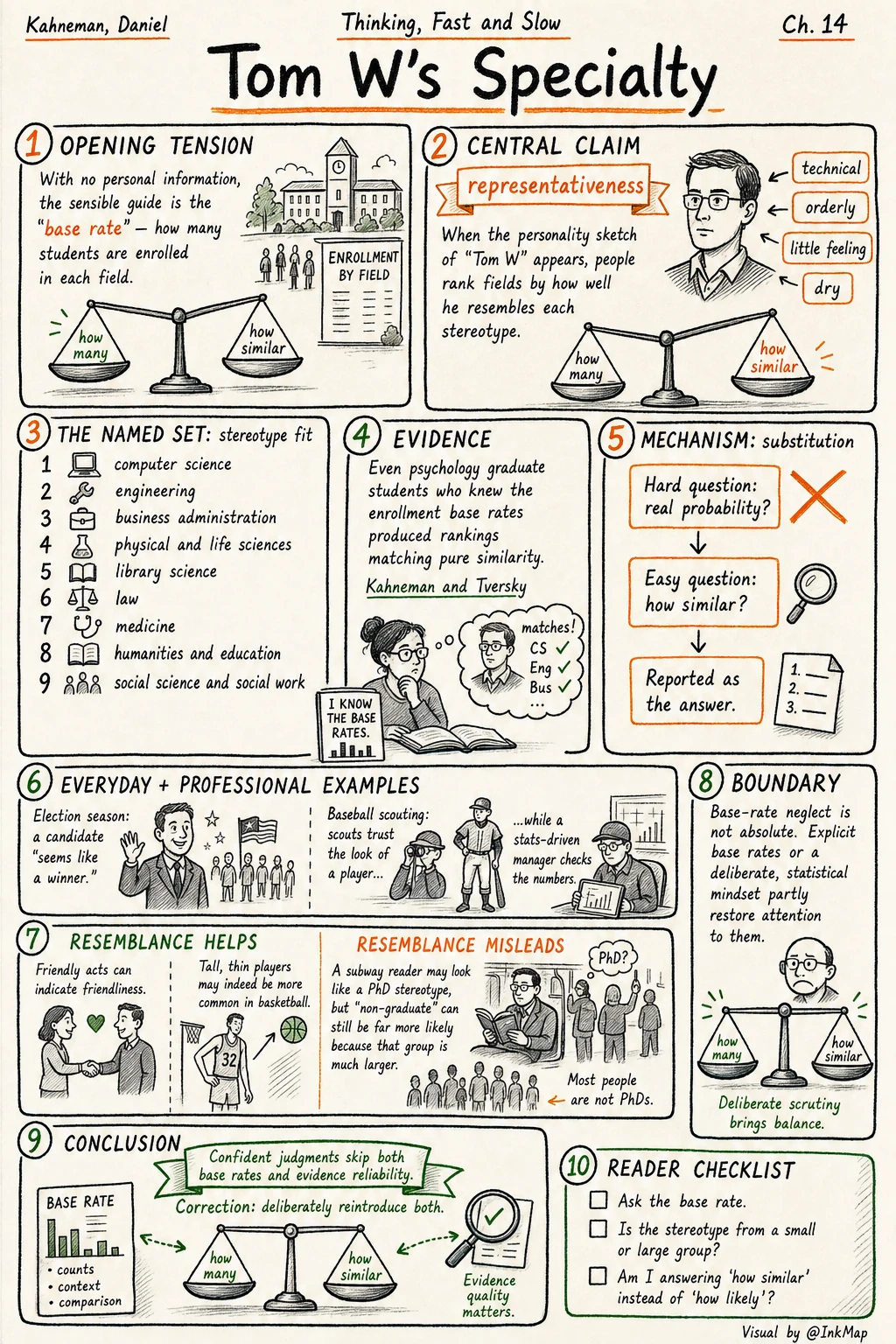
The Tom W. experiment is unsettling not because people ignore base rates, but because statistically trained people abandon probability rules the moment they meet a specific person. The more the description resembles a computer science student, the more certain people become that Tom studies computer science, even when that field is a tiny fraction of the student body. The issue isn't that they can't calculate; it's that System 1 delivers a coherent, vivid impression, and System 2 doesn't bother to check. Base rates aren't forgotten—they're replaced. With no personal information, people use them correctly. Introduce a description that fits a category, and similarity takes over. The error shrinks when people are prompted to think like statisticians or when they feel cognitive strain, which means System 2 can correct the mistake if it's engaged.
 Open full image ↗
Draw It
Two questions get compressed into one: "How similar is Tom to this type?" and "How probable is it that Tom is this type?" Similarity and probability are different, but intuition treats them as identical. Mapping the relationships shows the hierarchy: base rates are background, personal description is the trigger, similarity is the substitute path, and the final judgment is a tug-of-war between System 1 and System 2. This structure explains why statistical training doesn't automatically prevent the error—training changes System 2's capability but not System 1's default response.
Rethink It
In hiring interviews, a candidate tells a compelling debugging story, and the interviewer thinks, "This person is a great engineer," ignoring that few candidates in the pool actually have that skill. Or a mediocre resume gets a boost because the conversation flows well. The problem isn't unprofessionalism; it's that a specific story outweighs an abstract proportion. Structured behavioral interviews and scoring rubrics exist precisely to counter this substitution.
Take It With You
Similarity judgment isn't useless—it's a fast heuristic when information is scarce. But its boundary is narrow: it's only reliable when the individual case is genuinely correlated with category membership. When the case merely "looks like" the category and the base rate comes from solid data, ignoring the base rate is a systematic error.