CHAPTER 13
Availability, Emotion, and Risk
Read It
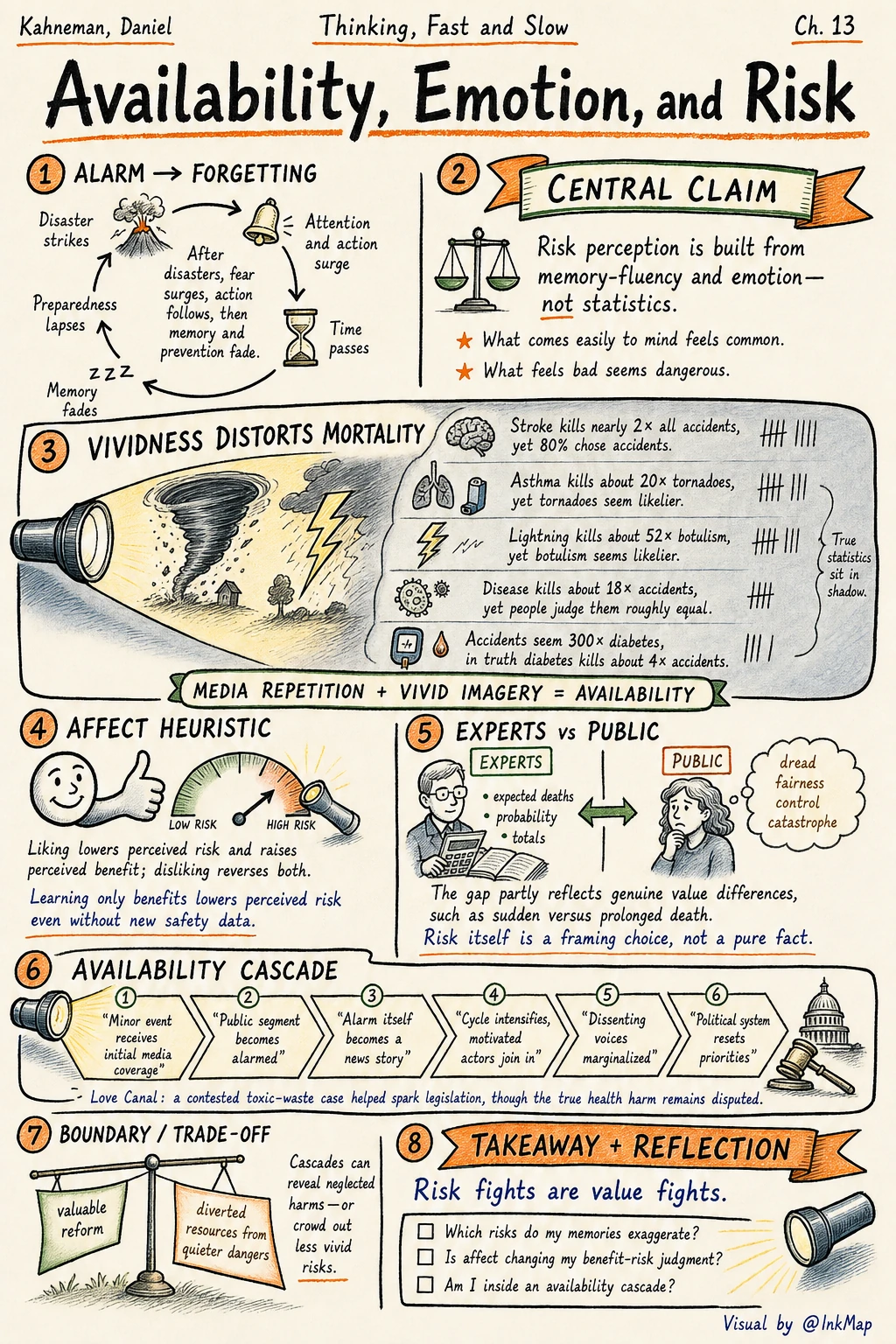
Risk perception has a dangerous property: once it forms, it manufactures its own evidence. After a plane crash, security tightens, media replays the footage, people cancel flights. These responses look like reactions to risk, but they also make the risk more memorable. The next time we evaluate flying, we don't consult accident rates; we consult how easily those images and emotions come to mind. A statistically tiny event gets amplified through emotion, coverage, and public response into a threat demanding immediate action. Emotion is the engine. How we feel about something becomes our judgment of its risk: liked technologies seem nearly harmless, disliked ones seem all downside. Media isn't neutral—it selects for the rare, the vivid, the emotionally charged—and so our mental frequency rankings drift further from reality.
 Open full image ↗
Draw It
Prose tends to collapse three distinct layers: objective frequency, memory availability, and emotional intensity. They influence each other but operate differently. Frequency is a property of the world; availability is the width of a cognitive channel; emotion is an amplifier. Separating them shows that media coverage isn't a single link but acts on both availability and emotion, then feeds back through public attention, creating a self-reinforcing loop. That loop explains why vigilance cycles: disaster memories fade, availability drops, alertness relaxes, until the next disaster reactivates the whole system.
Rethink It
Engineering teams show the same pattern. The most recent production incident makes everyone hypersensitive to similar problems, even when monitoring data says it's a rare event. In design reviews, a vivid failure scenario beats a page of statistics, not because anyone is unprofessional but because the brain defaults to availability for risk. Mature teams deliberately bring in base rates and long-term data, separating "what just happened" from "what is actually likely."
Take It With You
Risk assessment is never purely objective. It always involves value choices: who gets to define what counts as a risk, and which risks deserve priority. Public and expert disagreements often aren't about who is more rational but about what each side is weighing.