CHAPTER 12
The Science of Availability
Read It
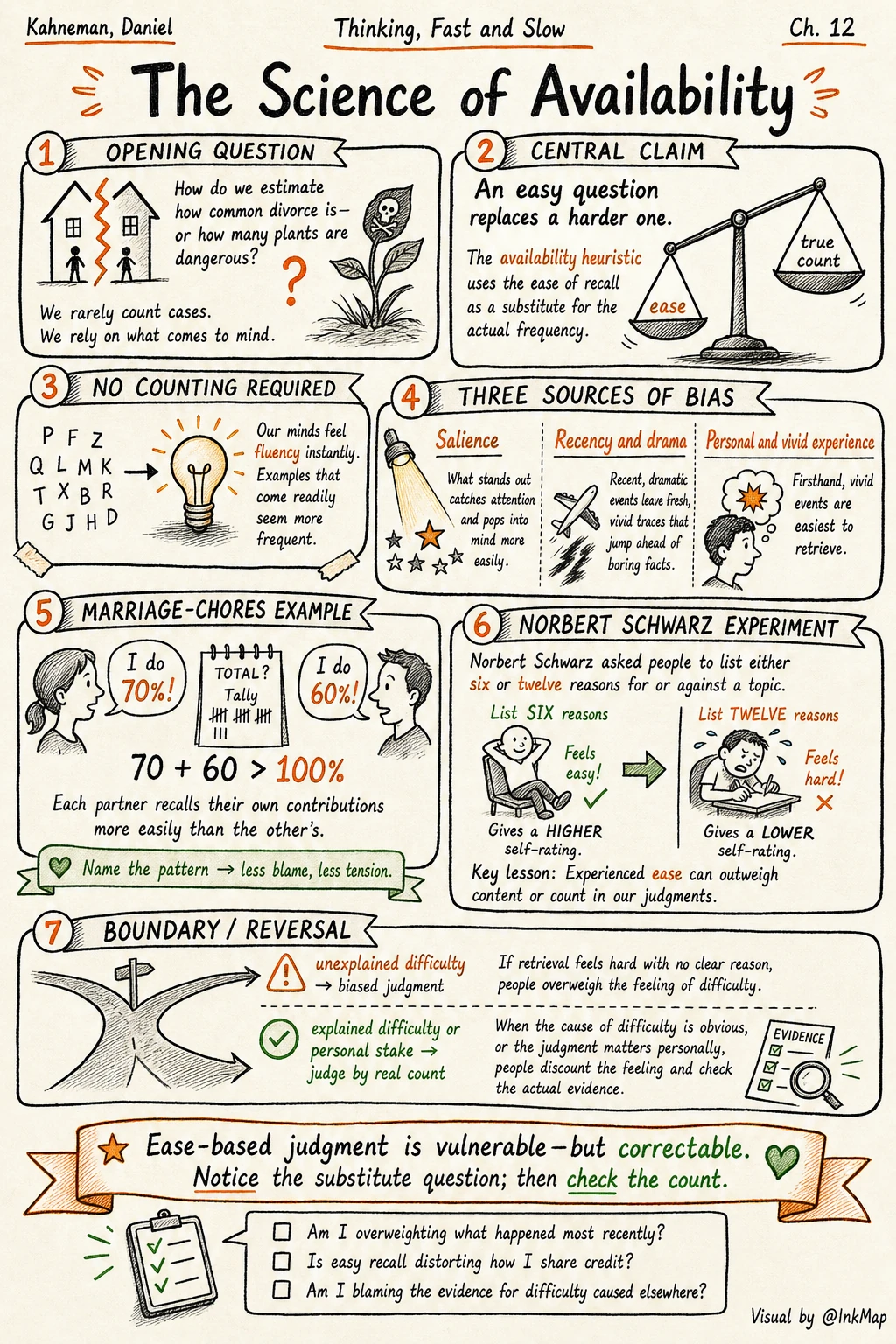
Judging how common something is feels like a simple act of remembering, but it hides a trade-off. You can either count actual instances—slow, effortful, and often impossible—or you can feel how easily examples come to mind. Most of the time we choose the feeling, because it arrives instantly and feels trustworthy. The problem is that retrieval ease is shaped by salience, recency, and vividness, not by true frequency. A plane crash looms larger than a car crash because it is dramatic and recent, not because it is more likely. The same mechanism distorts how much credit we claim in relationships and teams: our own contributions are always more vivid to us, so the sum of perceived effort exceeds 100%.
 Open full image ↗
Draw It
The chapter's core insight is the difference between retrieval fluency and retrieval count. Schwarz's experiment makes this vivid: people asked to list twelve examples of assertiveness felt less assertive than those asked for six, because the struggle of generating many examples outweighed the number they actually produced. In prose, fluency and count blur together. Mapping them as separate axes shows how the same judgment can be driven by completely different variables, and why the bias is so hard to notice from the inside.
Rethink It
In incident reviews, the most recent major outage dominates the conversation because it is easiest to recall. Teams pour resources into preventing that exact failure mode while ignoring statistically more frequent but less dramatic problems. The fix is to separate two questions: "What happened recently?" and "What happens most often over the long run?" Only the second question should drive resource allocation, but the first one usually does.
Take It With You
When "feels common" and "is common" conflict, distrust the feeling. Retrieval ease tells you about your memory, not about the world. The bias is unusually correctable—when people have an alternate explanation for why recall felt hard, or when they care deeply about accuracy, the effect shrinks. That means the error is not a fixed flaw but an inference we can learn to override.