CHAPTER 17
How an Accountability Partner Can Change Everything
Read It
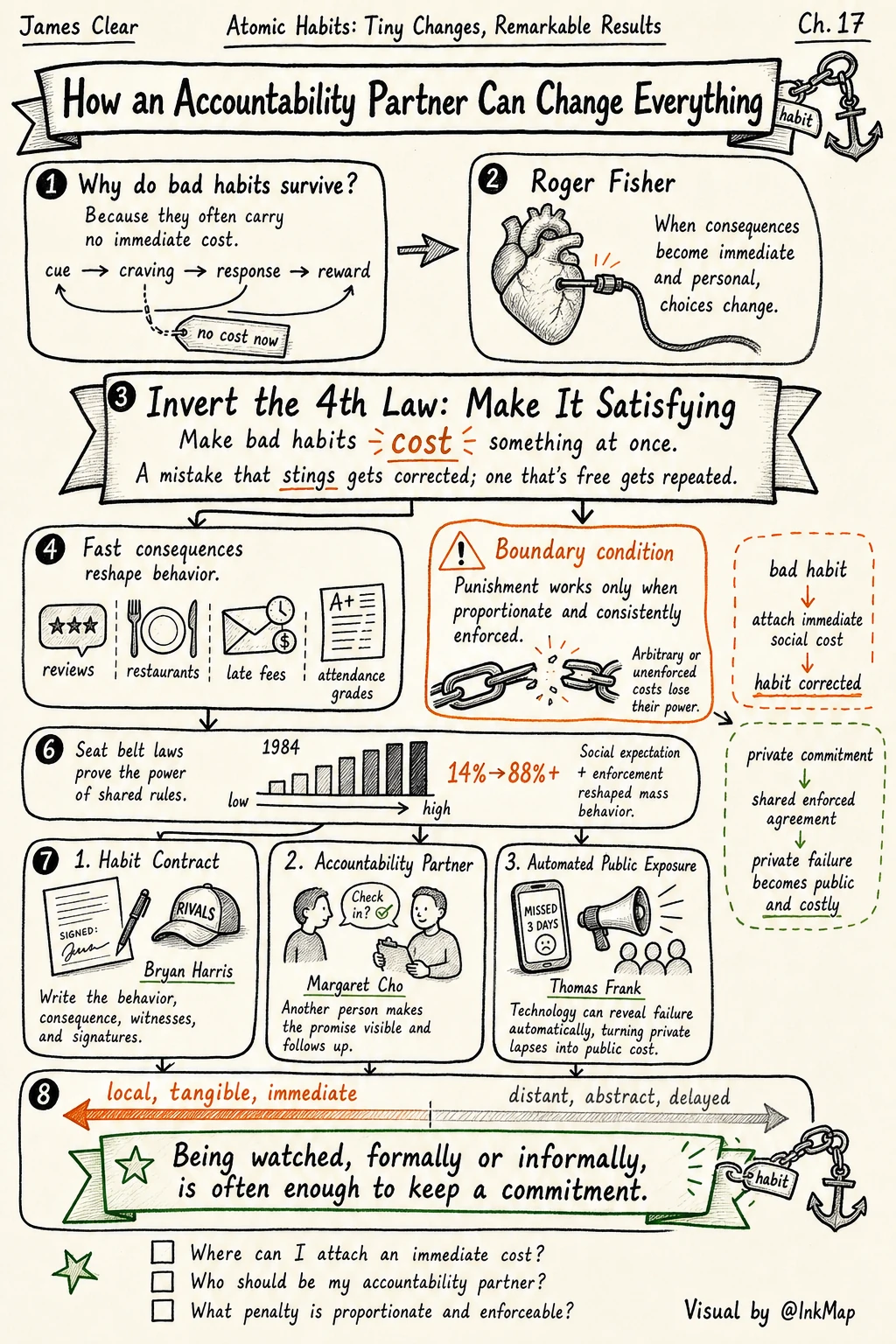
The fourth law says make it satisfying, but the same lever works in reverse. Make a bad habit immediately costly, and it stops feeling worth it. What surprises me is how little actual punishment is required. Most of the time, the cost is just being seen. A habit contract with a named penalty and a witness works because it converts a private lapse into a public one, and we care more about looking unreliable in front of someone else than we do about a distant consequence we can rationalize away.
 Open full image ↗
Draw It
The chapter’s logic is a chain, not a list. Immediate consequences beat delayed ones. Social exposure makes consequences immediate. Therefore accountability partners work. But the chain only holds if the penalty is proportionate and actually enforced. I wanted the diagram to show that enforcement is the load-bearing wall. Without it, the contract is just a piece of paper. With it, the mere possibility of being observed is enough to change behavior. That’s why the visual separates the mechanism from its conditions.
Rethink It
This shows up in code reviews, public roadmaps, and any commitment made in front of a team. The moment someone else can see whether you followed through, the cost of slacking rises. But the boundary matters too. If the penalty is trivial or the observer never checks, the effect evaporates. And if the habit is genuinely private—something you’re doing for yourself, not for others—social accountability can feel like surveillance and breed resentment. It’s a tool for commitments that benefit from external pressure, not a universal fix.
Take It With You
We already use other people’s judgment to keep ourselves honest. The chapter just makes that instinct explicit and gives it a structure. The trick is choosing witnesses who will actually hold the line.