CHAPTER 18
The Truth About Talent (When Genes Matter and When They Don't)
Read It
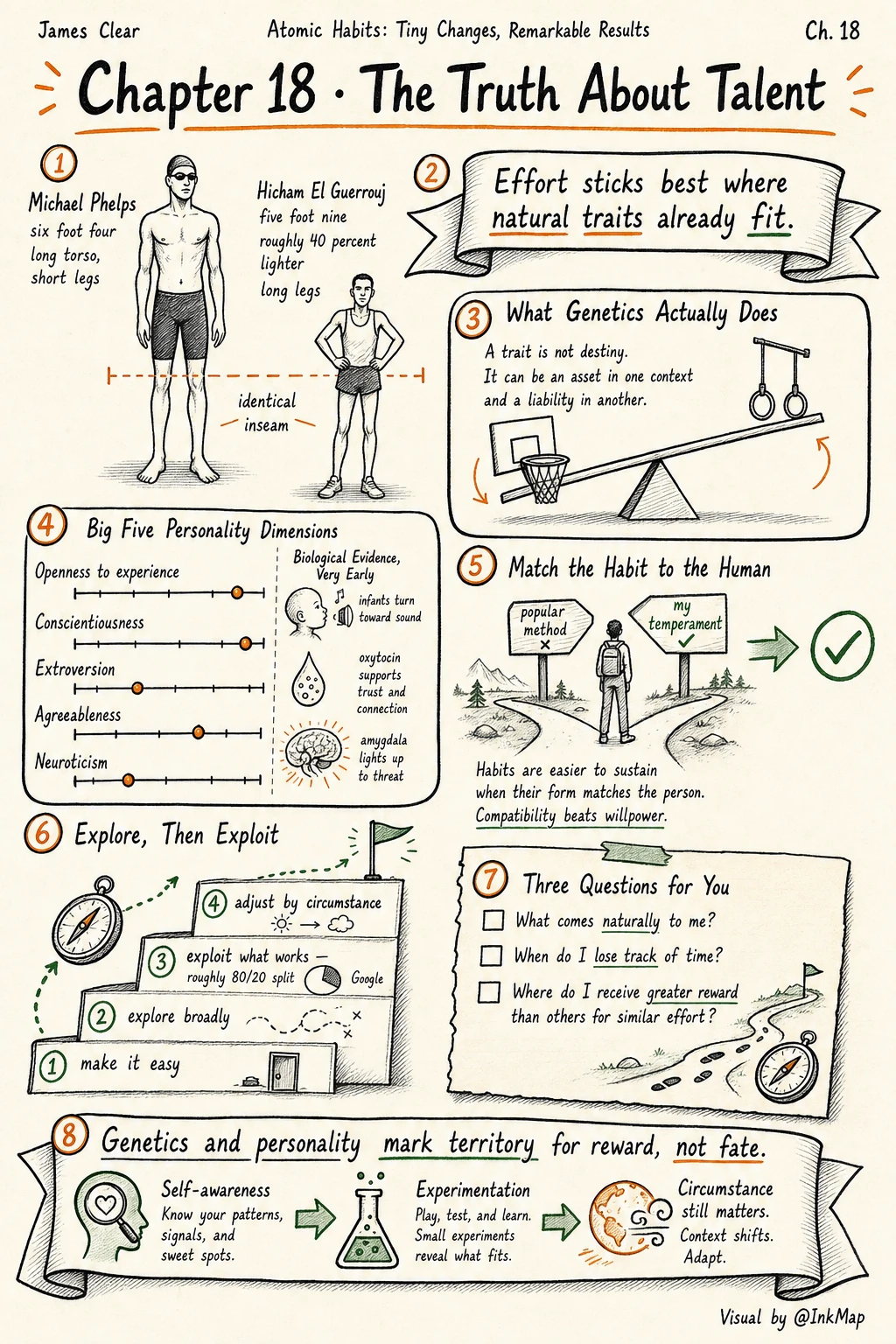
The real question isn’t “Am I talented enough?” It’s “Where does my particular wiring make effort feel less like fighting?” The same trait that makes someone a great endurance athlete can make them a terrible sprinter. The same restlessness that wrecks a meditation habit can fuel a career in crisis response. Genes don’t hand out verdicts; they hand out starting conditions. What matters is whether you find the environment where those conditions compound instead of collide.
 Open full image ↗
Draw It
The chapter could easily read as a personality test with extra steps. I wanted to avoid that. The diagram treats traits, domain demands, practice returns, and opportunities as a matching system, not a fixed identity. The key visual move is separating exploration from exploitation. Most of your time goes to deepening an advantage you’ve already found, but a slice stays open for sampling new domains. That ratio is the difference between a career and a cage.
Rethink It
Copying someone else’s morning routine or study method usually fails because it ignores your own energy curve and cognitive style. The more useful questions are quieter: What puts me into flow without effort? Which skills improve faster for me than for others? What do people keep asking me to help with? None of those answers are a final label. They’re just the next clue for where to point your effort.
Take It With You
Effort determines how far you can go. Fit determines whether the same effort keeps paying off. You need both, but most advice only talks about the first.